Blooming tea: what it is made of, how to brew it in a glass teapot and how to give it as a gift
What blooming tea balls are made of and which flowers they contain, how to brew them step by step and how many times to re-steep, how to store them and what to look for in a gift set with a teapot.
Contents
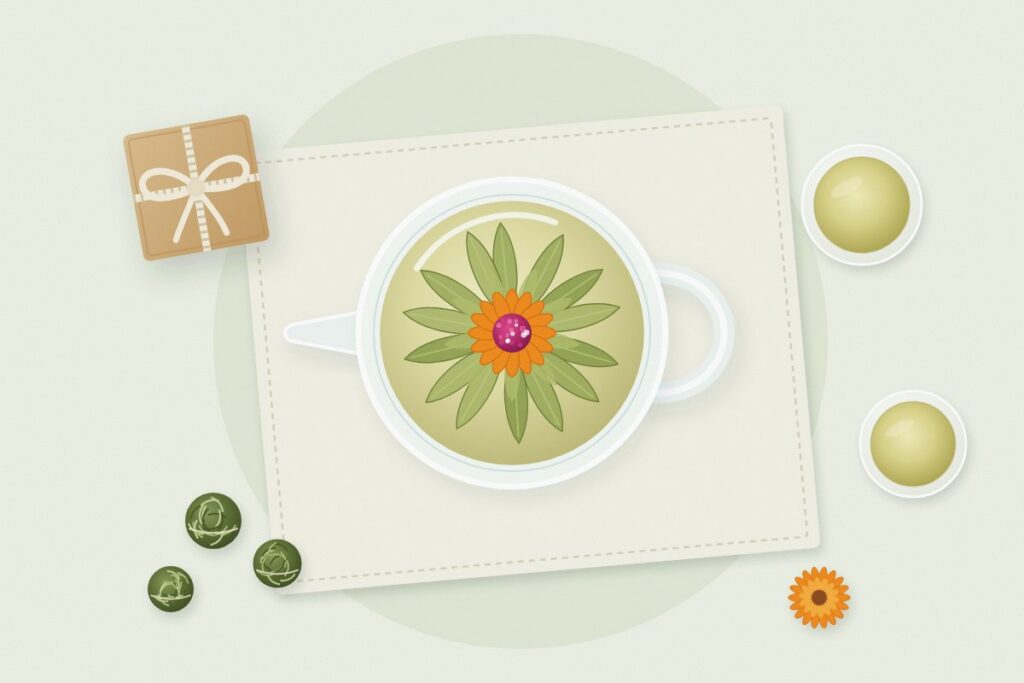
Blooming tea, also called flowering tea, is a hand-tied ball of dried tea leaves, most often green or white tea, that hides one or more dried flowers. In a glass teapot of hot water, it slowly unfurls over 3–5 minutes and the flower appears. The flavor of the infusion comes mainly from the tea, while the flowers add color and aroma. You can steep one ball two or three more times.
Because of the way they look, blooming teas are often given as gifts, especially before Christmas. Below you will find what they are made of, how to make them step by step, how to store them and what to look for in a gift set. You will find other types in our Types of tea category.
What blooming tea is made of
The base is leaves of the tea plant (Camellia sinensis), most often green or white tea. Their long, flexible leaves can be tied without breaking. Oolong is used less often, and black tea only rarely.
The leaves are tied with thread around the flowers into a ball, a rosette or another shape and then dried. A single piece takes dozens of leaves. Some balls have no flower inside and simply unfurl into the shape of a flower in water. In China, tea like this is called gongyi cha, for example, meaning “artistically crafted tea.”
Which flowers are used in blooming tea
- jasmine (Jasminum sambac) – small, fragrant white flowers,
- globe amaranth (Gomphrena globosa) – round flowers, most often purple or pink,
- calendula (Calendula officinalis) – orange or yellow flower heads,
- lily, for example Lilium longiflorum,
- chrysanthemum, hibiscus and osmanthus (Osmanthus fragrans),
- and, in the ingredients of some products, carnation (Dianthus caryophyllus) or rose.
Watch the names in ingredient lists: “marigold” can mean either calendula or Tagetes, and carnation is a flower, not the spice clove. Some blooming teas also contain flavorings, which must be stated in the list of ingredients.
Where blooming tea comes from
Blooming tea comes from China, and most of it is still tied by hand there. Sellers mostly give Yunnan, Fujian and Anhui provinces as the place where it is made.
According to the sources available, blooming tea in its present form appeared in China in the 1980s and spread to the West at the start of the 21st century. For example, according to the Chinese news agency China News Service, “green peony” (lü mudan), a green tea that unfurls into the shape of a flower in water, was already being made in Anhui province in the 1980s. Each piece takes about 80 leaves. Because the handwork was so demanding, it later disappeared from the market, and in 2022 local producers returned to it.
You will also often read about ancient origins, such as teas tied for an emperor a thousand years ago, or see a specific inventor and year named. These stories come mainly from sellers, and we have not confirmed them in any independent source. So take them as legend.
How to make blooming tea
We did not find any expert brewing instructions that did not come from sellers. The steps below are based on sellers’ instructions, which differ in the details. If the packaging gives a different temperature or time, follow it.
- Warm the vessel. Rinse a glass teapot or a tall glass with a capacity of 0.3–1 liter with hot water and pour the water out.
- Put in one ball. Two balls in a smaller vessel do not have enough room and may not unfurl completely.
- Pour water at about 80 °C (176 °F) over it. Let the water stand for a moment after it boils, or use a kettle with a temperature setting. Pour slowly until the water is 8–10 cm above the ball.
- Wait 3–5 minutes until the flower has fully opened. Tightly tied balls can take as long as 10 minutes.
- Pour the tea into cups. If you will not drink it right away, take the ball out with a spoon, otherwise the infusion will turn bitter.
Blooming tea in a glass teapot or a glass: at a glance
| What | What sellers recommend |
|---|---|
| Vessel | glass teapot or tall glass, 0.3–1 liter, most often about 0.5 liter |
| Number of balls | 1 per vessel |
| Water temperature | about 80 °C (176 °F); instructions range from 70 °C (158 °F) to boiling water |
| First steeping | 3–5 minutes, some balls up to 10 minutes |
| Further infusions | 2–3 more, each a little longer |
With boiling water, an infusion made from green tea easily turns bitter, so a lower temperature is the safer choice. A glass teapot is not essential, but in a porcelain or ceramic mug the flower gets lost. Heat-resistant glass, such as borosilicate glass, works well.
How many times can you steep blooming tea
Sellers say you can pour water over the unfurled ball two or three more times. Let each further infusion steep a little longer; the flavor and aroma will gradually get weaker. Do not leave the ball sitting in water between infusions, so that the tea does not turn bitter.
If you want to continue later, pour out the water and put the ball in a closed container in the refrigerator. One seller says it will keep this way for no more than 48 hours. After the last infusion, you can leave the flower in a glass of cold water for a while as a decoration.
Does blooming tea have caffeine?
Yes, if it contains tea leaves, which is true of most blooming teas. Every true tea from the tea plant contains caffeine, including green and white tea. How much ends up in your cup depends on the size of the ball, the amount of water and the steeping time. We did not find an exact figure for blooming tea; you will find approximate values for a cup of green and white tea in our caffeine in tea table.
If you are looking for caffeine-free blooming tea, the ingredients must not include green, white or any other tea from the tea plant, only flowers or herbs.
How to choose blooming tea
- Ingredients: check what tea the ball is made of, which flowers it contains and whether flavorings have been added. Under EU regulation, the list of ingredients and the best-before date must be on the packaging of every packaged tea.
- Whole balls: they should be firm, unbroken and free of leaf dust.
- Packaging: individually wrapped balls keep their aroma longer than balls stored loose in a box.
- Promises on the packaging: choose blooming tea for its look and flavor. In the EU, a food must not claim to prevent or cure diseases.
How to store blooming tea
Store blooming tea like any other loose leaf tea: in an opaque, tightly closed canister in a dry, dark place, away from the kettle, the stove and spices. If the balls are individually wrapped, open them only just before brewing. Dry balls do not belong in the refrigerator, as moisture and odors are more likely to harm them.
Green and white teas taste best fresh, so use up an opened package within a few months and follow the best-before date. Do not leave the balls on display for long in a clear jar on a shelf or a windowsill, because light takes away both their color and their aroma. Read more in How to store loose leaf tea.
Blooming tea as a gift: gift packs and sets with a teapot
Blooming teas are often sold in gift packs. These usually contain several balls, typically 4 to 12, in a box or a canister, and sometimes also a glass teapot or a glass. A set with a teapot is practical, because the blooming can be watched right after unwrapping, with no need to look for a suitable vessel.
When choosing a set, look at:
- The teapot: heat-resistant glass, a capacity of about 0.5–1 liter and a lid. Blooming tea does not need an infuser, but one is handy if the teapot will also be used for loose leaf tea.
- Ingredients and caffeine: if the gift is for someone who avoids caffeine, choose balls without tea leaves.
- Instructions: if the packaging has no instructions in the recipient’s language, add a card with the water temperature, the steeping time and the number of infusions.
- Balls on their own: add at least a tall glass, because in a mug the flower gets lost.
You will find more ideas on how to wrap tea and what to give with it in Tea as a gift.
What to watch out for
- Caffeine: the European Food Safety Authority (EFSA) recommends that pregnant and breastfeeding women have no more than 200 mg of caffeine a day from all sources. For children, keep in mind that blooming tea made with tea leaves contains caffeine.
- Allergies: the balls contain various flowers. If you are allergic to a particular plant, always read the ingredients.
Important: if you are not sure whether caffeine is right for you, for example during pregnancy, while breastfeeding or when taking medication, talk to your doctor or pharmacist.
Sources
- Wikipedia: Flowering tea, as of November 25, 2026.
- China News Service: report on the revival of “green peony” tea (Huangshan lü mudan) production in Anhui province, May 14, 2022.
- Brewing instructions and ingredients of blooming teas from five tea sellers in the USA, the Czech Republic and Slovakia (water temperature, steeping time, number of infusions, storage), November 2026.
- Regulation (EU) No 1169/2011 on the provision of food information to consumers, Articles 7 and 9.
- European Food Safety Authority (EFSA): Scientific Opinion on the safety of caffeine, 2015.
We wrote this article on November 25, 2026. It is for general information only. For details, see our Disclaimer.