Kombucha: what it is, what it tastes like and what studies say about its benefits and side effects
What kombucha and SCOBY are, what it tastes like, how much alcohol and sugar it has, what human studies found, who should avoid it and what to watch out for when brewing and storing it.
Contents
- What is kombucha
- What kombucha tastes like
- Which tea kombucha is made from
- How kombucha is made
- How much alcohol is in kombucha
- How much sugar is in kombucha
- Kombucha benefits: what human studies show
- Kombucha side effects
- Who should avoid kombucha
- How much kombucha a day
- Safety when brewing kombucha at home
- How to keep store-bought kombucha
- Sources
Kombucha is fermented sweetened tea. A culture of bacteria and yeasts called SCOBY is added to cooled tea with sugar, and over 7–10 days it turns part of the sugar into acids, carbon dioxide and a little alcohol. The result is a tart, lightly fizzy drink. Human studies have not confirmed the miraculous effects attributed to kombucha, and some people should not drink it.
You will find other tea drinks in our Types of tea category.
Important: kombucha contains alcohol, and homemade or unpasteurized store-bought kombucha also contains live microorganisms. It is not recommended during pregnancy and breastfeeding, for children or for people with weakened immunity. If you have a chronic condition or take medication, talk to your doctor or pharmacist first. Read more in Who should avoid kombucha.
What is kombucha
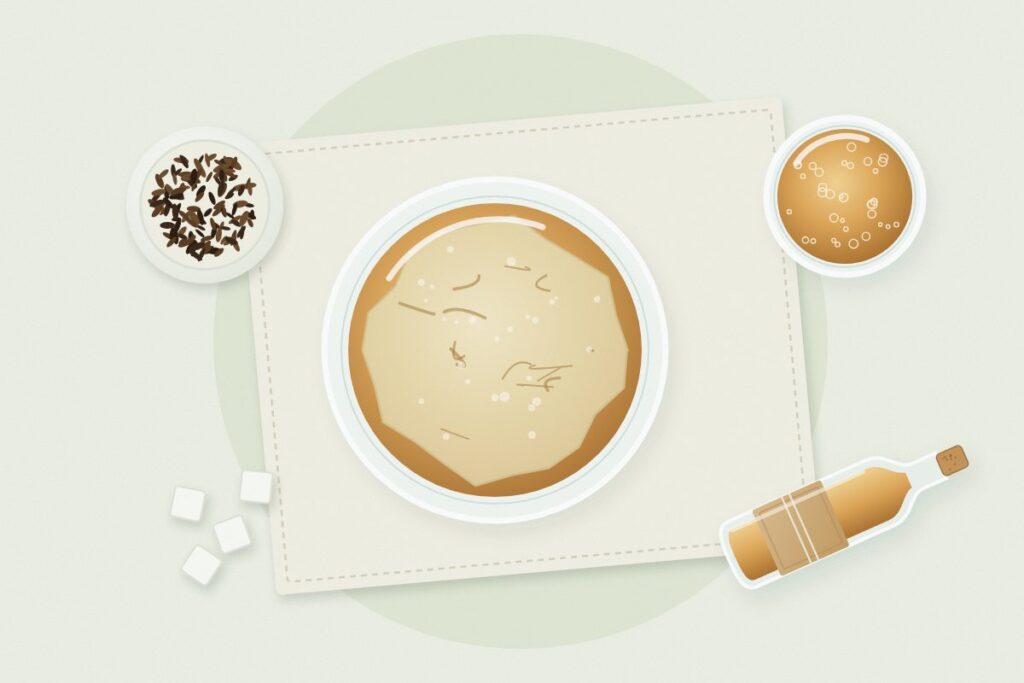
SCOBY is short for symbiotic culture of bacteria and yeast. It forms a flat, rubbery disc on the surface, popularly called the kombucha mushroom or tea mushroom. It is not a mushroom, though, but a layer of cellulose produced by the bacteria.
An analysis of 103 cultures from kombucha brewers showed that they are dominated by acetic acid bacteria of the genus Komagataeibacter, which form the disc, and yeasts of the genus Brettanomyces.
The claim that kombucha has been drunk in China for more than 2,000 years is a story with no evidence behind it. Scientific reviews give its likely origin as Manchuria.
What kombucha tastes like
Kombucha tastes tart and slightly sweet at the same time, with a mild vinegary note and a gentle fizz. Its sourness comes mainly from acetic, gluconic and lactic acid. The longer it ferments, the more sour and the less sweet it gets.
Which tea kombucha is made from
Most often from black or green tea and white sugar, which makes up 5–10% of the infusion, or 50–100 g per liter. Tested recipes from American universities call only for black or green tea, which can also be decaffeinated.
Kombucha made from tea also contains caffeine, and the amount varies from product to product. Read more in What determines the caffeine content of tea.
How kombucha is made
The principle is simple:
- Brew tea, dissolve the sugar in it and let it cool.
- Add the SCOBY and some finished kombucha from a previous batch, which acidifies the infusion right away.
- Cover the container with a tightly woven cloth and let the kombucha ferment at room temperature, usually for 7–10 days.
- Pour the finished drink into bottles, where it finishes fermenting and becomes fizzy at room temperature in 1–3 days. Then it goes in the fridge.
The yeasts break down the sugar and turn part of it into alcohol and carbon dioxide. Acetic acid bacteria make acids from the alcohol and sugars, so the pH drops from about 5 to 4.2 or lower.
How much alcohol is in kombucha
Alcohol forms during fermentation. The amount varies from batch to batch, and in unpasteurized kombucha it can keep rising even in a sealed bottle:
| Where it was measured | Result |
|---|---|
| Homemade kombucha, Iowa (CDC, 1995) | 0.7–1.3% |
| 132 store-bought kombuchas, Australia (2017–2018) | 35% below 0.5%, 42% from 0.5 to 1.15%, 23% above 1.15% |
| 32 fermented drinks including kombucha, Ireland (2021) | 4 had 1.5–3.9% alcohol not stated on the label |
In the EU, Regulation (EU) No 1169/2011 requires the alcohol content to be stated on the label only for drinks with more than 1.2% alcohol by volume. Laws in many countries also set a limit above which a drink counts as alcoholic and may not be sold to minors. In Slovakia, for example, it is more than 0.75% alcohol, and such drinks may not be sold or served to anyone under 18.
How much sugar is in kombucha
How much sugar is left after fermentation depends on how long the kombucha ferments and whether it is sweetened or flavored with juice afterward. The German consumer advice center Verbraucherzentrale reports an average of about 5 g of sugar per 100 ml in store-bought kombucha, but products vary widely. You will find the exact figure on the label in the line “of which sugars”. With homemade kombucha, you have no way of knowing it.
Kombucha benefits: what human studies show
Kombucha is promoted as a drink for detox, immunity, digestion or blood sugar. These claims are based mainly on laboratory and animal experiments, and there are few human studies:
- A 2019 review (Kapp and Sumner) went through 310 publications and found a single human study.
- A 2025 review (Fraiz et al.) found eight clinical studies lasting from 10 days to 10 weeks. Five looked at blood sugar levels with mixed results, and two recorded fewer problems with constipation.
- A 2024 study of 24 healthy adults, some of whom drank kombucha for four weeks, found no significant changes in blood or inflammatory markers. The composition of gut bacteria changed only slightly.
Is kombucha a probiotic?
Unpasteurized kombucha contains live bacteria and yeasts, pasteurized kombucha does not. However, under the definition of the Food and Agriculture Organization of the United Nations (FAO) and the World Health Organization (WHO), probiotics are only live microorganisms that, in adequate amounts, have a proven health benefit. That has not been shown for kombucha. In the EU, the word “probiotic” on a food counts as a health claim, and it has not been approved. Kombucha has no approved claims about detox or immunity either. Think of it as a refreshing drink, not a medicine.
Kombucha side effects
Serious problems are rare and are known from individual case reports: allergic reactions, nausea and vomiting, jaundice and liver damage, muscle inflammation or severe acidosis (lactic acidosis). In 1995, two women in Iowa, USA, who had drunk homemade kombucha every day for two months fell ill with acidosis, and one of them died. A link to kombucha was neither confirmed nor ruled out. Most cases involved homemade kombucha, and contamination may also have been the cause.
Who should avoid kombucha
- During pregnancy and breastfeeding – because of the alcohol and because the drink may be unpasteurized. Read more in Tea during pregnancy and breastfeeding.
- Children – because of the alcohol. Read more in Tea for babies and children.
- People with weakened immunity – homemade kombucha in particular can be a source of infection for them.
- People with a serious or chronic illness – the risks are not known, so talk to your doctor.
- People who need to avoid alcohol – drivers, people with an addiction, or anyone taking medication that should not be combined with alcohol.
How much kombucha a day
There is no current official recommendation. In 1995, the US Centers for Disease Control and Prevention (CDC) stated that the amount people usually drank, about 120 ml (4 fl oz) a day, is probably not harmful to healthy people. For larger amounts and for people who are ill, the risks are not known.
Safety when brewing kombucha at home
- Cleanliness: wash your hands, and clean and sanitize the container and utensils before every batch. Cover the container with a tightly woven cloth held in place with a rubber band to keep insects out.
- Use a culture from a reliable source, with enough acidic liquid from the previous batch (pH 4.0 or lower).
- Acidity: within 7 days, the pH should drop to 4.2 or lower, and finished kombucha should have a pH of 2.5–4.2. Measure it with test strips or a pH meter, and if it does not drop, pour the batch out.
- Mold or a change in color or smell: throw away both the culture and the liquid, and sanitize the container.
- Store finished kombucha in the fridge, at 4 °C (40 °F) or below, to slow down fermentation.
Unsuitable containers: ceramics and lead
Kombucha is acidic and can leach lead from glazes. That is why the CDC recommends not brewing or storing it in ceramic containers or lead crystal. A 1998 case report from Australia described lead poisoning in a married couple who had drunk kombucha brewed in a pot with an unsuitable glaze every day for six months. For fermenting, glass is recommended, or alternatively food-grade plastic or stainless steel.
How to keep store-bought kombucha
- If the label says “keep refrigerated”, it is usually unpasteurized kombucha, which belongs in the fridge at home too.
- In warm conditions, unpasteurized kombucha keeps fermenting: alcohol and carbon dioxide build up and the flavor changes.
- Pasteurized kombucha has no live microorganisms and keeps longer. Once opened, store it as the label says.
Sources
- CDC – Unexplained Severe Illness Possibly Associated with Consumption of Kombucha Tea – Iowa, 1995. MMWR, 1995.
- Phan T. G. et al.: Lead poisoning from drinking Kombucha tea brewed in a ceramic pot. Medical Journal of Australia, 1998.
- Kapp J. M., Sumner W.: Kombucha: a systematic review of the empirical evidence of human health benefit. Annals of Epidemiology, 2019.
- Fraiz G. M. et al.: Benefits of Kombucha Consumption: A Systematic Review of Clinical Trials Focused on Microbiota and Metabolic Health. Fermentation, 2025.
- Ecklu-Mensah G. et al.: Modulating the human gut microbiome and health markers through kombucha consumption: a controlled clinical study. Scientific Reports, 2024.
- Harrison K., Curtin C.: Microbial Composition of SCOBY Starter Cultures Used by Commercial Kombucha Brewers in North America. Microorganisms, 2021.
- Villarreal-Soto S. A. et al.: Understanding Kombucha Tea Fermentation: A Review. Journal of Food Science, 2018.
- Implementation Subcommittee for Food Regulation (Australia) – Coordinated survey of alcohol content and labelling of fermented soft drinks, 2019.
- Food Safety Authority of Ireland – Survey of Plant-based Fermented Beverages Available on the Irish Market, 2021; Probiotic health claims, 2026.
- Regulation (EU) No 1169/2011 on the provision of food information to consumers; Regulation (EC) No 1924/2006 on nutrition and health claims made on foods; Slovak Act No. 219/1996 Coll. on protection against the misuse of alcoholic beverages.
- FAO/WHO – Guidelines for the Evaluation of Probiotics in Food, 2002.
- Verbraucherzentrale – Kombucha: Das sollten Sie über das Teegetränk aus Asien wissen, 2026.
- Colorado State University – Kombucha; University of Georgia Extension – Crafting Kombucha at Home, 2026; Kansas State University – Kombucha Fermentation, 2024.
- Memorial Sloan Kettering Cancer Center – Kombucha, 2025.
We wrote this article on November 25, 2026. It is for general information only. For details, see our Disclaimer.