Pu-erh tea: raw vs. ripe, how to brew it and how to store it
Pu-erh is a post-fermented tea from Yunnan that can age for years. Learn the difference between raw and ripe, how to brew it and how to store it.
Contents
Pu-erh is a tea that is not afraid of time. While green tea tastes best fresh, pu-erh can age for years, and its flavor changes in a way similar to wine. It comes from China’s Yunnan province and has a dark infusion with an earthy, lightly sweet taste. In this article you will find how pu-erh is made, the difference between raw and ripe pu-erh, and how to brew and store it.
What is pu-erh
Pu-erh is tea from the tea plant (Camellia sinensis), specifically from its large-leaf variety that grows in Yunnan province in southwestern China. It is named after the city of Pu’er. Tea from the surrounding mountains has long been traded through this city, and from there it traveled by caravan to Tibet and other countries. During the Qing dynasty it was also sent as a gift to the imperial court.
The Chinese geographical indication standard allows only tea from designated areas of Yunnan to be called pu-erh. It belongs to the so-called dark teas. After processing, microorganisms act on it, which is why it is also called post-fermented tea.
Raw and ripe pu-erh
It always starts with the same intermediate product. After picking, the leaves are left to wither, briefly heated to stop oxidation, rolled and dried in the sun. This tea is called maocha. Two different kinds of pu-erh are then made from it.
Raw pu-erh (sheng)
The maocha is steamed and pressed into cakes or bricks and then ages slowly. Young raw pu-erh tastes fresh and fruity and is often distinctly bitter. Over the years it mellows, darkens and develops notes of dried fruit, wood or honey. Well-stored cakes can age for decades, and collectors pay high prices for them.
Ripe pu-erh (shou)
In the 1970s a method that speeds up aging was developed in Yunnan. The dampened maocha is piled into large heaps and ferments in them for several weeks under supervision. The result is a dark, almost black infusion with a mellow, earthy taste reminiscent of forest floor, wood or cocoa. Ripe pu-erh is not very bitter and also handles stronger brewing well.
Cakes, bricks and nests
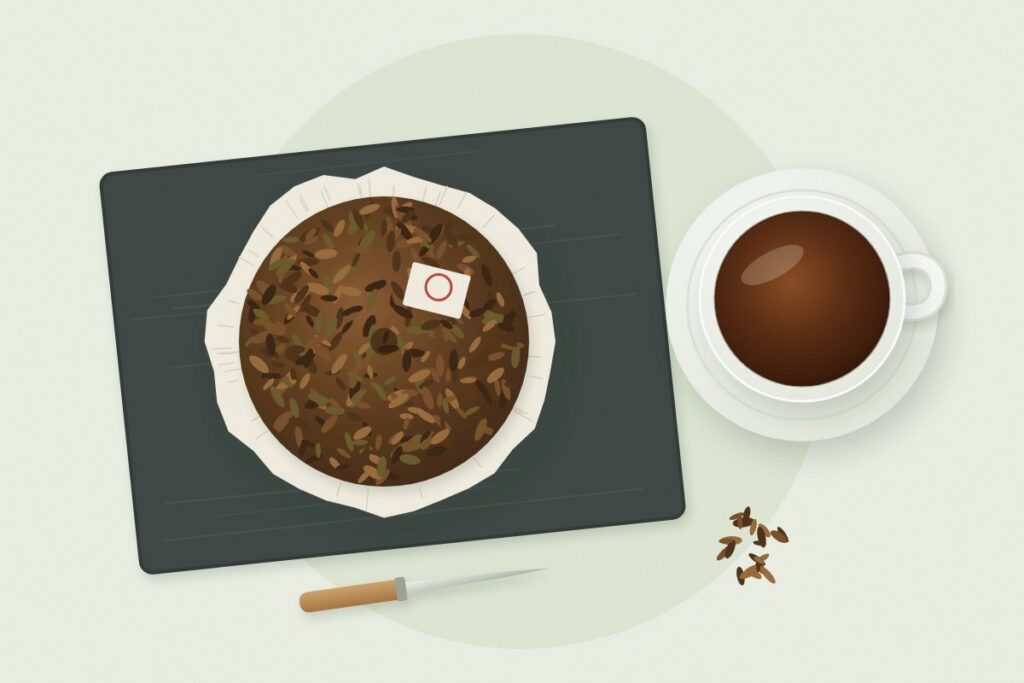
Pu-erh is sold in various shapes. The best known is the round cake, which traditionally weighs 357 g. There are also bricks, small “nests” (tuo cha) for one or a few cups, and loose leaf tea. Pressed tea ages more evenly and stores well.
How to brew pu-erh
Break off the amount you need from the cake with a knife or a pu-erh pick. Separate the leaves carefully in layers and do not crush them. We describe tea tools in the article A guide to tea brewing equipment.
- Rinse: pour boiling water over the leaves and pour the water out after 5–10 seconds. This “wakes up” the leaves, loosens them from the pressed shape and washes away dust.
- Western style: for a cup (200–250 ml), use 2–3 g of leaves and water at 95–100 °C (203–212 °F), and steep for 3–5 minutes. The leaves will last for three or more infusions.
- Chinese style (gongfu): put 5–7 g of leaves per 100 ml of water in a small teapot or gaiwan. Steep for just 10–20 seconds and make each following infusion a little longer. From one portion you can make eight to ten infusions and watch how the flavor changes.
Ripe pu-erh tolerates boiling water. With young raw pu-erh you can use water at 90–95 °C (194–203 °F) and a shorter steeping time so it is not too bitter. You will find more times and temperatures in the article How long to steep tea.
How to store pu-erh
Pu-erh is one of the few teas that benefits from longer storage. However, it needs different conditions than other teas:
- a little access to air, so do not store it in an airtight plastic bag,
- darkness, a steady temperature and moderate humidity,
- a place away from the kitchen, spices and other odors it could absorb.
Leave cakes in their original paper and keep them in a cardboard or wooden box. If a fuzzy white, green or black coating or a musty smell appears on the tea, throw it away. More in the articles How to store loose leaf tea and Does tea expire.
Caffeine and effects
Pu-erh contains caffeine, usually about as much per cup as black tea. The exact amount depends on the leaves and the preparation. More in the article What determines the caffeine content of tea.
In China, pu-erh is traditionally drunk after heavy and fatty meals. On the internet it is credited with lowering cholesterol or helping with weight loss. However, such effects have been studied mainly in animals or with concentrated extracts. It has not been confirmed that a cup of pu-erh lowers cholesterol or helps you lose weight. The European Food Safety Authority (EFSA) has not approved any such health claim for tea. If you are dealing with cholesterol or weight, talk to your doctor. We describe how tea relates to weight loss in the article Tea and weight loss.
So enjoy pu-erh for its taste and for the experience of preparing it. The brewing is as interesting as the cup itself.
Sources
- Chinese standard GB/T 22111-2008 – geographical indication product: Pu-erh tea.
- European Food Safety Authority (EFSA) – opinions on health claims about tea (Camellia sinensis).
We revised this article on November 24, 2026. It is for general information only. For details, see our Disclaimer.