Matcha tea: what it is, how to make it (even without a whisk) and what we know about it
What matcha is and how it is made, how to whisk it with a bamboo whisk or without one, what ceremonial grade means, how much caffeine it has and what studies really show.
Contents
- What matcha is and how it is made
- How to make matcha tea
- Matcha whisk, bowl and scoop
- Ceremonial and culinary matcha
- How to recognize good matcha
- How much caffeine does matcha have?
- Matcha benefits: what the studies show
- Matcha tea side effects
- Matcha during pregnancy
- Matcha latte in brief
- How to store matcha
- Sources
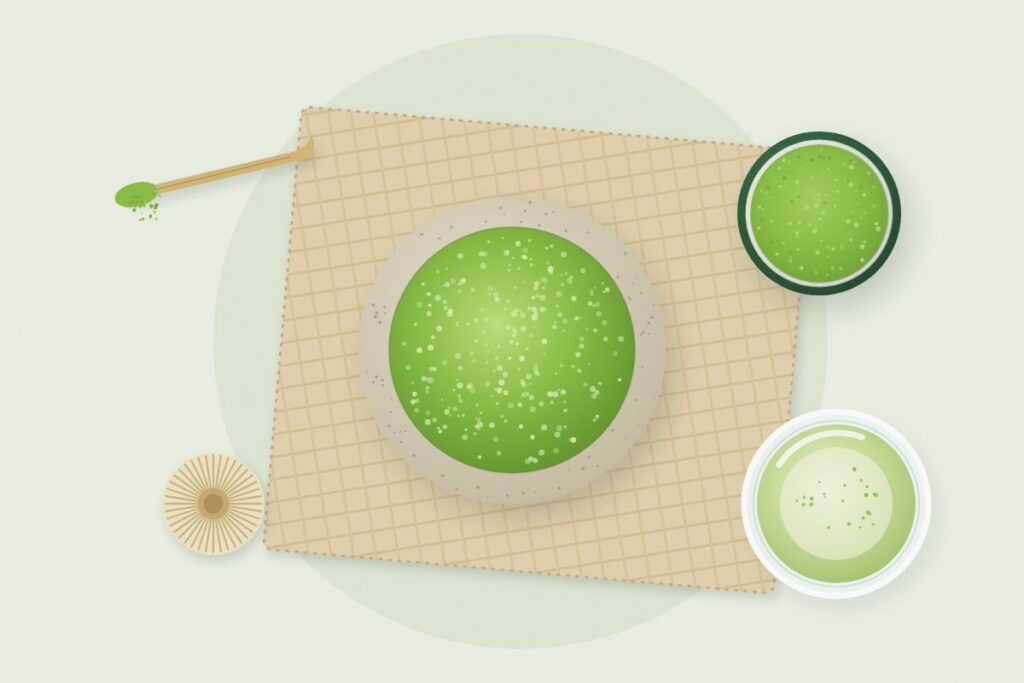
Matcha is a Japanese green tea in the form of a fine powder. It is made from tea leaves that grow in the shade for several weeks before harvest and are then steamed, dried and ground. Matcha is not steeped: you whisk 2 g of powder into about 70 ml of water at around 80 °C (176 °F) and drink the whole leaf. Below you will find how matcha is made, how to make matcha tea even without a whisk, how much caffeine it has and what we really know about it.
What matcha is and how it is made
Matcha does not come from a special plant but from the tea plant (Camellia sinensis), which is also used to make sencha and black tea. In Japan, selected cultivars are grown for matcha, such as Asahi.
In its green tea labeling standard, the Japan Tea Central Council describes matcha like this: leaves from shaded tea bushes are steamed, dried without rolling and ground into a fine powder. Powder made from other green teas is just powdered green tea, not matcha. A 2022 ISO technical report defines matcha for international trade in a similar way.
Shading
Before the spring harvest, the tea bushes are covered with nets, and traditionally also with mats made of straw and reed. The Japan Tea Central Council gives a shading period of roughly two to three weeks. Without sunlight, the leaves form fewer catechins, which give tea its bitterness and astringency, and more amino acids, including L-theanine, which bring an umami flavor. The leaves also turn a deeper green.
Tencha and grinding
After harvest, the leaves are briefly steamed to stop oxidation and dried without rolling. Then the stems and veins are removed. What remains is called tencha. It is traditionally ground slowly in stone mills, and today also by machine.
According to Japan’s Ministry of Agriculture, Forestry and Fisheries (MAFF), most tencha is grown in Kagoshima, Kyoto, with its well-known Uji area, and Shizuoka prefectures. We compare how matcha differs from sencha in the article Sencha vs. matcha.
How to make matcha tea
| Drink | Matcha | Water | How |
|---|---|---|---|
| Usucha, thin matcha (the usual bowl) | 2 g: 2 scoops with a chashaku or about one level teaspoon | about 70 ml, around 80 °C (176 °F) | whisk for 15–30 s until a fine foam forms |
| Koicha, thick matcha | 4 g | 30–40 ml, around 80 °C (176 °F) | stir slowly until smooth |
- Bring the water to a boil and let it cool to about 80 °C (176 °F). We explain how to do this without a thermometer in the article Why is green tea bitter?
- Warm the bowl and the whisk with warm water, then pour the water out.
- Sift 2 g of matcha through a fine sieve into the bowl so that no lumps form.
- Add a little water and mix the powder into a smooth paste. Then add the rest of the water, up to about 70 ml.
- Whisk quickly from the wrist in an M or W motion for 15–30 seconds, until a fine foam forms.
- Drink it right away, before the powder settles.
If your matcha tastes bitter, try cooler water or less powder.
How to make matcha without a whisk
First sift the powder or mix it with a little water into a paste. Then you can use:
- an electric milk frother, which makes foam on warm matcha as well as on a latte,
- a bottle or jar with a lid, in which you shake matcha thoroughly with cold water (hot water could spray out),
- a small kitchen whisk, although the foam will be coarser.
Matcha whisk, bowl and scoop
A traditional matcha set consists of three tools, and a fine sieve comes in handy as well. We describe other equipment in the article Tea brewing equipment.
Bamboo whisk (chasen)
The whisk is traditionally made by hand from a single piece of bamboo split into 80, 100 or 120 thin tines.
Before use, soak it in warm water so that the tines soften. After use, rinse it with water without detergent and let it air-dry, ideally on a whisk stand that helps it keep its shape. In a closed box, it can go moldy.
Bowl (chawan) and scoop (chashaku)
A matcha bowl is wide and deep enough for you to whisk freely. At home, a café au lait bowl will do too. A chashaku is a narrow bamboo scoop: two scoops are about 2 g of matcha. Don’t wash it with water, just wipe it with a dry cloth.
Ceremonial and culinary matcha
“Ceremonial” and “culinary” matcha are not formally defined by any standard or regulation; they are trade names. The Kyoto tea company Ippodo states that the term “ceremonial grade” arose when matcha began to be sold in the West and is not used in Japan.
Sellers usually use these names to distinguish finer matcha for drinking with water from cheaper, more bitter matcha for lattes and baking. What matters is origin, freshness and flavor.
How to recognize good matcha
- Color: bright, vivid green. A yellowish, olive or brownish color suggests lower quality or old powder.
- Fineness: the powder is silky fine.
- Flavor: full, with umami and only a slight bitterness. Sharp astringency or a hay-like smell gives away weaker or old matcha.
- Packaging: country and region of origin, best-before date, a small, opaque and well-sealed package.
- Ingredients: pure matcha powder lists only green tea as an ingredient. Matcha latte mixes may also contain sugar or milk powder.
How much caffeine does matcha have?
A cup of matcha made from 2 g of powder has about 40–90 mg of caffeine, because you drink the whole leaf. A 2021 review gives 18.9–44.4 mg of caffeine per gram of matcha. Koicha made from 4 g has roughly twice as much. According to the European Food Safety Authority (EFSA), a cup of drip coffee (200 ml) has about 90 mg. You will find other drinks in our caffeine in tea table.
According to EFSA, up to 400 mg of caffeine a day from all sources, and up to 200 mg at a time, does not cause problems for healthy adults. With the upper estimate of 90 mg, that is about four cups of matcha. For children, EFSA gives about 3 mg per kilogram of body weight per day, which is around 90 mg, or one cup, for a child weighing 30 kg. As little as 100 mg of caffeine before bedtime can affect sleep, so it is better to drink matcha in the morning.
Matcha benefits: what the studies show
Matcha contains caffeine, L-theanine and catechins, just like green tea. However, there are few studies of matcha in humans.
A review from Qatar University found five small randomized studies with matcha, with 209 participants in total. Some of them suggested fewer signs of stress or slightly better attention and memory; matcha did not affect mood. The authors point out that the studies are small, varied and partly contradictory.
In a 2024 Japanese study, 99 older adults with declining memory took capsules with 2 g of matcha a day or a placebo for 12 months. The main tests of thinking and of managing everyday activities did not improve; only the recognition of emotions from faces got better. The matcha was supplied by a tea company whose employees were among the authors.
In 2011, EFSA assessed claims about L-theanine from tea relating to concentration, stress and sleep, and did not confirm a link. In the European Union, no health claim has been approved for green tea, its catechins or L-theanine. We discuss what larger reviews of green tea have shown in the article Green tea.
Matcha tea side effects
- Caffeine: in larger amounts or if you are sensitive to it, insomnia, nervousness or a pounding heart.
- Stomach: if tea on an empty stomach doesn’t agree with you, drink it after a meal.
- Iron: tea reduces the absorption of iron from plant foods; if you are low on iron, drink matcha between meals.
- Vitamin K: according to the Japanese food composition tables, 2 g of matcha contains about 58 µg of vitamin K. If you take the blood thinner warfarin or other medications, talk to your doctor.
- Supplements and the liver: in 2018, EFSA considered a traditionally prepared green tea infusion to be generally safe. The concerns about the liver relate to supplements that provide 800 mg or more of EGCG (the main catechin) a day. EFSA has not assessed matcha as a drink separately.
Matcha during pregnancy
During pregnancy and breastfeeding, caffeine is what matters most. According to EFSA, an intake of up to 200 mg a day from all sources does not raise safety concerns for the unborn baby or the breastfed infant. That is two to three cups of matcha made from 2 g, or only two with the upper estimate. Koicha made from 4 g can come close to the limit on its own. Coffee, cola and chocolate also count toward the total. More in the article Tea during pregnancy and breastfeeding.
Important: if you are pregnant or breastfeeding, have a heart condition or high blood pressure, or take medication, talk to your doctor or pharmacist about matcha. Do not take supplements with green tea extract during this time without talking to your doctor.
Matcha latte in brief
Sift 2 g of matcha into a mug, add 30–50 ml of water at around 80 °C (176 °F) and whisk. Top up with 150–200 ml of warm frothed milk or plant-based milk and sweeten to taste. It has as much caffeine as a cup of matcha.
How to store matcha
The fine powder quickly loses its color and aroma. Store it in an opaque, well-sealed container in a cool place, away from strong odors. Use up an opened package within a few weeks, or within 1–2 months at the latest. An unopened package can go in the fridge, but let it come to room temperature before opening so that moisture does not condense inside.
Sources
- Japan Tea Central Council – green tea labeling standard (緑茶の表示基準), 2019.
- ISO/TR 21380:2022 Matcha tea – Definition and characteristics.
- Japan’s Ministry of Agriculture, Forestry and Fisheries (MAFF): aff magazine, April 2017 (tencha production), and the tea situation overview お茶をめぐる情勢, as of November 25, 2026.
- JETRO – Japanese green tea (Matcha, Tencha).
- Kyoto Prefectural Tea Research Institute – instructions for preparing matcha.
- Ippodo Tea – “ceremonial grade” and caring for a chasen whisk.
- Kochman J. et al.: Health Benefits and Chemical Composition of Matcha Green Tea: A Review. Molecules, 2021.
- Sokary S. et al.: The therapeutic potential of matcha tea: A critical review on human and animal studies. Current Research in Food Science, 2023.
- Uchida K. et al.: Effect of matcha green tea on cognitive functions and sleep quality in older adults with cognitive decline. PLoS ONE, 2024.
- European Food Safety Authority (EFSA): Scientific opinion on the safety of caffeine, 2015.
- European Food Safety Authority (EFSA): Scientific opinion on the safety of green tea catechins, 2018.
- European Food Safety Authority (EFSA): Scientific opinion on health claims related to L-theanine from tea, EFSA Journal 2011;9(6):2238.
- Japan’s Ministry of Education, Culture, Sports, Science and Technology (MEXT): Standard Tables of Food Composition in Japan, eighth revised edition, 2023 supplement (matcha).
We wrote this article on November 25, 2026. It is for general information only. For details, see our Disclaimer.