Sencha vs. matcha: how they differ in growing, preparation, flavor and caffeine
Why matcha is grown in the shade and ground into powder, how to prepare both sencha and matcha, and which of them has more caffeine.
Contents
Sencha and matcha are both Japanese green teas from the same plant, but they differ in almost everything: how they are grown, processed and prepared, and how they taste. You steep sencha like ordinary loose leaf tea and then throw the leaves away. Matcha is whisked into water, and you drink the whole ground leaf. In this article you will find how these two teas differ, how to prepare them, what they taste like and how much caffeine they contain.
The differences at a glance
| Feature | Sencha | Matcha |
|---|---|---|
| Growing | in the sun | in the shade before harvest, for about 2–3 weeks |
| Processing | the leaves are steamed, rolled and dried | the leaves are steamed and dried without rolling, the stems and veins are removed and the rest is ground |
| Appearance | thin dark green needles | fine bright green powder |
| Preparation | steeping, the leaves are discarded | whisking, you drink all of the powder |
| Flavor | fresh, grassy, slightly astringent | full, creamy, pronounced umami, slight bitterness |
| Caffeine per cup | about 20–45 mg | about 40–90 mg (2 g of powder) |
Sencha: the most common Japanese tea
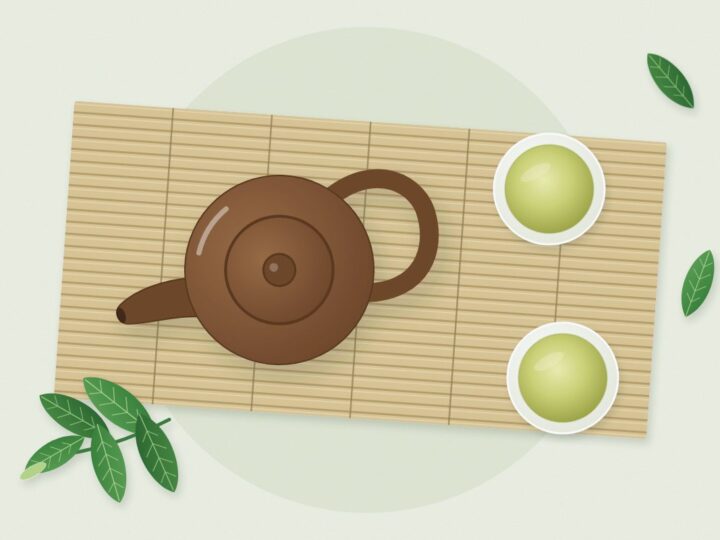
Sencha is the most widespread type of green tea in Japan. The tea bushes for it mostly grow in the sun, though some are briefly shaded before picking. Right after picking, the leaves are briefly steamed to stop oxidation. Then they are rolled and dried until they take the shape of thin, glossy needles. Steaming is typical of Japanese green teas. Most Chinese green teas are pan-fired instead, which is why they taste different. You will find more about green teas in the article Green tea.
Today’s method of making sencha is associated with Nagatani Soen, a grower from the area around Uji near Kyoto, who developed it in 1738. Most of Japan’s tea today is grown in Kagoshima and Shizuoka prefectures.
There is also a variant called fukamushicha, which is sencha that has been steamed for longer. Its leaves are smaller, the infusion is cloudier and deep green, and the flavor is milder and less astringent.
Matcha: shade-grown tea ground into powder
Matcha is not made from sencha but from a tea called tencha. Before the spring harvest, the tea bushes are covered with shade nets. In its green tea labeling standard, the Japan Tea Central Council gives a shading period of roughly two to three weeks. In the shade, the leaves darken and their composition changes: the content of amino acids, including L-theanine, and of caffeine rises, while the catechins that make tea astringent decrease. That is why matcha is less astringent and has a pronounced umami flavor.
After harvest, the leaves are steamed and dried, but unlike sencha they are not rolled. Then the stems and veins are removed, and what remains is tencha. It is ground into a fine powder, traditionally in stone mills. Shading, sorting and slow grinding are the reasons why matcha is more expensive than sencha.
Sencha, on the other hand, is not ground. It is sold as whole rolled leaves and steeped. You can buy ground sencha as powdered green tea, but under the Japanese labeling standard it is not matcha.
Powdered tea came to Japan from China at the end of the 12th century. Its spread is associated with the Zen monk Eisai, who returned from China in 1191. The Japanese tea ceremony later developed from the practice of drinking whisked tea.
How to choose matcha
Stores also sell powder made from other green teas as matcha. Labels such as “ceremonial” or “culinary” are not formally defined anywhere; they are just trade names. You can recognize good matcha by its bright, fresh green color and very fine powder. A dull, yellowish or olive color suggests lower quality or old powder. Cheaper matcha is more bitter and better suited to milk drinks or baking.
How to prepare sencha
- For one cup (200 ml), use 2–3 g of leaves, which is about one teaspoon.
- Pour water at 70–80 °C (158–176 °F) over them. Boiling water brings out the astringency.
- Let it steep for 1–2 minutes. Fukamushicha needs less time, about a minute.
- You can steep the same leaves once or twice more. The leaves have already unfurled, so the second infusion needs only half a minute and the water can be a little hotter.
If your sencha tastes bitter, lower the water temperature first and only then shorten the time. Our comic Why is green tea bitter? shows why. More in the article How long to steep tea.
How to prepare matcha
Usucha (thin matcha)
- Warm the bowl and the bamboo whisk (chasen) with hot water, then pour the water out.
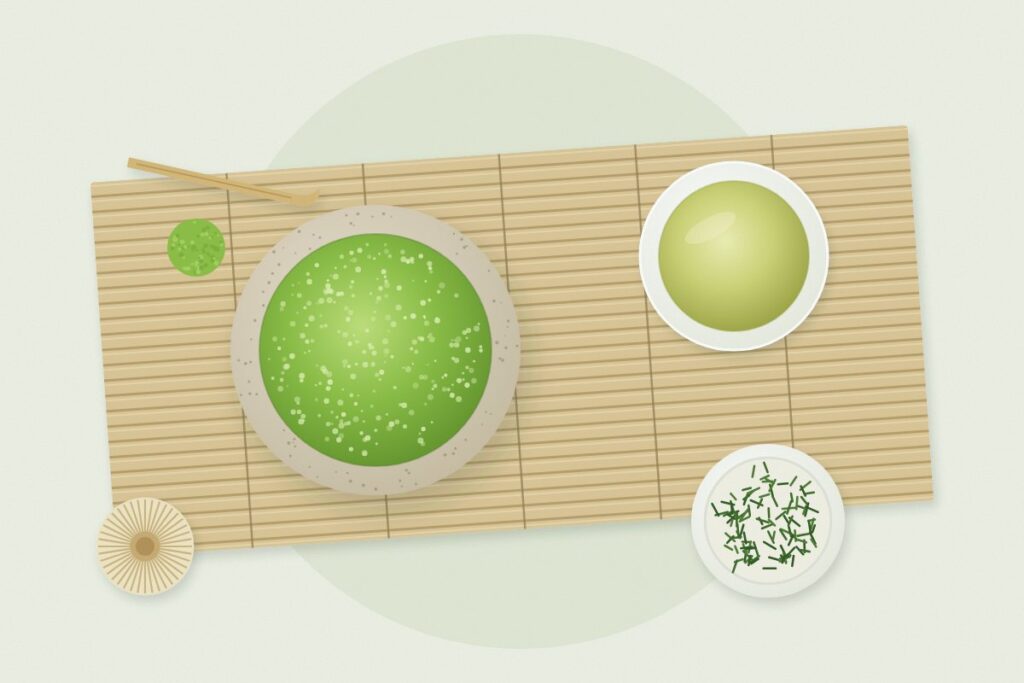
- Sift 2 g of matcha, about one level teaspoon, through a fine sieve into the bowl. Sifting breaks up any lumps.
- Pour in about 70 ml of water at around 80 °C (176 °F).
- Whisk quickly from the wrist in an M or W motion until a fine foam forms on the surface. This takes about 15–30 seconds.
- Drink it right away, before the powder settles to the bottom.
Koicha (thick matcha)
For koicha, only 30–40 ml of water is used for 4 g of matcha. It is not whisked but stirred slowly until it turns into a thick, smooth drink. It is made from the finest matcha, because any bitterness stands out in it.
Matcha latte and matcha without a whisk
For a matcha latte, whisk 2 g of matcha in a little water and top it up with warm frothed milk; plant-based milk works too. If you don’t have a bamboo whisk, a small electric milk frother will do, or a closed bottle in which you shake the matcha and water thoroughly. We describe more tools in the article A guide to tea brewing equipment.
What they taste like
- Sencha is fresh, green and grassy, with a slight astringency. Good sencha also has a sweetish note and a pleasant aftertaste. Steeped longer, it gets stronger and more astringent.
- Matcha is full and creamy, with a pronounced umami flavor and a slight bitterness at the end.
Which tea is better is a matter of taste. Sencha suits everyday drinking, while matcha is more for moments when you want to take your time over the preparation.
Caffeine and L-theanine
With sencha you drink only the infusion, and part of the caffeine stays in the leaves. With matcha you drink the whole ground leaf, which is why a cup of matcha usually has more caffeine. Shading also raises the caffeine content of the leaves. The Food Safety Commission of Japan gives about 20 mg of caffeine per 100 ml for a sencha infusion. For the shade-grown tea gyokuro, which is prepared with a lot of leaves and little water, it is as much as 160 mg per 100 ml.
Shade-grown teas also contain more of the amino acid L-theanine. It is often said that thanks to it, matcha gives a “calmer” boost. However, the effect of L-theanine on how caffeine acts has not yet been clearly confirmed. No health claim has been approved in the European Union for green tea catechins or for green tea as such.
If you are sensitive to caffeine, it is better to drink matcha in the morning. We discuss how much caffeine a day is fine in the article What determines the caffeine content of tea.
How to store them
Matcha is very sensitive to air, light and heat, because the fine powder has a huge surface area. Close an opened package tightly, keep it in a cool, dark place and use it up within a few weeks. Once it turns brown and loses its aroma, it won’t taste the way it should. Sencha keeps longer, but it is also best drunk within a few months of opening. You will find details in the article How to store loose leaf tea.
Sources
- Japan Tea Central Council (日本茶業中央会) – green tea labeling standard (緑茶の表示基準), 2019.
- Food Safety Commission of Japan (食品安全委員会) – fact sheet on caffeine in food.
- European Food Safety Authority (EFSA) – scientific opinion on the safety of caffeine (2015).
We revised this article on November 24, 2026. It is for general information only. For details, see our Disclaimer.