Why is green tea bitter? Boiling water and other mistakes (comic)
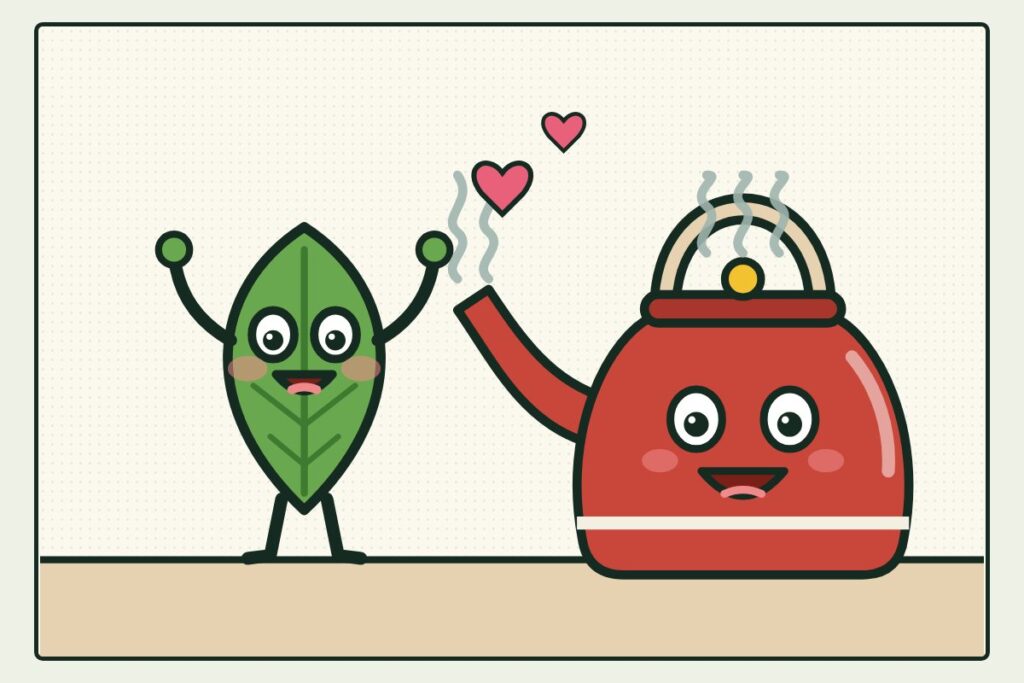
The first episode of the Tea Tales comic: Kettie pours boiling water over green tea and Leafy turns bitter. We explain why and how to make a gentle green tea.
Contents
Why is green tea bitter? Most often because you pour water that is too hot over it, often water that is still boiling, let it steep too long or put too many leaves in your cup. Just let the water cool to 70–80 °C (158–176 °F) and steep the tea for 2–3 minutes, and the same tea becomes a gentle drink. That is exactly what Kettie found out in the first episode of Tea Tales.
Tea Tales, episode 1: Leafy and the boiling water
Kettie: The water is boiling, 100 °C! Let me make you some green tea.
Leafy: Wait… isn’t that too hot for me?
Leafy: Ouch! Now I’ll taste bitter and harsh!
Kettie: Oops…
A little later…
Kettie: I’ll let the water stand until it’s 70–80 °C.
Leafy: Mmm, smooth and sweet!
Kettie: And we steep it for just 2–3 minutes.
Tip: brew green tea with water at 70–80 °C (158–176 °F) and steep it for 2–3 minutes. More in How long to steep tea.
Why green tea tastes bitter and astringent
The flavor of green tea is shaped mainly by three groups of substances. Catechins, the polyphenols in green tea, give the infusion its astringency and bitterness, and caffeine adds more bitterness. Amino acids, especially theanine, bring a gently sweet umami taste.
They do not dissolve in water in the same way, though. Japanese researchers found that the hotter the water, the more catechins and caffeine end up in the infusion. The strongly astringent epigallocatechin gallate (EGCG) barely dissolved at 50 °C (122 °F), while at 90 °C (194 °F) it dissolved to a large extent. Amino acids, on the other hand, are released easily even in cold water.
So boiling water pulls a lot of astringent substances out of the leaves all at once, and the delicate flavor gets lost underneath them. The result? Bitter green tea, just like Leafy in the comic.
Time and the amount of leaf matter just as much. According to a study by Unilever researchers, they are among the main factors that determine the composition of an infusion. In a 2015 Turkish study, green tea steeped for 30 and 45 minutes got very low ratings because of its bitter taste. Such is the fate of a forgotten mug.
What water temperature to use for green tea
The values are approximate and match our guide How long to steep tea.
| Tea | Leaves per 200–250 ml | Water temperature | Steeping time | Number of infusions |
|---|---|---|---|---|
| Green tea | 2–3 g, about 1 teaspoon | 70–80 °C (158–176 °F) | 2–3 min | 2–3 |
| More delicate Japanese, such as sencha | 2–3 g | closer to 70 °C (158 °F) | closer to 2 min | 2–3 |
| Chinese green | 2–3 g | closer to 80 °C (176 °F) | 2–3 min | 2–3 |
Japanese green teas are the most sensitive to temperature. You can read more about them in the article Sencha vs. matcha.
How to cool water for green tea without a thermometer
The most convenient option is a kettle with temperature control, and you will find more tools in the article Tea brewing equipment. Without one, you can manage like this:
- Let the water stand. After it boils, let it stand for a while with the lid open. How fast it cools depends on the amount of water and on the vessel.
- Pour it into another vessel. According to Japan’s Ministry of Agriculture, Forestry and Fisheries (MAFF), the temperature drops by 5–10 °C (9–18 °F) each time you pour the water, depending on the vessel and the season. Boiling water is around 90 °C (194 °F) after the first pour and around 80 °C (176 °F) after the second, for example into cups. This also warms up the cups.
- Add cold water. A little cold water lowers the temperature quickly.
- Measure it once. Use a thermometer to find out how long you need to wait, and remember it.
What to do when green tea is bitter or astringent
- Take the leaves out right away or pour off all of the infusion so it does not keep steeping. The Japanese brewing manual advises pouring even the last drop out of the teapot.
- Dilute an infusion that is too strong with hot water.
- Next time, change only one thing at a time: first lower the temperature, then shorten the time, or use fewer leaves.
- If the first infusion was already bitter, do not lengthen the steeping time for the next one from the same leaves.
Tea quality and tea bags matter too
According to MAFF, senchas from earlier harvests contain more amino acids, while summer harvests have slightly more tannins, that is, astringent catechins. Still, not even an excellent tea can stand up to boiling water.
Tea in bags is usually broken into small pieces that release their flavor faster. The Japanese brewing manual likewise recommends steeping fukamushicha, a sencha with finely broken leaves, for a shorter time than regular sencha. So with a tea bag, stick to the right temperature and take it out in time.
You will find more about the types of green tea in the article Green tea and more guides in our Brewing and tips category. And Kettie? She already knows there is no need to rush.
Sources
- Monobe M., NARO (Japan): Health Functions of Compounds Extracted in Cold-water Brewed Green Tea from Camellia sinensis L. Japan Agricultural Research Quarterly 52(1), 2018.
- Sakamoto A. et al.: The Compositions of the Respective Infusions of Sencha Brewed Three Times. Chagyo Kenkyu Hokoku (Tea Research Journal) 94, 2002.
- Japan’s Ministry of Agriculture, Forestry and Fisheries (MAFF): Tea Brewing Manual (茶の淹れ方マニュアル), as of November 25, 2026.
- Astill C. et al., Unilever Research: Factors Affecting the Caffeine and Polyphenol Contents of Black and Green Tea Infusions. Journal of Agricultural and Food Chemistry 49(11), 2001.
- Saklar S. et al.: Effects of Different Brewing Conditions on Catechin Content and Sensory Acceptance in Turkish Green Tea Infusions. Journal of Food Science and Technology 52(10), 2015.
We wrote this article on November 25, 2026. It is for general information only. For details, see our Disclaimer.