Christmas punch with tea: a recipe with rum or wine and a non-alcoholic version for kids
Christmas punch recipes with black tea and rum or wine, plus a non-alcoholic punch for kids made with rooibos or fruit tea. With exact amounts, steeping times and why not to boil punch.
Contents
- Tea punch: which tea to choose
- Christmas punch with rum: a recipe with black tea
- Christmas punch with wine and rum
- Who should not drink punch with alcohol
- Non-alcoholic Christmas punch for kids
- Tips for the best Christmas punch
- Punch in a thermos for Christmas markets
- Where the word punch comes from
- Sources
To make Christmas punch with tea, flavor hot tea with spices, orange and sugar, and for adults, stir in rum or wine at the very end. For 1 liter of water, 10 g of black tea steeped for 3–4 minutes is enough. For children, use rooibos or fruit tea instead, as they contain no caffeine. Below you will find exact recipes for 6–8 glasses with rum, with wine and without alcohol, plus tips on how to heat punch. If you want a spiced tea without alcohol that you can also keep on hand, see Christmas tea.
Important: punch with alcohol is not for children and adolescents, pregnant women or anyone who will be driving. Make children a non-alcoholic punch and serve it warm, not hot. If you only want one hot glass, see our grog recipe.
Tea punch: which tea to choose
Tea gives punch a fuller flavor than plain water. Black tea adds a gentle astringency that balances the sweetness of the juice and sugar. Hibiscus adds tartness and a ruby color, while rooibos adds a soft, slightly sweet flavor. Among black teas, bold ones such as Ceylon or Assam work well.
| Tea base | Per 1 liter of water | Water | Steeping | Caffeine |
|---|---|---|---|---|
| Black tea | 8–10 g, about 4–5 teaspoons | just after it reaches a boil | 3–4 minutes | yes |
| Hibiscus | 8–12 g, about 4–6 teaspoons | boiling | 5–10 minutes | no |
| Fruit tea | 15–20 g, about 5–6 heaping teaspoons | boiling | 8–10 minutes | no |
| Rooibos | 8–10 g, about 4–5 teaspoons | boiling | 5–8 minutes | no |
Do not steep black tea any longer, or the punch will turn bitter. Always pour boiling water over hibiscus, fruit blends and rooibos. The German Federal Institute for Risk Assessment (BfR) also recommends this for hygiene reasons. You can read more in Hibiscus tea and Fruit tea.
Christmas punch with rum: a recipe with black tea
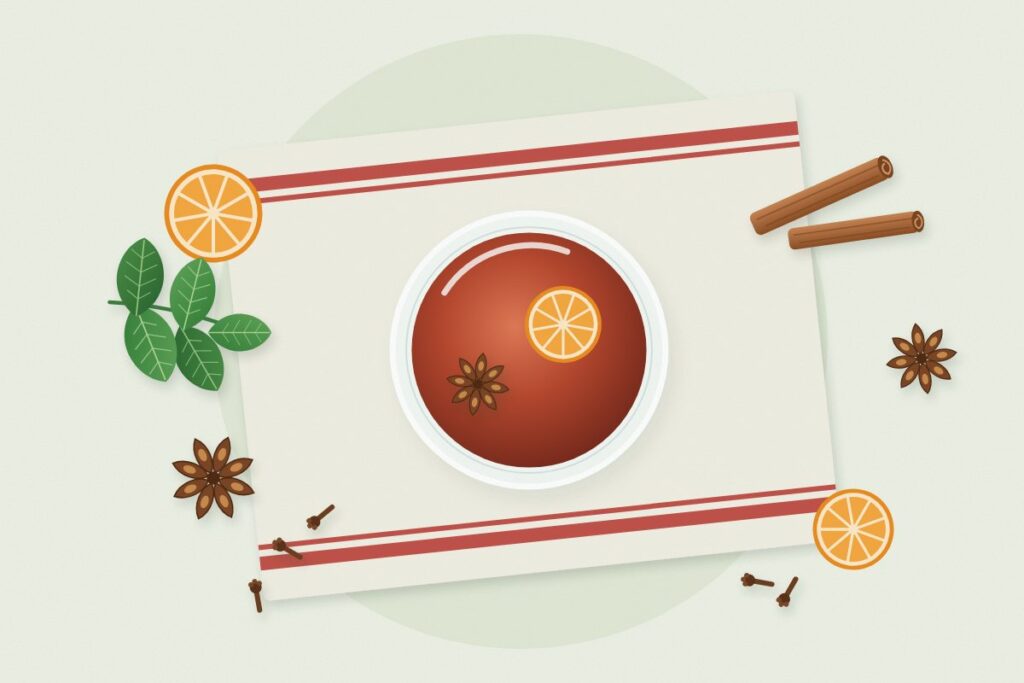
For 6–8 glasses (about 1.3 liters), you will need:
- 1 liter of water,
- 10 g of black tea (4–5 teaspoons),
- 2 oranges (one for juice, the other for slices),
- the juice of half a lemon,
- 1 cinnamon stick, 5 cloves and 1–2 star anise to taste,
- 60–100 g of sugar or honey, to taste,
- 200 ml of rum (37.5–40% alcohol).
Method:
- Pour the water into a pot and add the spices and a strip of peel from an orange washed in warm water. Bring to a boil and simmer gently for 5 minutes so the spices release their flavor.
- Take the pot off the heat, add the tea and let it steep for 3–4 minutes.
- Strain the tea.
- Stir in the sugar or honey and the orange and lemon juice. Taste and add more sweetener if needed.
- Only at the very end, off the heat, pour in the rum.
- Serve in thick-walled glasses with an orange slice.
The punch contains about 6% alcohol. A glass (200 ml) contains about 10 g of pure alcohol, roughly the same as 100 ml of wine.
Christmas punch with wine and rum
The stronger version is reminiscent of mulled wine. For 6–8 glasses, you need:
- 500 ml of water and 5 g of black tea or hibiscus (2–3 teaspoons),
- 750 ml of dry red wine,
- 100 ml of rum,
- 1 orange, 1 cinnamon stick, 4 cloves and 1 star anise,
- 50–80 g of sugar or honey.
Simmer the spices and orange peel in the water for 5 minutes, take the pot off the heat, let the tea steep in it for 3–4 minutes and strain. Pour in the wine and add the sugar and orange juice. Heat over low heat until the surface starts to steam, but do not let it boil. Take it off the heat and pour in the rum. The punch contains about 9% alcohol, so serve it in smaller glasses.
Why you should not boil punch with alcohol
Alcohol (ethanol) boils at about 78 °C (172 °F), which is a lower temperature than water. If you boiled the punch, its aroma would evaporate along with the alcohol and the punch would taste flat. So add the rum only after taking the pot off the heat, and only warm the wine.
Boiling, however, does not get rid of anywhere near all the alcohol. According to a table from the U.S. Department of Agriculture (USDA), about 85% of the alcohol remains if you pour it into a boiling liquid and take it off the heat right away. After 30 minutes of gentle simmering, about 35% still remains, and after an hour, 25%. So you cannot “boil off” the alcohol to make punch suitable for children.
Who should not drink punch with alcohol
- Children and adolescents under 18: Slovak law on protection against the misuse of alcoholic beverages prohibits serving them alcoholic drinks.
- Pregnant women: according to the U.S. Centers for Disease Control and Prevention (CDC), there is no known safe amount of alcohol during pregnancy.
- Drivers: Slovak road traffic law prohibits driving a vehicle at a time when alcohol could still be present in your body. So do not drive even after a single glass of punch.
- People who take medication or must not drink alcohol because of an illness: talk to a doctor or pharmacist.
Non-alcoholic Christmas punch for kids
Kids’ punch is made the same way, only with fruit juice instead of rum. For the base, choose a caffeine-free tea: rooibos, hibiscus or fruit tea.
For 8 glasses (about 1.7 liters):
- 1 liter of water,
- 8–10 g of rooibos or 15–20 g of fruit tea,
- 500 ml of 100% apple juice,
- 200 ml of orange juice,
- 1 cinnamon stick and 3–4 cloves,
- orange and apple slices,
- honey or sugar only to taste, since the juices are sweet on their own.
Method:
- Pour boiling water over the tea and let it steep: rooibos for 5–8 minutes, fruit tea for 8–10 minutes. Then strain it.
- Pour in the juices and add the spices and fruit.
- Heat over low heat for 10 minutes so the flavors come together.
- Before serving, let the punch cool so it does not scald your child.
One pot for everyone: make the non-alcoholic punch and add alcohol for adults only in their glasses, for example 20 ml of rum. Mark the glasses so they do not get mixed up.
Can children drink punch made with black tea?
Black tea contains caffeine even when diluted with juice. The European Food Safety Authority (EFSA) considers about 3 mg of caffeine per kilogram of body weight per day from all sources to be safe for children. For a child weighing 20 kg, that is about 60 mg. We explain how much caffeine a cup of tea contains in How much caffeine is in tea and what determines it.
What to keep in mind with children
- Temperature: according to Ireland’s Health Service Executive (HSE), a hot drink can still scald a child 15 minutes after it is poured. Serve kids’ punch lukewarm, for example in a mug with a lid, and keep the pot of hot punch out of children’s reach.
- Honey: do not give honey to children under one year old. The U.S. CDC advises this because of the risk of botulism.
- Star anise: do not add it to kids’ punch. In 2003, the U.S. Food and Drug Administration (FDA) warned against teas made from star anise because poisonous Japanese star anise can get mixed into ordinary Chinese star anise. Infants also had health problems after drinking these teas.
Tips for the best Christmas punch
- Punch with fruit: add orange slices, pieces of apple or pear and a handful of cranberries to the finished punch.
- A spicier version: add a few slices of ginger and crushed cardamom, much as in masala chai.
- Keep it warm, not boiling. In 2016, the International Agency for Research on Cancer (IARC) classified drinking very hot beverages above 65 °C (149 °F) as probably carcinogenic. So wait until the punch has cooled a little before you drink it.
Punch in a thermos for Christmas markets
You can take punch to Christmas markets in a thermos. Rinse it with hot water first and pour in the punch just before you leave. If you buy punch at the market and it is for children, always ask whether it is really alcohol-free, because both versions can look the same.
Where the word punch comes from
The word punch comes from English, and Slovak borrowed it as punč. The oldest known record of the word dates from 1632, in a letter written by an employee of the English East India Company in India. The first punches were mixed from arrack, an Asian distilled spirit, with sugar, citrus juice, water and spices.
The most common explanation is that the name comes from the Hindi word pāñč, meaning “five,” after the drink’s five ingredients. This explanation is based on John Fryer’s travel account from 1698, and linguists consider it uncertain. Drinks historian David Wondrich leans instead toward the theory that the name is related to a cask called a puncheon. Neither explanation has been proven, so take them as legends.
You will find more recipes and tips in our Brewing and tips category.
Sources
- U.S. Department of Agriculture (USDA): USDA Table of Nutrient Retention Factors, Release 6, 2007.
- International Agency for Research on Cancer (IARC): IARC Monographs, Volume 116, Drinking Coffee, Mate, and Very Hot Beverages, 2018.
- European Food Safety Authority (EFSA): Scientific Opinion on the safety of caffeine, 2015.
- German Federal Institute for Risk Assessment (BfR): Boiling water a must for herbal teas, press release, 2005.
- U.S. Food and Drug Administration (FDA): consumer advisory on star anise teas, 2003.
- Health Service Executive (HSE), Ireland: preventing scalds from hot liquids in children.
- U.S. Centers for Disease Control and Prevention (CDC): About Alcohol Use During Pregnancy; Botulism – prevention.
- Slovak Act No. 219/1996 Coll. on protection against the misuse of alcoholic beverages, Section 2.
- Slovak Act No. 8/2009 Coll. on road traffic, Section 4(2).
- Regulation (EU) 2019/787 on the definition, description, presentation and labelling of spirit drinks, Annex I.
- Difford’s Guide: Punch & Punches, history (citing David Wondrich).
- Online Etymology Dictionary: punch.
We wrote this article on November 25, 2026. It is for general information only. For details, see our Disclaimer.