Masala chai: the spiced tea from India and how to make it at home
Where Indian spiced milk tea comes from, which spices belong in it, and how to make masala chai step by step at home.
Contents
Masala chai is strong black tea brewed with milk, sugar and spices. In India it is sold on every corner and drunk several times a day. The word chai simply means tea in Hindi, and masala is a spice mixture. In this article you will find where masala chai comes from, which spices belong in it, how to make it at home, and what the facts say about its effects. For the café version with frothed milk, see our chai latte recipe.
Where masala chai comes from
It is often written that masala chai is thousands of years old and was invented by a king as a healing drink. There is no evidence for such stories. Spiced drinks have been enjoyed in India since ancient times, but tea as we know it today is relatively new in Indian cups.
The tea plant began to be grown on a large scale in India in the 19th century, mainly in Assam and Darjeeling, and almost all the tea was exported to Britain. At home, tea became widespread only in the first half of the 20th century. Street vendors, called chaiwalas, began to brew it with milk, sugar and spices to make it tastier and cheaper. This created the drink that is found everywhere in India today.
You will find more about Indian teas in Seven teas from India and Darjeeling tea.
Which spices belong in masala chai
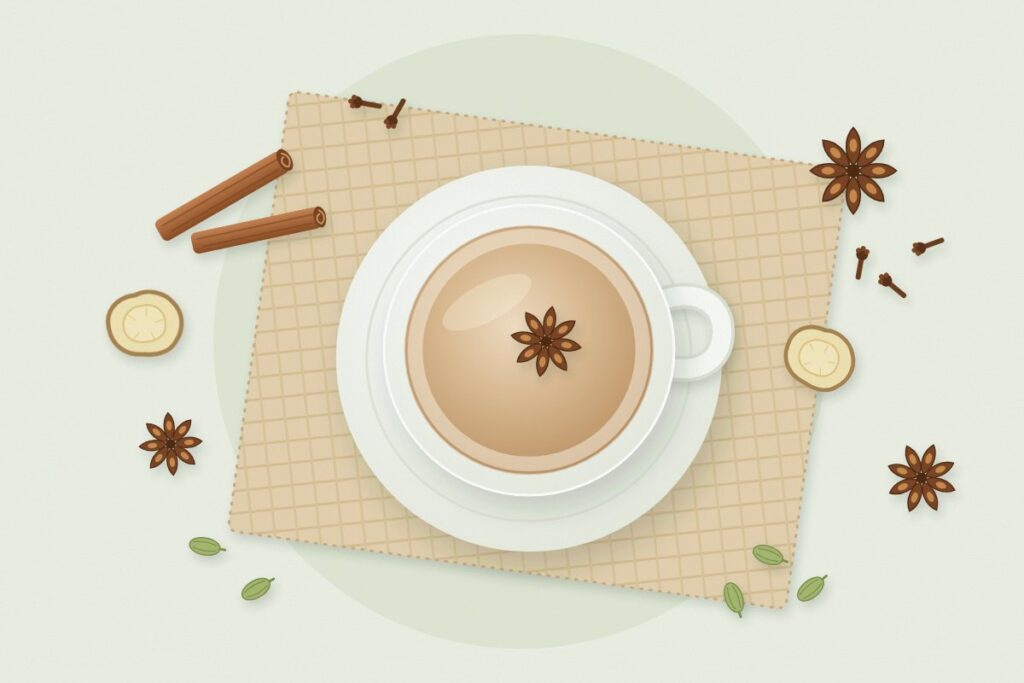
There is no single correct recipe. Every family and every vendor has their own. The most commonly used are:
- cardamom, which is the base of most recipes,
- fresh ginger, which adds heat,
- cinnamon,
- cloves,
- black pepper,
- less often star anise, fennel or nutmeg.
The tea used is strong black tea, most often Assam. In India, granulated CTC tea is often used. It quickly gives a dark, bold infusion that does not get lost in the milk.
How to make masala chai
For two cups you will need:
- 200 ml of water and 200 ml of milk (plant-based milk works too),
- 2 teaspoons of black tea, preferably Assam (about 5 g),
- 4 cardamom pods, 2 cloves, a piece of cinnamon and 2–3 black peppercorns,
- 2 cm of fresh ginger,
- sugar or honey to taste.
- Lightly crush the cardamom and spices in a mortar, and grate or slice the ginger.
- Put the spices and ginger into cold water and bring to a boil. Let it simmer gently for 3–5 minutes.
- Add the tea and simmer for another 1–2 minutes.
- Pour in the milk and add the sugar, bring to a boil again and remove from the heat right away so the milk does not boil over.
- Strain into cups.
If you want a milder masala chai, use less spice or simmer the tea for just a minute. For a stronger flavor, simmer the spices longer. You can also prepare the spice mix in advance and store it in a sealed container.
How much caffeine masala chai has
Masala chai contains caffeine from black tea. A cup usually has a little less than plain black tea, because part of the volume is milk. The exact amount depends on how much tea you use and how long you simmer it. You can read more in How much caffeine is in tea and what determines it. If you want chai for the evening, use rooibos instead of black tea, which has no caffeine.
What we know about the effects of the spices
On the internet, masala chai is credited with boosting immunity, protecting the heart or helping with inflammation. Such claims about a cup of spiced tea have not been confirmed. The spices are present in small amounts, and most studies examined concentrated extracts or capsules.
Most is known about ginger among the spices in masala chai. The European Medicines Agency (EMA) recognizes ginger as a medicine for the prevention of nausea and vomiting when traveling, but this concerns measured doses of powder in capsules. Ginger is also traditionally used for mild digestive complaints such as bloating. A cup of masala chai is a different preparation, and nobody has studied its effects.
Masala chai is above all a tasty, warming drink. So drink it because you enjoy it.
What to watch out for
- Cinnamon: common cheap cinnamon (cassia) contains coumarin, which in large amounts can put a strain on the liver. If you drink chai with cinnamon often, reach for Ceylon cinnamon, which has only very little.
- Sugar: street chai is often very sweet. At home, adjust the amount of sugar to your liking.
- Caffeine: if you are sensitive to it, drink chai in the morning or make it with rooibos.
Sources
- European Medicines Agency (EMA), Committee on Herbal Medicinal Products (HMPC): European Union herbal monograph on Zingiber officinale Roscoe, rhizoma, revision 1, and its public summary.
- European Food Safety Authority (EFSA): Opinion on coumarin in flavourings and other food ingredients with flavouring properties (2008).
We revised this article on November 24, 2026. It is for general information only. For details, see our Disclaimer.