Ginger tea: how to make it, with lemon and honey, and what we know about its effects
How to make ginger tea from fresh or ground ginger, with lemon and honey. We also cover what the European Medicines Agency says about ginger and when to be careful.
Contents
To make ginger tea, pour hot water over slices of fresh ginger or simmer them briefly. For one cup, 10–15 g of ginger and 10–15 minutes of steeping is enough. It tastes spicy and warming, contains no caffeine and goes well with lemon and honey. Below you will find the exact method, what the European Medicines Agency says about ginger, and when to be careful.
Important: this article is for general information and does not replace advice from a doctor or pharmacist. If you are pregnant or breastfeeding, take blood-thinning medication or have gallstones, read the section When to avoid ginger.
What ginger is
Ginger (Zingiber officinale) is a tropical plant from Asia. The tea is made from its rhizome, a thick underground stem that is usually called ginger root. Its pungent taste comes from compounds called gingerols, and its aroma from its essential oil.
Ginger tea is not tea in the true sense of the word. It is a herbal infusion made without leaves of the tea plant and without caffeine. You can read more about drinks like this in Herbal tea, and you will find other herbs in the Herbs category.
How to make ginger tea with fresh ginger
For one cup (250 ml), you need 10–15 g of fresh ginger. That is roughly a 2.5 cm piece of a medium-thick root, cut into 5–7 thin slices.
- Wash the ginger thoroughly. You don’t need to peel it, because the skin is edible. On older roots, however, the skin can taste bitter. In that case, gently scrape it off with a spoon, because most of the aromatic compounds sit just beneath it.
- Cut it into thin slices or grate it. Do this just before you make the tea so the aroma does not fade.
- Pour water at around 95 °C (203 °F) over it (just let the water stand for a moment after it boils) and cover the cup.
- Steep for 10–15 minutes. Then take out the ginger or strain the tea.
The longer you steep it, the spicier the tea gets, but it can also turn bitter.
Steep or simmer?
You can also simmer ginger. Put the slices in a small saucepan of cold water, bring it to a boil and let it simmer gently for 5 minutes. For a stronger tea, simmer for 10 minutes. Some of the water will evaporate, so use a little more of it.
| Method | Ginger per cup (250 ml) | Water | Time |
|---|---|---|---|
| Steeping fresh ginger | 10–15 g, 5–7 thin slices | around 95 °C (203 °F), covered | 10–15 minutes |
| Simmering fresh ginger | 10–15 g | cold, brought to a boil | 5–10 minutes of gentle simmering |
| Ground ginger | a quarter to half a teaspoon (0.5–1 g) | boiling | 5–10 minutes |
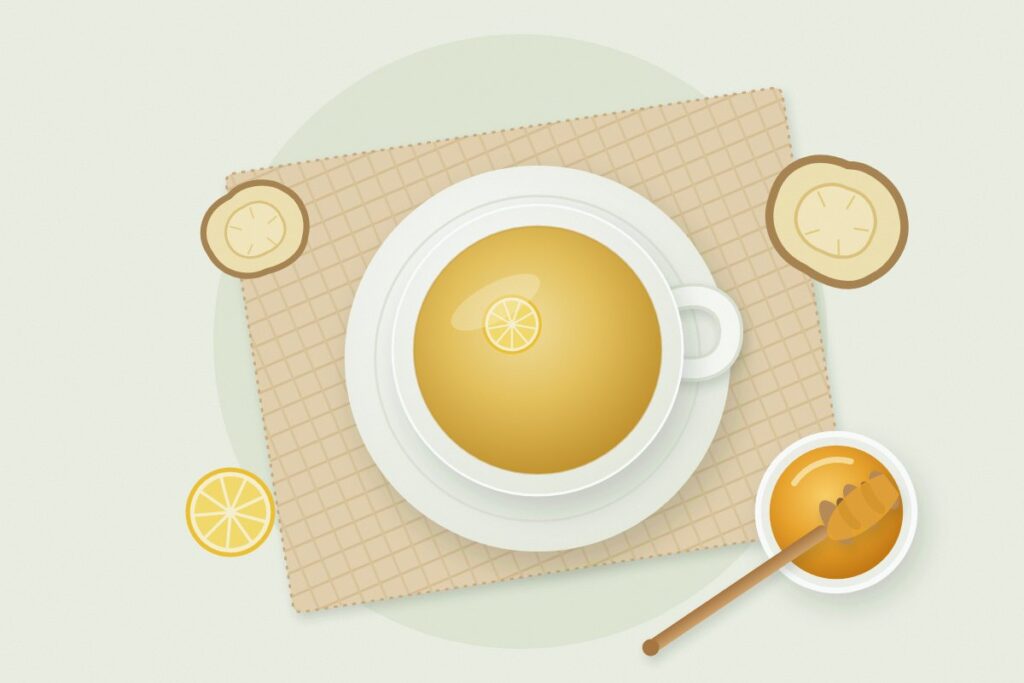
Ginger tea with lemon and honey
- Make ginger tea as described above.
- Add a slice of washed lemon or 1–2 teaspoons of lemon juice.
- Once the tea has cooled a little, stir in a teaspoon of honey, or more to taste.
Do not give honey to children under one year old, not even in tea. The US Centers for Disease Control and Prevention (CDC) advise this because of the risk of botulism.
Ginger also goes well with cinnamon, fresh mint or black tea, and it is one of the basic ingredients of spiced masala chai and chai latte. With turmeric, it goes into golden milk.
Tea from dried and ground ginger
Ground ginger, the kind you keep at home as a spice, is the quickest option. For one cup, use a quarter to half a teaspoon, about 0.5–1 g. Pour boiling water over it, stir and let it stand for 5–10 minutes. Recipes differ in the amount, so start with a smaller dose. The powder settles at the bottom, so pour the tea off carefully or strain it.
Dried pieces of ginger are simmered in the same way as fresh ginger. Fresh root is almost 80% water, so 10–15 g of fresh ginger corresponds to roughly 2–3 g of dried ginger.
According to the Austrian health portal, ground ginger keeps for at least two years in a tightly sealed container, depending on its quality.
How long fresh ginger lasts
Approximate times according to Iowa State University:
- At room temperature: a whole, unpeeled root keeps for 1–2 weeks.
- In the refrigerator: 4–6 weeks in a closed bag or container in the crisper drawer.
- Peeled or cut: 2–3 weeks tightly wrapped in the refrigerator.
- In the freezer: it keeps its best quality for about 3 months. Freeze it sliced, or grated in small portions, and squeeze the air out of the bag.
Throw away ginger that gets moldy, turns soft, changes color or smells unpleasant.
Ginger tea and its effects: what the EMA says
In May 2025, the Committee on Herbal Medicinal Products (HMPC) of the European Medicines Agency (EMA) adopted a revision of the European Union monograph on ginger rhizome. The monograph distinguishes two levels:
- Well-established use, which is based on clinical studies: preventing nausea and vomiting in motion sickness, the sickness caused by movement when traveling. It applies to adults and to a dose of 1–2 g of powdered ginger one hour before the journey. It is not recommended for children and adolescents under 18.
- Traditional use, which rests only on at least 30 years of use, including 15 years in the EU, and not on clinical studies: relief of motion sickness (from the age of 6), mild cramp-like digestive complaints including bloating and flatulence, temporary loss of appetite, mild joint pain and symptoms of the common cold. Apart from motion sickness, it applies to adults only.
Even for motion sickness, the evidence is not strong. The EMA assessment report acknowledges that the studies are old and weak by today’s standards. The US National Center for Complementary and Integrative Health (NCCIH) states that most studies on motion sickness have not confirmed a benefit of ginger.
What is more, the monograph covers medicines, that is, powdered ginger in measured doses and alcohol-based tinctures. Ginger tea is not one of them, and the amount of these compounds in a cup varies with the root and the way the tea is made. No health claim has been authorized in the European Union for foods containing ginger, including tea.
So drink ginger tea for its flavor and the feeling of warmth. If digestive complaints last longer than two weeks, the monograph recommends seeing a doctor. You will find other herbs for digestive complaints in Tea for digestion. We write about teas for a sore throat in Tea for a sore throat, and about echinacea and its use for colds in Echinacea tea.
Ginger tea and pregnancy
Ginger is one of the few herbs whose effect on pregnancy nausea has been studied in clinical trials. However, expert sources differ:
- NICE in the UK, in its guideline on antenatal care (2021), recommends that pregnant women with mild to moderate nausea and vomiting who want a non-drug option try ginger.
- The US NCCIH states that ginger may help with nausea in pregnancy and that ginger supplements may be safe during pregnancy. However, it recommends talking to a doctor.
- The EMA is more cautious. Data from 300–1,000 pregnancies do not suggest birth defects or harm to the unborn baby, but the animal studies are not sufficient. As a precaution, it therefore recommends not taking ginger as a medicine during pregnancy, and it does not recommend it during breastfeeding because there is not enough data.
If you want to drink ginger tea regularly during pregnancy, talk to your OB-GYN or midwife. Severe or prolonged vomiting is always a reason to see a doctor. We describe other herbs in Herbal tea during pregnancy.
When to avoid ginger
- Allergy: if you are allergic to ginger, do not drink it. This is the only contraindication listed in the EMA monograph.
- Sensitive stomach: the EMA lists stomach irritation, belching, indigestion, heartburn and nausea as common side effects (affecting 1 to 10 people in 100). If ginger gives you heartburn, make the tea weaker or skip it.
- Blood-thinning medication: the EMA does not list any interactions in the monograph and considers the reports so far inconclusive. However, the assessment report describes cases of people treated with warfarin or rivaroxaban, for example, who had bleeding after regularly eating ginger or drinking large amounts of ginger tea, in one case 2–3 liters a day. Official texts for some ginger medicines in Germany and the Netherlands warn against combining them with anticoagulant medicines. If you take such medication, talk to your doctor before you start drinking ginger regularly.
- Gallstones: the EMA monograph does not mention them. However, official texts for some ginger medicines in Germany recommend that people with gallstones talk to a doctor before using them.
- Children: the EMA does not recommend ginger as a medicine for children under 6 for motion sickness, or for children and adolescents under 18 for other complaints, because data are lacking. Ask your pediatrician about ginger tea for your child. You can read more in Herbal teas for children.
- Pregnancy and breastfeeding: see the section Ginger tea and pregnancy.
Sources
- European Medicines Agency (EMA), Committee on Herbal Medicinal Products (HMPC): European Union herbal monograph on Zingiber officinale Roscoe, rhizoma, revision 1 (EMA/HMPC/885789/2022), 2025.
- EMA, HMPC: Assessment report on Zingiber officinale Roscoe, rhizoma, revision 1 (EMA/HMPC/765220/2022), 2025.
- NICE: Antenatal care (NG201), recommendation 1.4.3, 2021.
- National Center for Complementary and Integrative Health (NCCIH): Ginger, 2025.
- US Department of Agriculture (USDA), FoodData Central: Ginger root, raw; Spices, ginger, ground.
- Iowa State University Extension and Outreach, AnswerLine: Storing Fresh Ginger, 2019.
- ÖKO-TEST: Ingwertee selber machen, 2025.
- Österreichisches Gesundheitsportal (gesundheit.gv.at): Ingwer.
- Centers for Disease Control and Prevention (CDC): Botulism – prevention.
- European Union Register of nutrition and health claims.
We wrote this article on November 25, 2026. It is for general information only. For details, see our Disclaimer.