Saffron tea: flavor, how to make it and what we know about its effects
Saffron tea is golden, lightly honeyed and needs just a few threads. Learn how to make it, how to spot real saffron and what the research says.
Contents
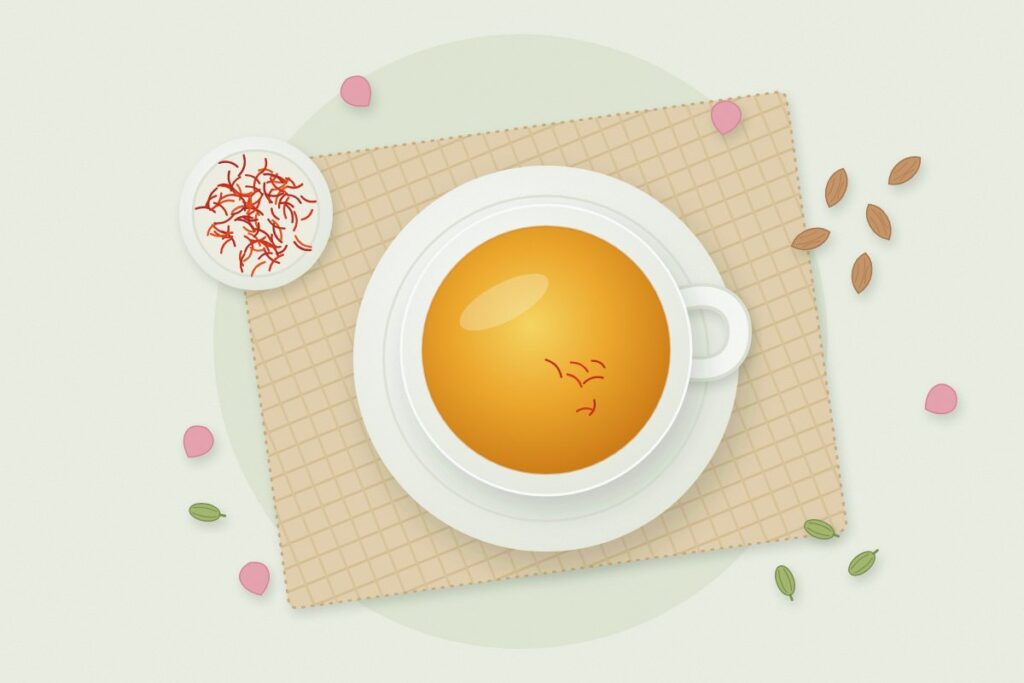
Saffron is the most expensive spice in the world, and tea made from it is one of the most beautiful drinks you can prepare at home. It has a golden-yellow color and a lightly honeyed aroma, and just a few threads are enough. In this article you will find where saffron comes from, how to make saffron tea, how to recognize real saffron and what studies have really found about its effects.
Important: this article is for general information and does not replace medical advice. If you are pregnant or take medication, read the section When to be careful.
What is saffron
Saffron is the dried stigmas of the saffron crocus flower (Crocus sativus). Each flower has only three dark red stigmas, and they are picked by hand during a short flowering period in autumn, usually in October and November. About 150,000 flowers are needed for one kilogram of saffron. That is why it is so expensive.
Most saffron today is grown in Iran. Smaller amounts come from, for example, Spain, Greece, Indian Kashmir or Afghanistan. People have used it for thousands of years: for cooking, for dyeing fabrics and in perfumes.
The color of saffron comes from crocin, the slightly bitter taste from picrocrocin and the aroma from safranal. All of them are very intense, so a really small amount is enough for a cup of tea.
What saffron tea tastes like
Saffron tea tastes lightly honeyed and floral, with a grassy to earthy undertone and a slight bitterness at the end. If you use too much saffron, the flavor turns sharply bitter, almost medicinal. Less really is more here.
Saffron goes well with green tea, cardamom, cinnamon, rose, lemon and honey. In Indian Kashmir people drink kahwa, a green tea with saffron, cardamom, cinnamon and almonds. We describe more teas from India in the article Seven teas from India.
How to make saffron tea
For one cup (200–250 ml), 4 to 8 threads of saffron are enough.
- Crush the threads lightly between your fingers or in a mortar.
- Pour a spoonful of hot, not boiling, water over them and let them sit for 10–20 minutes. The saffron slowly releases its color and aroma.
- Add the rest of the water at about 90 °C (194 °F) and let it steep for another 5 minutes.
- Add honey or a slice of lemon to taste. The threads can stay in the cup.
Saffron with green tea
Make green tea as usual, that is 2–3 g of leaves per cup, water at 70–80 °C (158–176 °F) and 2–3 minutes of steeping. Then pour the saffron infusion from the first two steps into it. You will find the exact times and temperatures for individual types in the article How long to steep tea.
Saffron with spices
Add a crushed cardamom pod or a piece of cinnamon to the water. Tea made this way is more pronounced and is especially good on colder days.
Cold saffron tea
Put the threads in a glass of cold water and leave them in the refrigerator overnight. In the morning you will have a delicate golden drink, to which you can add lemon and mint. You will find more summer ideas in the article Iced tea.
How to recognize real saffron
Saffron is expensive, which is why it is one of the most frequently adulterated foods. When buying, look for these signs:
- Real threads are dark red, 2–3 cm long and widen into a funnel shape at one end.
- In water, real saffron slowly colors it golden yellow while the thread stays red. If the water turns red right away and the thread fades, it is probably a dye.
- Buy whole threads, not ground saffron. It is much easier to mix turmeric, paprika or other cheap ingredients into a powder.
- Cheap “saffron” is almost always a substitute. Most often it is safflower, also called false saffron, or dyed corn silk.
The quality of saffron is graded by the international standard ISO 3632. It divides saffron into categories by color, bitterness and aroma. If the seller states it, that is a good sign.
Store saffron in a small closed container in a dark, dry place. It keeps like this for up to two years, but the aroma gradually weakens. You can read more about storing tea and spices in the article How to store loose leaf tea.
What we know about the effects of saffron
In Persian, Indian and European tradition, saffron was used for many complaints. Today’s research is interested mainly in its effect on mood. Reviews of studies describe promising results, but also point out their weaknesses. The studies were small and short, mostly came from one country and examined capsules with a standardized extract, most often 30 mg a day.
A cup of tea made from four to eight threads is not the same as an extract in a capsule, and nobody has properly studied the effects of the tea yet. In addition, no health claim for saffron has been approved in the European Union.
So drink saffron tea for the taste, the aroma and a pleasant moment. If you are troubled by sadness, anxiety or premenstrual complaints, see a doctor. Do not take saffron supplements on your own, especially if you take medication.
When to be careful
- Pregnancy: in the usual amount in food, saffron is considered safe. In large doses, however, it may cause uterine contractions. During pregnancy, therefore, do not drink saffron in larger amounts and avoid saffron supplements. More in the article Which herbal teas to drink during pregnancy.
- Medication: if you take medication for depression, for blood pressure or blood thinners, talk to your doctor before drinking larger amounts of saffron or taking supplements with it.
- Large amounts: in the kitchen, saffron is used in milligrams. A review of toxicology studies gives up to 1.5 g a day as a safe amount and reports poisoning at doses of 5 g and more. Ordinary saffron tea is very far from these amounts.
- Side effects: in studies with supplements, dry mouth, nausea, headache or a change in appetite occasionally appeared. Allergy to saffron is rare. If you do not feel well after it, stop drinking it.
Sources
- Bostan H. B., Mehri S., Hosseinzadeh H.: Toxicology effects of saffron and its constituents: a review. Iranian Journal of Basic Medical Sciences, 2017.
- Marx W. et al.: Effect of saffron supplementation on symptoms of depression and anxiety: a systematic review and meta-analysis. Nutrition Reviews, 2019.
- ISO 3632 – Saffron (Crocus sativus L.), specification and test methods.
- European Union Register of nutrition and health claims.
We revised this article on November 24, 2026. It is for general information only. For details, see our Disclaimer.