Iced tea: hot and cold brew methods, recipes and storage
Two ways to make iced tea, tried and tested recipes and the rules that will make it both tasty and safe.
Contents
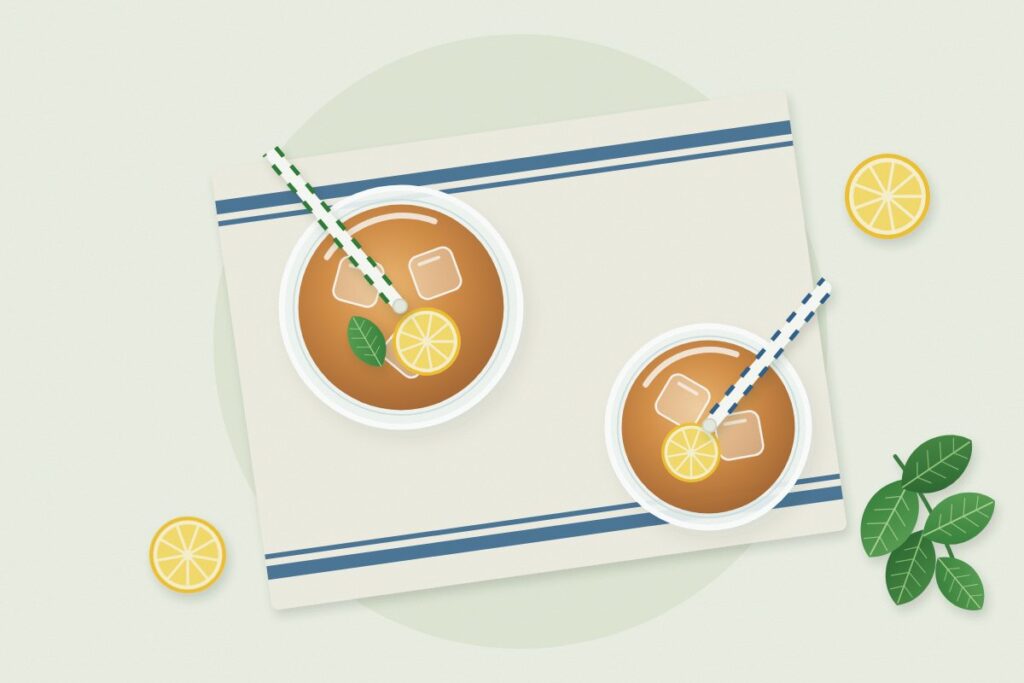
In summer, iced tea is one of the best ways to drink enough without reaching for sweetened soft drinks. You can make it at home from black, green, white or herbal tea in two ways: by brewing it hot and chilling it quickly, or by steeping it slowly in cold water. In this article you will find both methods, a few recipes and the rules that will make your iced tea both tasty and safe.
Where iced tea came from
It is often said that iced tea was invented at the 1904 World’s Fair in St. Louis. That is not quite true. Recipes for tea with ice appear in American cookbooks as early as the 1870s. The book Housekeeping in Old Virginia, for example, advises pouring boiling water over green tea and then pouring it into glasses with ice and sugar. At the fair in St. Louis, tea merchant Richard Blechynden served chilled tea during a heat wave and helped it become hugely popular.
Today, iced tea in the US is made mostly from black tea. In the South, sweet tea is popular; it is sweetened while still hot. Store-bought iced teas are usually sweetened too. At home, you decide for yourself whether to add sugar and how much.
Which tea to use
- Black tea is the classic. It has a full flavor that stands up well to ice and lemon. Flavored Earl Grey works well too.
- Green tea is fresher and lighter. When cold brewed, it does not turn bitter even with a longer steeping time. More about it in the article Green tea.
- White tea and oolong have a delicate, often floral flavor that comes through well in a cold infusion.
- Herbs and fruit contain no caffeine. Mint, hibiscus, rooibos or fruit blends are excellent. Special rules apply to them, however; see below.
Method 1: hot infusion and ice
This method is quick and the tea has a full flavor. You make an infusion twice as strong as usual and pour it over ice, which dilutes it to normal strength.
For about 1 liter of black tea:
- Put 15–20 g of leaves in a teapot.
- Pour 500 ml of water at 95–100 °C (203–212 °F) over them and let them steep for 3–4 minutes.
- If you want to sweeten the tea, dissolve the sugar or honey now, while the infusion is hot.
- Strain it into a pitcher containing about 500 g of ice.
For green tea, use water at 70–80 °C (158–176 °F) and steep for 2–3 minutes. You will find temperatures and times for other types in the article How long to steep tea.
Method 2: cold brewing
With cold brewing, you leave the leaves in cold water in the refrigerator for several hours.
- Put 7–10 g of leaves per 1 liter of cold drinking water in a glass bottle or pitcher.
- Close it and put it in the refrigerator.
- Let green and white tea steep for about 6–8 hours, black tea and oolong for 8–12 hours.
- Strain and throw away the leaves.
Cold water releases substances from the leaves more slowly. The tea is therefore gentler, less astringent and less bitter, and it usually contains less caffeine than a hot infusion. In tastings that were part of studies, people often preferred it to a hot infusion poured over ice.
Cold brewing is only suitable for tea from the tea plant. Even then, care is needed, because there is no step that would destroy any bacteria. In 2023, the Austrian Agency for Health and Food Safety (AGES) checked 40 teas and herbal teas intended for cold preparation. None of them failed, but the agency warns about this risk. So use good-quality tea and a clean container, and always cold brew your tea in the refrigerator, not at room temperature.
Herbs and fruit: boiling water first
Herbal and fruit teas can occasionally contain bacteria such as salmonella. The German Federal Institute for Risk Assessment (BfR) therefore recommends always making them with boiling water and steeping them for at least 5 minutes. For iced tea, make them using the hot method and then chill them. The exception is products that the manufacturer has explicitly labeled for cold brewing. More about fruit teas in the article Fruit tea: what it is made of and how to make it hot or cold.
Recipes
- Black tea with lemon and mint: make black tea using the first method. Add lemon slices and a sprig of mint to the pitcher and sweeten with honey to taste.
- Green tea with peach: cold brew green tea overnight in the refrigerator. Before serving, add slices of ripe peach and a basil leaf.
- Hibiscus with orange: pour 500 ml of boiling water over 15–20 g of hibiscus, strain after 10 minutes, and add ice and orange slices. More in the article Hibiscus tea.
- Rooibos with vanilla: steep rooibos in boiling water for 6–8 minutes, let it cool and serve it with ice and a piece of vanilla bean or orange peel. More in the article Rooibos tea.
- Tea lemonade: mix chilled black or fruit tea 1:1 with sparkling water and add lemon juice.
If you do not want to add sugar, give the drink a gentle sweetness with cinnamon, citrus peel, mint or pieces of fresh fruit. Simple syrup (sugar boiled with an equal amount of water) is good for sweetening cold tea, because sugar dissolves poorly in a cold drink.
Why iced tea turns cloudy
Strong black tea sometimes turns cloudy when chilled quickly. The caffeine and tannins in the tea bind together in the cooled infusion and form a fine haze. It is harmless and only affects the appearance. It appears less often with cold brewing and with softer water.
How to store iced tea
- Keep finished iced tea in a closed container in the refrigerator and drink it within 1–2 days.
- Do not leave it at room temperature or in the sun for long.
- Do not make so-called sun tea, which is steeped in a container in the sun. The water only warms up to a temperature at which bacteria are not destroyed but, on the contrary, multiply well.
- If the tea thickens, turns slimy or smells strange, pour it out.
- Wash containers and bottles thoroughly.
Remember that iced tea made from the tea plant contains caffeine. A large pitcher drunk over a hot afternoon may contain more of it than you would expect. You will find how much caffeine the individual types contain in the article How much caffeine is in tea. For children and for the evening, choose herbs or fruit.
Sources
- Lantano C. et al.: Effects of alternative steeping methods on composition, antioxidant property and colour of green, black and oolong tea infusions. Journal of Food Science and Technology, 2015.
- Austrian Agency for Health and Food Safety (AGES): Mikrobiologie von Tee und Kräutertee, die kalt zubereitet werden (Microbiology of teas and herbal teas prepared cold). Report on targeted inspection A-033-23, 2023.
- German Federal Institute for Risk Assessment (BfR): Boiling water a must for herbal teas. Press release, 2005.
- Tyree M. C. (ed.): Housekeeping in Old Virginia. Cookbook, 1879.
We revised this article on November 24, 2026. It is for general information only. For details, see our Disclaimer.