Lavender tea: how to make it from dried or fresh lavender and what we know about its effects
How to make tea from dried or fresh lavender, why to use English lavender and not Spanish lavender (Lavandula stoechas), what the EMA says about its effects and when to be careful.
Contents
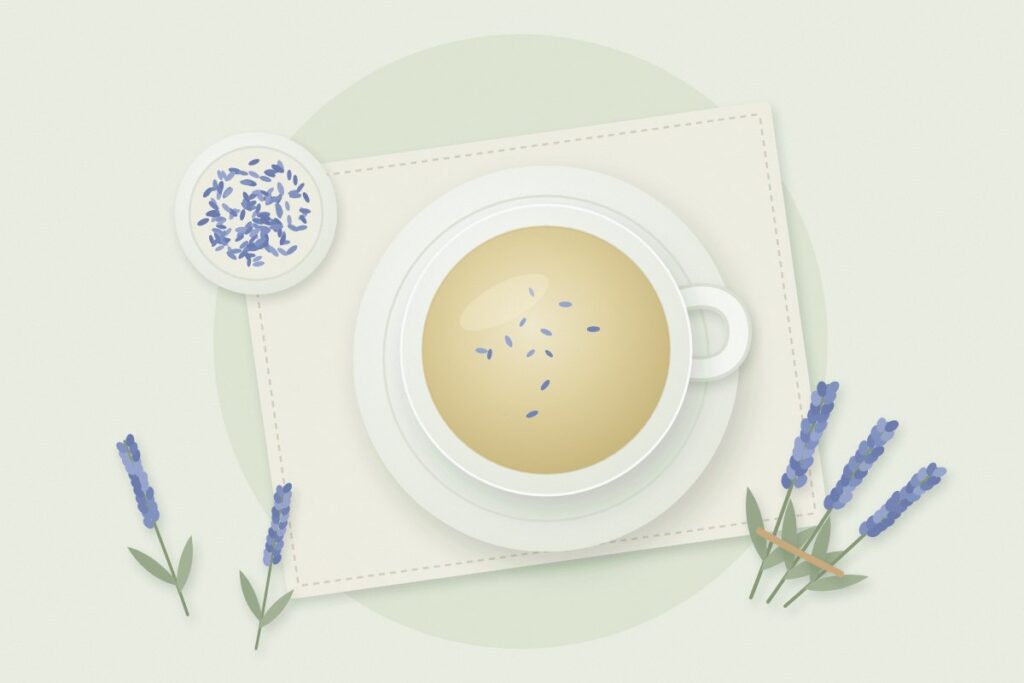
To make lavender tea, use 1–2 g of dried English lavender flowers, which is about one teaspoon. Pour a cup of boiling water over them and let them steep for about 5 minutes. If you use too many flowers or steep the tea for too long, it tastes like soap. The European Medicines Agency (EMA) lists the traditional use of lavender flower for mild symptoms of stress and to support sleep, but clinical studies have not proven that it works.
You probably know lavender from sachets for the closet, from soaps and from purple fields in photos of Provence. In this article you will find which lavender is right for tea, how to make it from dried and fresh flowers, when and where to pick lavender, what we know about its effects, and when to be careful.
Important: this article is for general information and does not replace medical advice. Never drink lavender essential oil or add it to tea. If you take medicines, want to give the tea to a child, or are pregnant or breastfeeding, read the section Side effects and when to be careful.
Which lavender to use for tea
Tea is made from the dried flowers of English lavender (Lavandula angustifolia), also called true lavender or narrow-leaved lavender. An older Latin name for it is Lavandula officinalis. This is the flower that the EMA monograph and the European Pharmacopoeia refer to. It comes from the Mediterranean and is now grown all over Europe. Its name is often linked to the Latin word lavare, to wash. Lavender has been added to baths and laundry water since ancient times.
Other types of lavender grow in gardens and fields, too. The surest way to tell them apart is by the Latin name on the plant label. They differ mainly in the composition of their essential oil, which determines both the scent and the flavor of the tea.
| Lavender | Latin name | Camphor in the essential oil | For tea |
|---|---|---|---|
| English lavender (true lavender) | Lavandula angustifolia | 0–1.7% | yes, the EMA monograph covers it |
| lavandin | Lavandula × intermedia | 2.5–11.1% | less suitable, sharper taste |
| Spanish or French lavender | Lavandula stoechas | 7.9–51.6% | no |
The camphor ranges come from a review by Batiha et al. (2023). The composition of the oil varies with the variety, the location and the year.
Lavandin
Fields are often planted with lavandin (Lavandula × intermedia). It is a sterile hybrid of English lavender and spike lavender. It has more camphor and a sharper scent, and it is less suitable for tea. So buy lavender intended for drinking, not flowers from decorative sachets, which may have been treated or scented.
Spanish lavender (Lavandula stoechas)
You can recognize Spanish lavender by the striking “ears” at the top of the flower spike. These are four sterile bracts, about 2.5 cm long. In stores it is sold as Spanish lavender or French lavender. The name French lavender is also used for other species, so go by the Latin name. Its essential oil is dominated by fenchone and camphor, while it contains little or no linalool and linalyl acetate, which are typical of English lavender.
Do not use it for tea. There is no EMA monograph for it, and two cases of health problems after drinking tea made from it have been described in Turkey: one involved a markedly fast heart rate, the other acute kidney injury. These are case reports, that is, individual cases that do not prove cause and effect.
What lavender tea tastes like
Lavender tea is distinctly floral, with a slightly bitter, herbal note. If you use too many flowers or steep it too long, the taste turns bitter and soapy. That is why lavender is often just one ingredient in a tea blend.
It combines well with:
- chamomile and lemon balm for an evening herbal tea,
- black tea, for example in lavender Earl Grey (read more in Earl Grey tea),
- lemon, honey or fresh mint,
- green tea in delicate floral blends.
How to make lavender tea
- For a cup (150–200 ml), use at most 1 teaspoon of dried flowers, about 1–2 g. If you have never had lavender before, start with half.
- Pour boiling water over the flowers.
- Cover the cup and steep for about 5 minutes. Steeping longer makes the tea bitter.
- Strain, and add honey or lemon to taste.
Boiling water for herbal teas is recommended by the German Federal Institute for Risk Assessment (BfR), because in rare cases dried plants can carry bacteria such as salmonella. The EMA monograph specifies 1–2 g of the flower in 150 ml of boiling water, three times a day, for adults and adolescents.
For a blend with black tea, a few flowers per cup are enough. Steep it as you would the black tea, that is 3–5 minutes at 95–100 °C (203–212 °F). You will find times for other types in How long to steep tea.
Evening tea with lavender: a recipe
For a mug (250 ml), use half a teaspoon of dried lavender, one teaspoon of chamomile and one teaspoon of lemon balm. Pour boiling water over them, cover and steep for 5 minutes. A small amount of lavender gives the tea its scent without overpowering the other herbs. Chamomile adds a gentle sweetness and lemon balm a lemony scent.
Tea from fresh lavender
In summer, you can also make lavender tea from fresh flowers. Use only English lavender that you know has not been sprayed (see When and where to pick lavender).
- Cut one or two flower spikes that are just starting to bloom.
- Rinse them briefly in cold water and strip the flowers off the stem with your fingers, straight into the cup. Tea is made from the flowers, not the leaves or stems.
- Pour boiling water over them, cover the cup and steep for about 5 minutes.
- If the tea is weak, add another spike next time. If it is bitter, use fewer flowers.
Fresh flowers contain a lot of water, so the amount for dried flowers (1–2 g) cannot simply be converted. No official source gives an amount for fresh lavender, so it is better to start with less.
When and where to pick lavender for tea
Lavender blooms in summer. According to the University of Illinois Extension, cut the stems when the flowers on the spike are starting to open, because that is when the spikes are most fragrant. Pick in dry weather.
- Only from untreated plants. The consumer advice center in South Tyrol recommends using only flowers from plants that have not been sprayed. The safest choice is lavender from your own garden or balcony.
- Not from public flower beds. With lavender in parks, on traffic circles or along roads, you do not know whether it was treated, or with what.
- Not from a florist or garden center. Potted lavender is usually sold as an ornamental plant, and growing ornamental plants allows products that are banned or restricted for food. In 2025, the magazine Öko-Test tested 16 lavender plants from German garden centers and home improvement stores and found pesticide residues in most of them, with as many as 11 different substances in one plant. According to the BfR, the EU has not set maximum residue levels for cut flowers as it has for food.
- Check the label. A crossed-out knife and fork on the pot means the plant is not meant to be eaten.
Tie the spikes into small bunches and hang them in a cool, dry, dark and well-ventilated place. Strip the dried flowers off the stems and store them in an airtight container. Read more in How to store loose leaf tea.
Lavender tea and its effects: what we know
The European Medicines Agency (EMA) published a monograph on lavender flower in 2012. It states that lavender is traditionally used to relieve mild symptoms of mental stress and exhaustion and to support sleep. Traditional use means it has been used this way for at least 30 years, including 15 years in the EU. It is based on long experience, not on clinical studies.
The studies on lavender that are often cited mostly examined lavender oil in capsules or the scent of lavender. Not tea. Their results therefore do not automatically apply to a cup of tea. Even for the oil, the EMA stated in its assessment that studies suggested a possible effect on anxiety, stress and insomnia, but had too few participants.
What a study with lavender tea found
Lavender tea itself has been studied very little. In a 2015 study from Taiwan, 40 women who had recently given birth and were sleeping poorly drank one cup of lavender tea a day for two weeks. Another 40 women received only usual care, with no placebo. After two weeks, the women who drank the tea reported less fatigue and lower scores on a depression scale, but after four weeks the groups no longer differed. The EMA assessed this study in its periodic review in 2020 and did not change the monograph.
No health claims are authorized in the EU for herbal teas, including lavender tea; claims for plant substances are on hold. Still, a warm, caffeine-free drink can be a pleasant part of an evening bedtime ritual. If you have trouble with sleep or stress for longer than two weeks, see a doctor. We describe other herbs for the evening in our articles on chamomile, linden and peppermint tea.
Side effects and when to be careful
For lavender flower, the EMA lists no known side effects and no reported interactions with medicines. In its 2020 review, it found only six reports involving English lavender in the European EudraVigilance reporting database for the years 1996–2020, always together with other herbs, and saw no reason in them to change the monograph. Even so:
- Sedatives, sleeping pills and antidepressants: if you take them, talk to your doctor about lavender. In 2021, doctors in Australia described the case of a person taking the antidepressant sertraline who developed symptoms of serotonin toxicity after drinking lavender tea. They described the link as only possible.
- Driving: for medicines made from lavender flower, the EMA warns that they may impair the ability to drive and use machines. There are no studies on this.
- Essential oil: lavender oil is very concentrated and is not meant for drinking. Do not add it to tea or food.
- Allergy: lavender belongs to the mint family (Lamiaceae), like peppermint, rosemary and sage. Allergy is rare, but if you do not feel well after the tea, stop drinking it.
- Other types of lavender: make tea only from English lavender (Lavandula angustifolia), not from Spanish lavender (Lavandula stoechas).
Can children drink lavender tea?
The EMA does not recommend medicines made from lavender flower for children under 12 because there is not enough data. According to the EMA, lavender oil is also intended only for adults and children aged 12 and over. Do not give lavender to younger children without talking to a doctor.
Babies under six months do not need tea, only breast milk or formula. Do not add honey to tea for children under one year old; the World Health Organization (WHO) warns about infant botulism. Read more in Herbal teas for children and babies.
Lavender tea during pregnancy and breastfeeding
The safety of lavender flower during pregnancy and breastfeeding has not been established, and because of a lack of data, the EMA does not recommend it as a medicine during this time. That is not proof that it is harmful, but a matter of caution. Talk to your doctor before drinking lavender tea. Read more in Which herbal teas to drink during pregnancy.
Important: if you are pregnant or breastfeeding, have a long-term illness or take medicines, or if the tea is for a child, talk to a doctor or pharmacist about drinking lavender tea regularly.
You will find more herbs in the Herbs category.
Sources
- European Medicines Agency (EMA), Committee on Herbal Medicinal Products (HMPC) – European Union herbal monograph on lavender flower (Lavandula angustifolia Mill., flos), EMA/HMPC/734125/2010, 2012.
- EMA, HMPC – addendum to the assessment report on lavender flower (periodic review), EMA/HMPC/487394/2020, 2020.
- European Medicines Agency (EMA) – summary for the public on lavender oil (Lavandulae aetheroleum), EMA/HMPC/530968/2012.
- Batiha G. E. et al.: A review of the bioactive components and pharmacological properties of Lavandula species. Naunyn-Schmiedeberg’s Archives of Pharmacology, 2023.
- El Omari N. et al.: Fenchone and camphor: Main natural compounds from Lavandula stoechas L., expediting multiple in vitro biological activities. Heliyon, 2023.
- Royal Horticultural Society (RHS): Lavandula stoechas.
- Acikalin A. et al.: Anticholinergic syndrome and supraventricular tachycardia caused by lavender tea toxicity. Keio Journal of Medicine, 2012.
- Ozer H. et al.: Unknown criminals for kidney: Acute interstitial nephritis due to lavender tea. Explore, 2023.
- Seet H. R., Rotella J. A.: Moderate serotonin toxicity precipitated by a possible interaction between lavender tea and sertraline. Emergency Medicine Australasia, 2021.
- Chen S. L., Chen C. H.: Effects of Lavender Tea on Fatigue, Depression, and Maternal-Infant Attachment in Sleep-Disturbed Postnatal Women. Worldviews on Evidence-Based Nursing, 2015.
- German Federal Institute for Risk Assessment (BfR): Boiling water a must for herbal teas. Press release, 2005.
- BfR: Bewertung gesundheitlicher Risiken von Pestizidrückständen auf Schnittblumen. Opinion No 013/2021.
- Öko-Test: test of lavender plants from garden centers and home improvement stores, issue 6/2025.
- Öko-Test (dpa): Kräuter aus dem Supermarkt – Warum Sie das Etikett immer prüfen sollten, 2026.
- Verbraucherzentrale Südtirol: Sind Blüten essbar?
- University of Illinois Extension: Herb Gardening – Lavender.
- WHO – Botulism, 2023; Infant and young child feeding.
- Regulation (EC) No 1924/2006 on nutrition and health claims made on foods; EU Register of nutrition and health claims.
We updated this article on November 25, 2026. It is for general information only. For details, see our Disclaimer.