Linden tea: when to harvest linden flowers, how to make it and what we know about its effects
When to pick linden flowers, how to dry them and make linden tea, which lindens are suitable, and what the European Medicines Agency actually says about it.
Contents
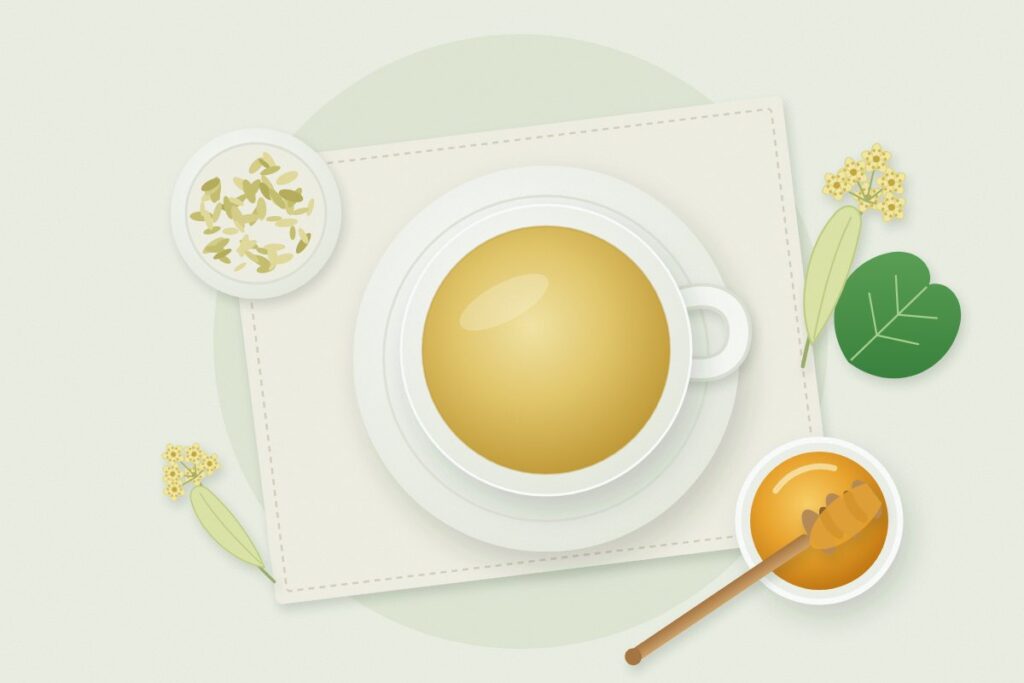
Linden tea, also known as linden flower tea or lime blossom tea, is made from the dried flower clusters of small-leaved or large-leaved linden, which are picked together with their pale, papery bract. For one cup, one teaspoon of flowers (about 1.5–2 g) is enough: pour boiling water over it and let it steep for 5–10 minutes. Harvest linden in full bloom, usually in June and July, and dry it in the shade.
In this article you will find which lindens are suitable for tea, when and how to harvest and dry linden flowers, how to make the tea with honey, and what the European Medicines Agency (EMA) actually says about its effects. You will find more herbs in our Herbs category.
Important: this article is for general information and does not replace medical advice. If the tea is for a child, or if you are pregnant, breastfeeding or ill, read the section When not to drink linden tea.
Which lindens are used for tea
The European Pharmacopoeia describes linden flower as the whole dried flower clusters of small-leaved linden (Tilia cordata), large-leaved linden (Tilia platyphyllos), their hybrid, common linden (Tilia × vulgaris, also called European linden), or a mixture of these. The EMA monograph lists the same three lindens. According to the Bavarian State Institute of Forestry (LWF), the flowers of both native species contain almost the same constituents, so in practice no distinction is made between them.
According to the pharmacopoeia, linden flower has a faint aromatic scent and a delicately sweetish, slightly mucilaginous taste. The mucilage is found mainly in the bract, which is part of linden flower.
Small-leaved or large-leaved linden
Both lindens are native to Central Europe and grow in forests as well as in parks and along avenues. You can tell them apart by their leaves and flowers:
| Feature | Small-leaved linden | Large-leaved linden |
|---|---|---|
| Leaves | smaller, about 4–7 cm, gray-green underneath | larger, about 6–11 cm, green underneath |
| Tufts of hair in the vein axils on the underside of the leaf | rusty brown | whitish to yellowish |
| Flower cluster | upright or spreading, usually 5–8 flowers | drooping, 2–7 flowers |
| Flowering | June–July | June, about 10–15 days earlier |
Silver linden (Tilia tomentosa), which is planted in parks and along avenues, is not suitable for tea. You can recognize it by its leaves, which are covered in grayish-white felt underneath, and it flowers later than the native lindens. In 2012, the EMA did not adopt a monograph for it because it does not meet the conditions for traditional use.
When to harvest linden flowers
Linden flowers are harvested in full bloom, when most of the flowers in the cluster have opened. According to the Bavarian institute LWF, large-leaved linden is in full bloom roughly in the second half of June and small-leaved linden in the first half of July. The exact timing depends on the weather and altitude.
The same source recommends picking them as soon as possible after flowering begins, ideally within one day and no later than four days. At that point the flowers have a particularly pleasant, honey-like scent.
- Pick the whole flower cluster, including the bract and stalks.
- Harvest in dry weather. Wet flowers dry slowly and go moldy easily.
- Avoid trees next to busy roads and flower clusters that have already finished flowering and are starting to set fruit.
- Only pick lindens you can identify with certainty. Leave silver linden alone.
How to dry and store linden flowers
Spread the flower clusters in a thin layer on paper or a screen and let them dry in a shady, airy place. Turn them carefully a few times while they dry. The LWF considers a short final drying in a dehydrator acceptable at a maximum of 45 °C (113 °F).
Store the dried flowers somewhere dry and dark, ideally in a closed glass or porcelain container. According to the EMA assessment report, the aromatic compounds in linden flower break down quickly in damp conditions. You can read more in How to store loose leaf tea.
How to make linden tea
- For a cup (150 ml), use 1 teaspoon of linden flowers, which is about 1.5–2 g. For a larger mug (250 ml), use about 1.5 teaspoons.
- Pour boiling water over them.
- Cover the cup with a saucer so the aroma does not escape, and steep for 5–10 minutes. For a stronger flavor, steep for up to 15 minutes.
- Strain the tea and let it cool a little before drinking.
The EMA monograph is based on 1.5 g of crushed flowers in 150 ml of boiling water, 2 to 4 times a day for adults and adolescents. According to the package leaflet of a German pharmacy linden tea, a teaspoon holds about 1.8 g and the tea is steeped for 10–15 minutes.
Do not drink it boiling hot. In 2016, the International Agency for Research on Cancer (IARC) classified drinking very hot beverages above 65 °C (149 °F) as probably carcinogenic. You can read more in Tea for a sore throat.
Linden tea with honey
Linden tea is often sweetened with honey. Do not add honey to boiling water; stir it into tea that has cooled a little. When honey is heated, its natural enzymes break down, for example diastase, which quality control uses to check whether honey has been overheated. The EU Honey Directive even prohibits selling honey as honey if it has been heated so much that its enzymes have been destroyed or significantly weakened. The exception is baker’s honey.
Do not give honey to children under one year of age. The World Health Organization (WHO) warns against it because of the risk of infant botulism.
What to blend linden with
In Germany and Switzerland, linden flower is traditionally blended with elderflower, chamomile or mint.
Linden tea and its effects: what the EMA says
In 2012, the EMA’s Committee on Herbal Medicinal Products (HMPC) published a monograph on linden flower. In it, linden flower is recognized as a traditional herbal medicine for two uses:
- to relieve the symptoms of the common cold,
- to relieve mild symptoms of mental stress.
Traditional use means that linden flower has been used this way for at least 30 years, including at least 15 years in the European Union, and is considered sufficiently safe. However, clinical studies have not proven that it works. According to the EMA assessment report, no conclusion on its effectiveness can be drawn because of a lack of data. In 2022, the committee reviewed the monograph and found no new data that would require it to be changed.
In folk tradition, linden tea has been drunk hot as a “sweating tea” since the Middle Ages, but there are no reliable studies to back this up. There is also no approved health claim for linden on foods in the EU. So enjoy linden tea mainly for its delicate flavor and aroma. What the EMA says about echinacea, which is also associated with colds, is covered in Echinacea tea.
Linden tea for children
For colds, the EMA monograph gives a lower dose for children aged 4 to 12: 1 g of linden flower in 150 ml of boiling water, 2 to 4 times a day. It does not recommend it for children under 4 because there is not enough data. We compare linden with other herbs for colds in Tea for colds. For mental stress, it is not recommended for children under 12.
Babies under six months do not need tea, only breast milk or formula. If you want to give linden tea to a young child, talk to your pediatrician and make it weaker, unsweetened and without honey. You can read more in Herbal teas for children and babies.
Linden tea during pregnancy and breastfeeding
According to the EMA, the safety of linden flower during pregnancy and breastfeeding has not been established, so the EMA does not recommend it as a medicine during this time. This is not evidence that it is harmful, but a precaution due to the lack of studies. If you enjoy linden tea, talk to your doctor. You can read more in Herbal tea during pregnancy.
Side effects and when not to drink linden tea
The EMA monograph lists no known side effects, interactions with medicines or cases of overdose. Even so, keep the following in mind:
- Allergy: if you are hypersensitive to linden, do not drink linden tea. Small-leaved linden pollen is a known allergen, and a case of allergy after contact with dried flowers has also been described.
- A cold that does not go away: if symptoms last longer than a week or get worse, see a doctor. If you have shortness of breath, a high fever or purulent phlegm, see a doctor right away.
- Stress and nervousness: if symptoms persist, talk to a doctor.
- Heart: you may read online that people with heart disease should not drink linden tea. The EMA assessment report states that the scientific basis for this older warning is unknown. If you are being treated for a heart condition, talk to your doctor.
Sources
- European Medicines Agency (EMA), Committee on Herbal Medicinal Products (HMPC) – Community herbal monograph on linden flower (Tiliae flos), EMA/HMPC/337066/2011, 2012.
- EMA, HMPC – assessment report on linden flower, EMA/HMPC/337067/2011, 2012, and the addendum following the periodic review, EMA/HMPC/176303/2022, 2022.
- EMA, HMPC – public statement on silver linden (Tilia tomentosa), EMA/HMPC/510064/2011, 2012.
- World Health Organization (WHO) – WHO monographs on medicinal plants commonly used in the Newly Independent States (NIS), Flos Tiliae, 2010.
- Lagoni N.: Die Linde – ein bewährter Heilmittellieferant. LWF Wissen 78, Bayerische Landesanstalt für Wald und Forstwirtschaft, 2016.
- Botany.cz – species descriptions of lípa srdčitá (Tilia cordata), lípa velkolistá (Tilia platyphyllos) and lípa plstnatá (Tilia tomentosa).
- Package leaflet of a German medicinal linden flower tea (Lindenblütentee).
- Council Directive 2001/110/EC relating to honey, as amended by Directive 2014/63/EU.
- WHO – Botulism fact sheet, 2023.
- International Agency for Research on Cancer (IARC) – evaluation of drinking very hot beverages, 2016.
- Regulation (EC) No 1924/2006 on nutrition and health claims made on foods and the EU Register of nutrition and health claims.
We wrote this article on November 25, 2026. It is for general information only. For details, see our Disclaimer.