Tea for sleep and relaxation: lemon balm, lavender, valerian, passionflower and hops
Which herbs people drink as a tea for sleep, how much to use per cup and what the EMA says about children and pregnancy. In episode 2 of the Tea Tales comic, Kettie cannot fall asleep after black tea.
Contents
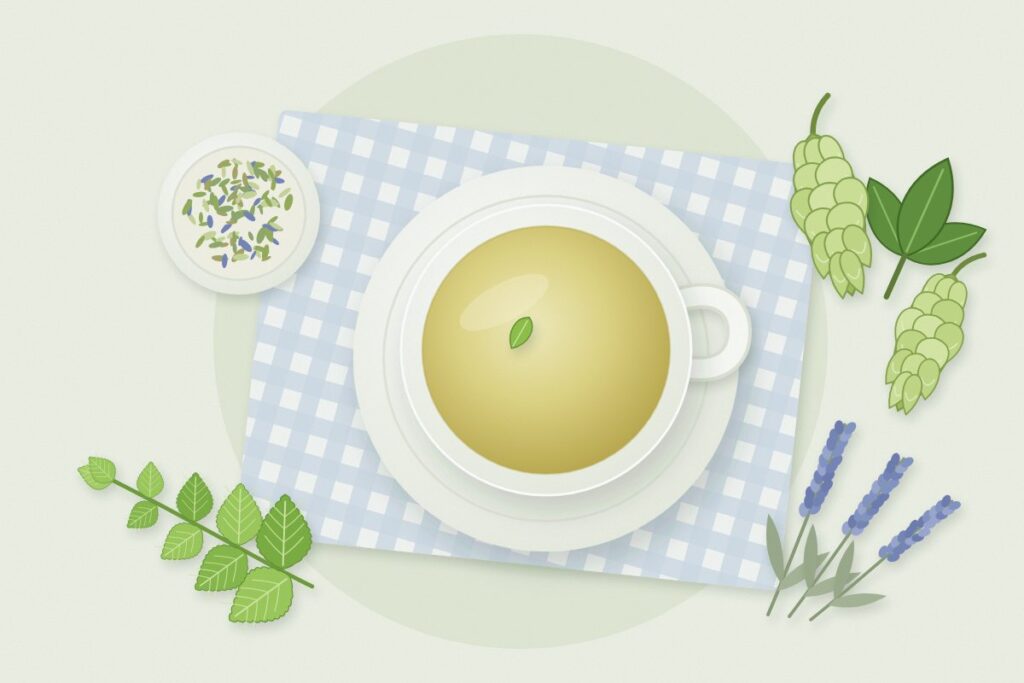
The most popular herbal teas for sleep are made from lemon balm, lavender, valerian root, passionflower and hops, on their own or in blends. The European Medicines Agency (EMA) lists them as traditional herbal medicines for relieving mild symptoms of stress and to aid sleep, but clinical studies have not proven that the tea works. None of them is a cure for insomnia, and none is guaranteed to put you to sleep.
A caffeine-free evening
Before you reach for herbs, take a look at what you drink in the afternoon and evening. Caffeine is not only in coffee and cola but also in teas from the tea plant, and if you are a light sleeper, even a late cup may disturb your sleep. Episode 2 of our Tea Tales shows how that turned out for Kettie, and you can find out how much caffeine each tea contains in our article Caffeine in tea.
Tea Tales, episode 2: Kettie and the evening tea
Kettie: It’s nine in the evening. Time for one more cup of black tea!
Leafy: Wait! Black tea has caffeine, like every leaf of the tea plant. Me too!
At midnight…
Kettie: Three hundred and twenty-one sheep… and I’m still wide awake!
The next evening…
Leafy: Tonight let’s try lemon balm. It has no caffeine.
Kettie: Mmm, it smells of lemon!
Leafy: Good night, Kettie.
Tip: every tea from the tea plant contains caffeine – black, green, white, oolong and matcha. According to EFSA, 100 mg of caffeine shortly before bedtime may make it take longer to fall asleep and shorten sleep in some adults. In the evening, reach for herbal tea or rooibos instead. How much caffeine each tea has: Caffeine in tea.
Calming tea for stress and nerves: what the EMA says
The EMA’s Committee on Herbal Medicinal Products (HMPC) has issued separate monographs on lemon balm, lavender, valerian, passionflower and hops. For all five, it lists the same traditional use: relief of mild symptoms of mental stress and to aid sleep. For lavender, it mentions exhaustion in addition to stress.
Traditional use means that the herb has been used this way for at least 30 years, including 15 years in the EU. An effect is plausible, but clinical studies have not proven it. Valerian is the exception, as you will see below.
The EMA speaks of mild stress, not anxiety disorders, depression or long-term insomnia, which are matters for a doctor. No health claim has been authorized in the EU for herbal teas sold as food. Claims about botanical substances are “on hold”, and the EU has not yet decided on them. Until then, they may be used on packaging under the transitional rules of Regulation (EC) No 1924/2006, but a label saying “calming” or “for sleep” is no confirmation that the tea actually works.
Herbal tea for sleep: which herbs are used
| Herb | Per cup | Boiling water | Steeping time | Age |
|---|---|---|---|---|
| Lemon balm (leaf) | 1.5–4.5 g, 1–3 teaspoons | 150 ml | 10 min | from 12 years |
| English lavender (flower) | 1–2 g, no more than 1 teaspoon | 150 ml | 5 min | from 12 years |
| Valerian (root) | 0.3–3 g, a teaspoon holds about 2.5 g | 150 ml | 10 min | from 12 years |
| Passionflower (herb) | 1–2 g, ½–1 teaspoon | 150 ml | 5–10 min | from 12 years |
| Hops (cones) | 0.5–1 g, 1–2 teaspoons | 150–200 ml | 10 min | from 12 years |
The grams, water and age come from the EMA monographs. The EMA does not give teaspoons or steeping times. These come from an Austrian regulation on herbs sold outside pharmacies, from the package leaflets of German medicinal teas and from our articles on lemon balm and lavender.
Lemon balm
Lemon balm has a delicate lemony scent and also suits people who do not like the taste of other herbs. Besides stress and sleep, the EMA also lists mild digestive complaints for it and gives a dose of one to three cups a day.
Lavender
Make lavender tea only from English lavender (Lavandula angustifolia), not from Spanish lavender (Lavandula stoechas), which is sometimes called French lavender. Use only a little and steep it briefly, otherwise it tastes bitter and soapy. The EMA gives a dose of three cups a day. Never drink lavender essential oil, and do not add it to tea.
Valerian root
Valerian (Valeriana officinalis) is one of the best-known herbs for sleep. Note that the EMA assesses it in two different ways:
- Tea made from the root has only traditional use, just like the other herbs. To aid sleep, drink a cup half an hour to an hour before bedtime, and if needed, another one earlier in the evening. For stress, up to 3 times a day.
- Tablets and capsules with a dry extract (extracted with 40–70% ethanol) have “well-established use” for mild nervous tension and sleep disorders. In controlled studies, they shortened the time it took to fall asleep and improved sleep quality. The effect builds up gradually, though, which is why the EMA recommends taking them without a break for 2–4 weeks.
The results of studies with extracts do not automatically apply to a cup of tea. Valerian root has a strong smell that many people find unpleasant, so it is most often found in blends. Valerian may cause digestive complaints, such as nausea or abdominal cramps.
Passionflower
Tea is made from the dried herb, meaning the above-ground parts of passionflower (Passiflora incarnata). Passion fruit comes from a different passionflower species. The EMA gives 1–2 g per cup 1 to 4 times a day and lists no known side effects.
Hop tea
You probably know hops (Humulus lupulus) from beer. Tea is made from the dried cones of female plants, which the EMA monograph refers to as the flower (Latin flos). To aid sleep, 0.5–1 g in 150–200 ml of boiling water is drunk 30–60 minutes before bedtime; for stress, 0.5 g up to 4 times a day. The cones are light, and a teaspoon weighs only about half a gram. Hop tea tastes bitter.
Chamomile
Chamomile tea is a very common evening drink, but the EMA does not list it for sleep or for calming. Its monograph on chamomile flower covers digestive complaints, colds, irritation in the mouth and throat, and minor skin complaints. If you enjoy it in the evening, go ahead, just do not expect it to help you sleep.
Best tea for sleep: which one to choose
There is no single best tea for sleep. For all five herbs, the EMA lists almost the same traditional use and the same age limit, and we have not found a study that compares herbal teas for sleep with one another. Valerian has the most evidence, but it concerns extracts in tablets, not tea.
So choose mainly by taste. Lemon balm is the mildest and a good place to start, lavender only needs a little, and valerian and hops are more often used in blends because of their smell and bitterness.
If you do not like any of these herbs, rooibos is another warm, caffeine-free drink. It has no EMA monograph, and there is no reliable evidence of an effect on sleep.
A stronger tea for sleep?
More herb or a longer steeping time will not turn tea into a stronger sleep aid. The doses in the monographs are backed by many years of use; larger ones are not. For valerian root, the EMA describes a case in which about 20 g caused fatigue, abdominal cramps, chest tightness, light-headedness, hand tremor and dilated pupils, which went away within 24 hours.
Herbal blends
The EMA has also issued a joint monograph for calming tea blends (Species sedativae). It covers traditionally used blends of 2 to 4 of the five herbs above, with the same traditional use for mild stress and to aid sleep. It gives 1.5–4 g of the blend in 150 ml of boiling water 3 to 4 times a day, with the last cup before bedtime, from the age of 12. For ready-made blends, follow the information on the package.
The EMA also has a separate monograph for the combination of valerian and hops, but it covers only extracts, not tea.
How to make a bedtime tea
- Measure out the herb according to the table; for a blend, use 1.5–4 g per cup.
- Pour boiling water over it. The German Federal Institute for Risk Assessment (BfR) recommends boiling water for herbal teas because of bacteria that are occasionally found on dried plants.
- Cover the cup and let the tea steep according to the table.
- Strain the tea. For valerian and hops, the EMA states that the tea is drunk half an hour to an hour before bedtime.
Bedtime tea for children
The EMA does not recommend any of the five herbs or their blends for children under 12, because there are not enough data. Give a younger child tea for sleep only after talking to a pediatrician, who will also look at why the child is sleeping poorly. More in our article Tea for babies and children.
Tea for sleep during pregnancy and breastfeeding
For lemon balm, lavender, valerian, passionflower, hops and their blends, the EMA states that safety during pregnancy and breastfeeding has not been established, and because of the lack of data, it does not recommend them during this time. This is not proof that they are harmful, but a matter of caution. For dried chamomile flowers for tea, the EMA considers safety during pregnancy to be established, but it does not list chamomile for sleep. Talk to your doctor. You will find details and caveats in our article Tea during pregnancy and breastfeeding.
When to be careful
- Driving: for all five herbs and their blends, the EMA warns that they may impair your ability to drive and use machines. If you feel drowsy after the tea, do not drive.
- Sleeping pills, sedatives and antidepressants: the EMA reports no interactions with teas made from these herbs, and for lemon balm, there are no data. If you take such medicines, ask your doctor or pharmacist.
- Allergy: if you are hypersensitive to any of these herbs, do not drink it.
Important: tea for sleep is not a treatment for insomnia. If you have been sleeping poorly for more than 2 weeks (the limit the EMA gives for most of these herbs), if the problems get worse, or if insomnia comes with anxiety or sadness, see a doctor, because tea will not solve the cause. During pregnancy and breastfeeding, when taking medicines, if you have a chronic illness, and for children, talk to a doctor or pharmacist before using these herbs.
Sources
- European Medicines Agency (EMA), Committee on Herbal Medicinal Products (HMPC) – European Union herbal monograph on valerian root (Valeriana officinalis L., radix), EMA/HMPC/150848/2015, 2016.
- EMA, HMPC – monograph on passionflower herb (Passiflora incarnata L., herba), EMA/HMPC/669740/2013, 2014.
- EMA, HMPC – monograph on hops (Humulus lupulus L., flos), EMA/HMPC/682384/2013, 2014, and addendum to the assessment report, EMA/HMPC/8694/2025.
- EMA, HMPC – monograph on lavender flower (Lavandula angustifolia Mill., flos), EMA/HMPC/734125/2010, 2012.
- EMA, HMPC – monograph on lemon balm leaf (Melissa officinalis L., folium), EMA/HMPC/196745/2012, 2013.
- EMA, HMPC – monograph on chamomile flower (Matricaria recutita L., flos), EMA/HMPC/55843/2011, 2015.
- EMA, HMPC – monograph on Species sedativae, EMA/HMPC/438183/2017, 2020, and summary for the public, EMA/645615/2020, 2021.
- EMA, HMPC – monograph on the combination of valerian root and hops, EMA/HMPC/327107/2017, 2019.
- European Food Safety Authority (EFSA) – Scientific Opinion on the safety of caffeine, EFSA Journal 13(5):4102, 2015.
- Austria – Abgrenzungsverordnung 2004, annex (Baldrianwurzel, Hopfenzapfen, Passionsblumenkraut), as amended by BGBl. II No. 150/2014.
- Package leaflets: Baldrianwurzel Tee and Hopfenzapfen Tee (Bombastus-Werke), Passionsblumenkraut Arzneitee (Salus).
- German Federal Institute for Risk Assessment (BfR): Boiling water a must for herbal teas. Press release, 2005.
- Regulation (EC) No 1924/2006 on nutrition and health claims made on foods and the EU Register of nutrition and health claims.
We wrote this article on November 25, 2026. It is for general information only. For details, see our Disclaimer.