Lemon balm tea: how to make it, effects, growing and when to be careful
How to make tea from dried and fresh lemon balm, when to harvest and dry it, how to grow it, and what the European Medicines Agency says about its effects, blood pressure, children and pregnancy.
Contents
- What is lemon balm
- How to make lemon balm tea
- When to harvest and how to dry lemon balm
- Growing lemon balm
- Lemon balm effects: what the EMA says
- Lemon balm and blood pressure
- Lemon balm and the thyroid
- Lemon balm for children
- Lemon balm during pregnancy and breastfeeding
- Side effects and when to be careful
- Sources
Lemon balm (Melissa officinalis) is a perennial herb of the mint family (Lamiaceae) with leaves that smell of lemon. To make lemon balm tea, use 1.5–4.5 g of dried leaves, which is about 1–3 teaspoons, pour 150 ml of boiling water over them and let them steep for 10 minutes. According to the European Medicines Agency (EMA), lemon balm is traditionally used to relieve mild symptoms of mental stress, to aid sleep and to relieve mild digestive complaints, but clinical studies have not proven that it works.
You will find more herbs in our Herbs category.
Important: this article is for general information and does not replace medical advice. Lemon balm tea is not a treatment for insomnia or anxiety. If your symptoms last longer than 2 weeks, see a doctor. The EMA does not recommend lemon balm as a medicine for children under 12 or during pregnancy or breastfeeding, and it warns that it may impair your ability to drive. You can read more in the section When to be careful.
What is lemon balm
Lemon balm comes from the Mediterranean and today is also grown in Central and Eastern Europe. It is a perennial 0.5–1 m tall with oval to heart-shaped leaves 2–8 cm long and scalloped edges. In summer, it produces small white to pale purple flowers that attract pollinators. The top growth dies back in winter and sprouts again in spring.
Its lemon scent comes from an essential oil containing citral and citronellal. The leaves contain little essential oil, 0.06–0.8% according to the EMA. The dried leaves are used medicinally; the EMA lists them under the Latin name Melissae folium.
Lemon balm, mint and lemongrass
Lemon balm belongs to the same family as peppermint, but mint smells of menthol, which feels cool in your mouth. Lemongrass (Cymbopogon citratus) is a true grass (family Poaceae) and is not related to lemon balm, even though both smell of lemon.
How to make lemon balm tea
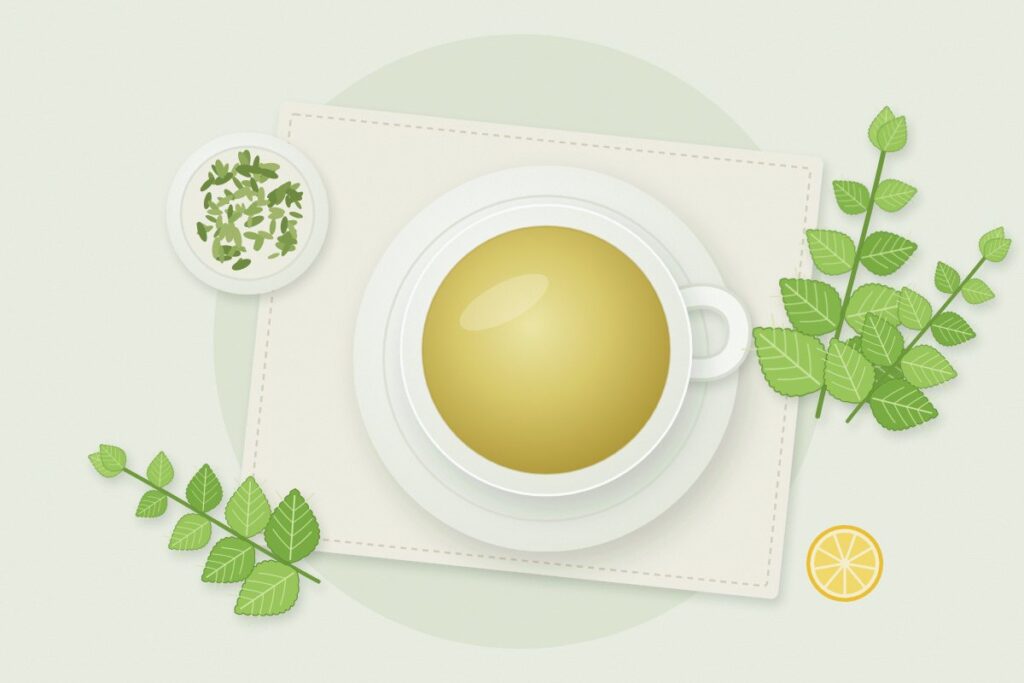
- For one cup, use 1.5–4.5 g of dried leaves. The package leaflet of a German medicinal lemon balm tea puts this at 1–3 teaspoons.
- Pour 150 ml of boiling water over them.
- Cover the cup so the aroma does not escape and let it steep for 10 minutes.
- Strain the tea.
The dose comes from the EMA monograph and applies to adults and children from 12 years of age, 1 to 3 times a day. An Austrian regulation on herbs sold outside pharmacies gives 1 teaspoon per cup, a steeping time of 10 minutes and several cups a day.
| Preparation | Dried leaves | Fresh leaves |
|---|---|---|
| Amount | 1.5–4.5 g (1–3 teaspoons) | 2–4 tablespoons |
| Water | 150 ml, boiling | 1 cup, boiling |
| Steeping | 10 minutes | 10 minutes |
Fresh lemon balm tea
The EMA does not give a dose for fresh leaves. They contain a lot of water: according to the Bavarian State Research Center for Agriculture (LfL), 4–5 kg of fresh leaves leave about 1 kg once dried. A recipe from Food Hero, a U.S. university program, uses 2–4 tablespoons of fresh leaves per cup of boiling water and 10 minutes of steeping. Rinse the leaves before use.
When to harvest and how to dry lemon balm
For fresh tea, pick the leaves as you need them from spring to fall, preferably young ones. For drying, cut lemon balm before it flowers, while it has no flower buds yet, in dry weather and ideally in the late morning. Cut the stems about 10 cm above the ground; the plant grows back quickly. You can cut it 2 to 3 times a season. In LfL trials, leaves from July and August contained significantly more essential oil than those from May.
Why lemon balm loses its scent when dried
Lemon balm contains little essential oil, and that oil is volatile. The LfL therefore advises processing the harvest as soon as possible and not bruising or heating the leaves. Dry them in a thin layer in the shade in an airy place; this takes several days. In a dehydrator, the LfL recommends 35–40 °C (95–104 °F). The leaves are ready when they rustle. Even so, according to the UK’s Royal Horticultural Society (RHS), dried lemon balm has a much milder flavor than fresh.
Store it in a tightly closed container away from light and moisture. You can read more in How to store loose leaf tea.
Growing lemon balm
Lemon balm is an undemanding perennial. According to the RHS, it needs sun or partial shade and almost any well-drained soil. The only thing that harms it is waterlogged soil in winter, which makes the roots rot. It survives frost even in harsh continental winters.
It spreads quickly and self-seeds readily. If you want to keep it in place, grow it in a container at least 25 cm wide and deep. Every few years, dig up the clumps in spring or fall and divide them; this is also the easiest way to propagate it. Sow seeds in spring and cover them only thinly, as light helps them germinate. They come up within three weeks.
After flowering, cut the whole plant back to just above the ground. It will produce new leaves and will not set seed.
Lemon balm effects: what the EMA says
The EMA’s Committee on Herbal Medicinal Products (HMPC) issued a monograph on lemon balm leaf in 2007 and revised it in 2013. It lists these traditional uses:
- relieving mild symptoms of mental stress and aiding sleep,
- relieving mild digestive complaints, including bloating and flatulence.
Traditional use means that lemon balm has been used this way for at least 30 years, including 15 years in the EU. Its efficacy has not been proven in clinical studies. We write about herbs for digestion in Tea for digestion. Since 2024, the EMA has been reviewing the monograph, and the outcome is not yet known.
What studies have shown
The studies the EMA assessed were small and mostly tested extracts, not tea. It did not consider an open-label study of 20 people with mild anxiety and sleep disorders sufficient because it was too small and had no control group. A 2021 review found better anxiety and depression scores with lemon balm than with placebo, but its authors point to the small number of studies and the large differences between them.
No health claim has been authorized for lemon balm in the EU. Claims about botanical substances are “on hold”, and the EU has not yet decided on them. Until then, they may be used on packaging under the transitional rules of Regulation (EC) No 1924/2006, but a lemon balm tea labeled “calming” or “helps you fall asleep” is no confirmation that it actually works.
Lemon balm and blood pressure
The EMA monograph does not mention blood pressure, either as a use or as a risk. A 2020 review found slightly lower systolic (upper) blood pressure in three studies, while diastolic (lower) blood pressure did not change significantly, and the authors warn of a high risk of bias. In a 2021 review, the blood pressure data came from two studies of capsules in people with type 2 diabetes, and systolic pressure fell by less than 1 mmHg on average.
So reliable evidence is lacking, and we did not find any study that looked at lemon balm tea and blood pressure. If you have high or low blood pressure, lemon balm tea will not replace your medication; talk to your doctor.
Lemon balm and the thyroid
The EMA monograph states that, based on test-tube and animal experiments, a water extract of lemon balm may inhibit the action of TSH, the hormone that controls the thyroid gland. Whether this matters in humans is not known. If you are being treated for a thyroid condition, talk to your doctor about drinking lemon balm tea.
Lemon balm for children
The EMA does not recommend lemon balm as a medicine for children under 12 because there is not enough data. The dosage in the monograph applies only from 12 years of age. Only give lemon balm tea to a younger child after talking to your pediatrician. You can read more in Herbal teas for children and babies.
Lemon balm during pregnancy and breastfeeding
The safety of lemon balm during pregnancy and breastfeeding has not been established, and there are also no studies on its effects on the unborn baby, so the EMA does not recommend it during this time. This is not proof that it is harmful, just a precaution. Talk to your doctor. You can read more in Herbal tea during pregnancy.
Side effects and when to be careful
The EMA monograph lists no known side effects, and no cases of overdose have been reported. There are no data on interactions with medicines. Still, keep the following in mind:
- Allergy: if you are hypersensitive to lemon balm, do not drink it.
- Driving: according to the EMA, lemon balm may impair your ability to drive and use machines. If it makes you feel drowsy, do not drive.
- Alcohol and sleeping pills or sedatives: the EMA assessment report acknowledges that, combined with them or in high doses, lemon balm could theoretically cause drowsiness. If you take such medicines, ask your pharmacist.
- Longer-lasting problems: if sleep problems, stress or digestive complaints last longer than 2 weeks or get worse, see a doctor.
Sources
- European Medicines Agency (EMA), Committee on Herbal Medicinal Products (HMPC) – monograph on lemon balm leaf (Melissa officinalis L., folium), EMA/HMPC/196745/2012, 2013.
- EMA, HMPC – assessment report on lemon balm leaf (Melissa officinalis L., folium), EMA/HMPC/196746/2012, 2013.
- EMA – Melissae folium, call for data for the periodic review of the monograph, EMA/HMPC/130926/2024.
- Heshmati J. et al.: Effects of Melissa officinalis (Lemon Balm) on cardio-metabolic outcomes: A systematic review and meta-analysis. Phytotherapy Research, 2020.
- Liao D. et al.: Effects of Melissa officinalis L. (Lemon Balm) Extract Supplementation on Cardiovascular Risk Factors: A Pooled Analysis of Randomized Controlled Trials. Journal of Food and Nutrition Research, 2021.
- Ghazizadeh J. et al.: The effects of lemon balm (Melissa officinalis L.) on depression and anxiety in clinical trials: A systematic review and meta-analysis. Phytotherapy Research, 2021.
- Bayerische Landesanstalt für Landwirtschaft (LfL) – Kulturanleitung für Zitronenmelisse, 4th edition, 2001.
- Royal Horticultural Society (RHS) – Melissa officinalis; How to grow lemon balm; Cymbopogon citratus.
- Oregon State University Extension, Food Hero – Garden Herbal Tea.
- Austria – Abgrenzungsverordnung 2004, annex (Melissenblätter).
- Melissenblätter Tee (Abtswinder Naturheilmittel) – package leaflet.
- Regulation (EC) No 1924/2006 on nutrition and health claims made on foods and the EU Register of nutrition and health claims.
We wrote this article on November 25, 2026. It is for general information only. For details, see our Disclaimer.