Wild thyme tea: how to make it, harvesting, effects and how it differs from thyme
How to recognize wild thyme, how it differs from common thyme, how to make tea from it, when and where to harvest it, how to grow it and what expert sources actually know about it.
Contents
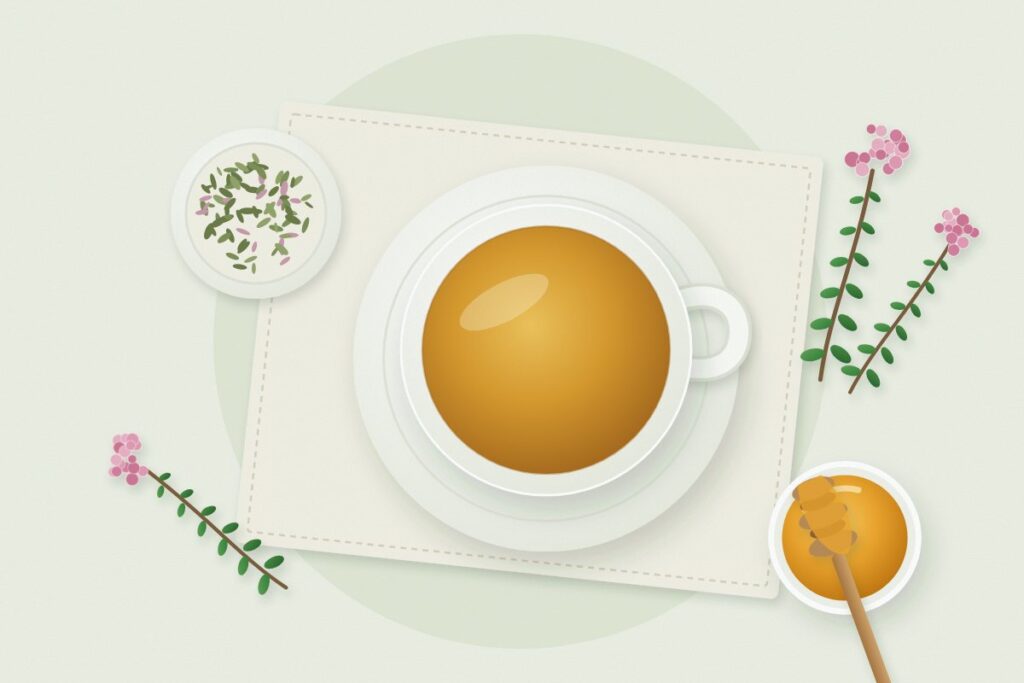
Wild thyme tea is made from wild thyme, the common name for the small, creeping Thymus serpyllum and its close relatives, which grow on dry, sunny slopes and pastures in Slovakia. To make the tea, pour boiling water over one teaspoon of the dried flowering herb and let it steep for 10 minutes. Unlike common thyme, wild thyme has no monograph from the European Medicines Agency (EMA), so what we know about its effects comes mainly from tradition.
You will find more herbs in our Herbs category.
Important: this article is for general information and does not replace medical advice. Wild thyme tea is not a cough medicine. If a cough lasts longer than a week or gets worse, see a doctor. Only give it to children after talking to a pediatrician, and if you are pregnant or breastfeeding, talk to your doctor. You can read more in the section When to be careful.
What is wild thyme
In English, the species Thymus serpyllum is called wild thyme, creeping thyme or Breckland thyme. Like mint and sage, it belongs to the mint family (Lamiaceae). Several species of thyme grow in Slovakia, for example large thyme (Thymus pulegioides) or Thymus pannonicus. They differ in small details, such as how hairy the stems are, so they are hard for a non-expert to tell apart.
True wild thyme is about 4–9 cm tall, with creeping stems and small, narrow leaves. According to the Flora of the Czech Republic (Květena České republiky), it is tied to sandy soils and grows in Slovakia only in scattered patches, at the edge of its range. On meadows and pastures, you are therefore more likely to find large thyme, the most common thyme in the Czech Republic, whose herb is also gathered for tea. Both the ESCOP monograph and an Austrian regulation list Thymus serpyllum “in the broad sense”, meaning the whole group of related thyme species.
Wild thyme vs thyme: what is the difference
The thyme you know from the kitchen is common thyme, also called garden thyme (Thymus vulgaris). It grows wild in southern France and eastern Spain; in Slovakia, it is only cultivated.
| Feature | Wild thyme | Common thyme |
|---|---|---|
| Where it grows | wild in Europe, including Slovakia | the Mediterranean; in Slovakia, in gardens |
| Growth habit | low and creeping, forms mats | upright subshrub, usually 20–30 cm |
| Leaves | flat, fringed with hairs near the base | rolled under at the edges, white and felty underneath |
| What is harvested | the whole flowering herb, stems included | leaves and flowers without stems |
| Essential oil according to the European Pharmacopoeia | at least 0.3%, often mostly carvacrol | at least 1.2%, mostly thymol |
| EMA monograph | no | yes, from 2013 |
The composition of wild thyme essential oil varies widely: a 2024 review reports carvacrol levels ranging from 2 to 80%.
How to make wild thyme tea
- For one cup (150–200 ml), use 1 teaspoon of the dried herb, which is about 1–2 g depending on how finely it is cut.
- Pour boiling water over it.
- Cover the cup so the aroma does not escape, and let it steep for 10 minutes.
- Strain the tea and let it cool a little before drinking.
This is also how it is described in an Austrian regulation on the labeling of medicinal herbs sold outside pharmacies, according to which a cup of freshly made tea is drunk several times a day. For common thyme, the EMA works with 1–2 g in 150 ml of boiling water, 3 to 4 times a day.
With honey, in blends and in the kitchen
Stir honey only into tea that has cooled a little. Do not give honey to children under one year of age. The World Health Organization (WHO) warns against it because of the risk of infant botulism.
Wild thyme is often added to herbal blends. An EMA assessment report mentions, for example, a Czech tea in which it is combined with plantain leaf, marshmallow root, licorice root, linden flower and rose hips. In folk tradition, it is also used as a seasoning.
When and how to harvest wild thyme
The herb is harvested while the plant is in flower. According to the Flora of the Czech Republic, both wild thyme and large thyme flower mainly from July to September, and large thyme also in October.
- Cut the herb with scissors and leave the roots in the ground. Take only part of the patch.
- Harvest in dry weather, away from roads and sprayed fields.
- Only pick plants you can identify with certainty.
Protected areas: in Slovakia, the Nature and Landscape Protection Act prohibits picking plants where the third to fifth level of protection applies, for example in nature reserves and in the more strictly protected zones of national parks. Exceptions apply to landowners, land managers and tenants, and to sites designated by the district office.
Tie the herb into small bunches and dry it in a warm, dark, well-ventilated place. Store it in a tightly closed container. You can read more in How to store loose leaf tea.
How to grow wild thyme
Wild thyme is an undemanding perennial for rock gardens, gaps between paving stones or containers. According to the Royal Horticultural Society (RHS) in the UK, it needs full sun and light, well-drained soil that is neutral to alkaline. It tolerates drought and survives frosts down to −10 to −15 °C (14 to 5 °F). It does not like wet conditions in winter, so if your soil is heavy, plant it in a raised bed or a container instead.
It can be propagated by dividing clumps in spring or fall, or from seed. Sow the seeds in spring on the surface of the growing medium without covering them; at 15–20 °C (59–68 °F), they germinate in about two weeks. After flowering, a light trim is all it needs.
Wild thyme and its effects: what we know
Common thyme is on the list of plants assessed by the EMA’s Committee on Herbal Medicinal Products (HMPC), but wild thyme is not. A 2024 review in the journal Frontiers in Nutrition confirms this.
For common thyme, the EMA recognized traditional use for productive cough associated with colds in 2013. Traditional means that it has been used this way for at least 30 years, but clinical studies have not proven that it works. These conclusions cannot be applied to wild thyme, because it is a different herbal substance with a lower essential oil content. What the EMA says about other herbs for coughs is summarized in Tea for cough.
In 1987, the German Commission E published a positive monograph on wild thyme herb for catarrh of the upper respiratory tract, and ESCOP (2014) lists the same use. In folk tradition, it was also drunk for digestive complaints. However, clinical studies are lacking: the 2024 review found only one small pilot study with 40 people who took a water extract, and its authors call for further research.
No health claim has been approved for wild thyme in the EU, and the proposed claims about the respiratory tract and digestion are among the so-called on-hold claims for botanical substances. So drink it for its aroma, not as a medicine. We write about teas for sore throats in Tea for a sore throat.
Wild thyme for children
The EMA has not set an age limit for wild thyme, since there is no monograph for it. For common thyme, the EMA does not recommend the tea as a medicine for children under 12 because there is not enough data.
Babies under six months do not need tea, only breast milk or formula. Only give wild thyme tea to a young child after talking to your pediatrician, and make it weaker, unsweetened and without honey. A cough with a fever or difficulty breathing needs a doctor. You can read more in Herbal teas for children and babies.
Wild thyme during pregnancy and breastfeeding
There are no reliable data on the safety of wild thyme during pregnancy and breastfeeding. For the same reason, the EMA does not recommend common thyme as a medicine during this time. This is not evidence that it is harmful, but a precaution. Talk to your doctor. You can read more in Herbal tea during pregnancy.
Side effects and when to be careful
According to the 2024 review, neither Commission E nor ESCOP lists any known side effects or interactions with medicines. However, there are few studies, so keep the following in mind:
- Allergy: for common thyme, the EMA lists hypersensitivity to plants of the mint family (Lamiaceae) as a contraindication. Wild thyme belongs to this family too, so if you are allergic to these plants, avoid it.
- Sensitive stomach: for common thyme, the EMA mentions digestive complaints. If the tea does not agree with you, do not drink it.
- Cough: if it lasts longer than a week or gets worse, see a doctor. If you have shortness of breath, a fever or purulent phlegm, see a doctor right away.
- Medicines: there are no data on interactions. If you take medicines regularly, ask your pharmacist.
- Essential oil is not tea: concentrated essential oil can irritate the skin and mucous membranes.
Sources
- European Medicines Agency (EMA) – overview of herbal medicines (Herbal medicines), as of November 25, 2026.
- EMA, Committee on Herbal Medicinal Products (HMPC) – monograph on thyme herb (Thymus vulgaris, Thymus zygis), EMA/HMPC/342332/2013, and assessment report, 2013.
- EMA, HMPC – assessment report on herbal tea combinations for cough and colds (Species pectorales), 2023.
- BfArM – list of Commission E monographs: Serpylli herba / Quendelkraut, Bundesanzeiger 1987, correction 1990.
- ESCOP – Serpylli herba (Wild Thyme), 2014.
- Jalil B. et al.: Wild thyme (Thymus serpyllum L.): a review of the current evidence of nutritional and preventive health benefits. Frontiers in Nutrition, 2024.
- Austria – Abgrenzungsverordnung 2004, annex (Quendelkraut).
- Štěpánek J., Tomšovic P.: Thymus L. – mateřídouška. In: Květena České republiky 6, Academia, 2000.
- Lexikon der Arzneipflanzen und Drogen (Spektrum) – Thymus-Arten.
- Fotonet.sk – plant atlas, genus Thymus.
- Royal Horticultural Society (RHS) – Thymus serpyllum; How to grow thyme.
- Slovakia – Act No. 543/2002 Coll. on Nature and Landscape Protection.
- WHO – Botulism fact sheet, 2023; Infant and young child feeding.
- Regulation (EC) No 1924/2006 on nutrition and health claims made on foods and the EU Register of nutrition and health claims.
We wrote this article on November 25, 2026. It is for general information only. For details, see our Disclaimer.