Thyme tea: how to make it and what we know about its use for coughs
How to make thyme tea from dried or fresh thyme and with honey and lemon, what the EMA says about thyme for coughs, when to be careful and how to grow it on a balcony.
Contents
- What is thyme
- How to make thyme tea from dried thyme
- Fresh thyme tea
- Thyme tea with honey and lemon
- How much thyme tea per day
- Thyme tea for cough: what the EMA says
- Can children drink thyme tea?
- Thyme tea during pregnancy and breastfeeding
- Side effects: when to be careful
- How to grow thyme on a balcony
- When and how to harvest thyme
- Sources
To make thyme tea, pour 150 ml of boiling water over 1–2 teaspoons of dried thyme, which is 1–2 g, and let it steep for 10 minutes. If you use fresh thyme, put roughly three times as many leaves in the cup. The European Medicines Agency (EMA) lists the traditional use of thyme for a wet cough associated with a cold, but clinical studies have not proven that it works.
You will find more herbs in our Herbs category.
Important: this article is for general information and does not replace medical advice. Thyme tea is not a cough medicine. If a cough lasts longer than a week or gets worse, see a doctor. The EMA does not recommend thyme tea as a medicine for children under 12 or during pregnancy and breastfeeding. You can read more in the section When to be careful.
What is thyme
Thyme, known botanically as common thyme or garden thyme (Thymus vulgaris), is an aromatic subshrub of the mint family (Lamiaceae). It comes from the Mediterranean; in Slovakia, it is grown in gardens and pots. The tea is made from thyme herb, meaning the dried leaves and flowers. The EMA also counts the related species Thymus zygis as thyme herb.
Thyme is not wild thyme
Wild thyme is the name for other species of thyme that grow wild in Slovakia and contain less essential oil. The EMA has no monograph for it, so conclusions about common thyme cannot be applied to it. We compare the differences in Wild thyme vs thyme.
How to make thyme tea from dried thyme
- For one cup (150 ml), use 1–2 teaspoons of dried thyme. According to the food database of the US Department of Agriculture (USDA), one teaspoon of dried leaves weighs about 1 g.
- Pour boiling water over it.
- Cover the cup so the aroma does not escape, and let it steep for 10 minutes.
- Strain the tea and let it cool a little.
The EMA monograph gives the same amount: 1–2 g of the herb in 150 ml of boiling water, 3 to 4 times a day as a traditional medicine. The EMA does not state a steeping time; the 10 minutes come from an Austrian regulation on herbs sold outside pharmacies.
Dried thyme from your kitchen also works for tea you drink for the flavor. However, the EMA data refer to the medicinal herb of European Pharmacopoeia quality.
Fresh thyme tea
According to the USDA, fresh thyme is about 65% water, while dried thyme is just under 8%. So for one cup, use roughly 3–5 g, which is 4–6 teaspoons of leaves.
- Rinse the sprigs and strip the leaves from the stems.
- Pour 150 ml of boiling water over the leaves and cover the cup.
- Strain the tea after 10 minutes.
The EMA dosage applies to the dried herb; for fresh thyme, this is only a rough conversion.
| Thyme | Per cup (150 ml) | Water | Steeping |
|---|---|---|---|
| Dried | 1–2 g, 1–2 teaspoons | boiling | 10 minutes, covered |
| Fresh | about 3–5 g, 4–6 teaspoons of leaves | boiling | 10 minutes, covered |
Thyme tea with honey and lemon
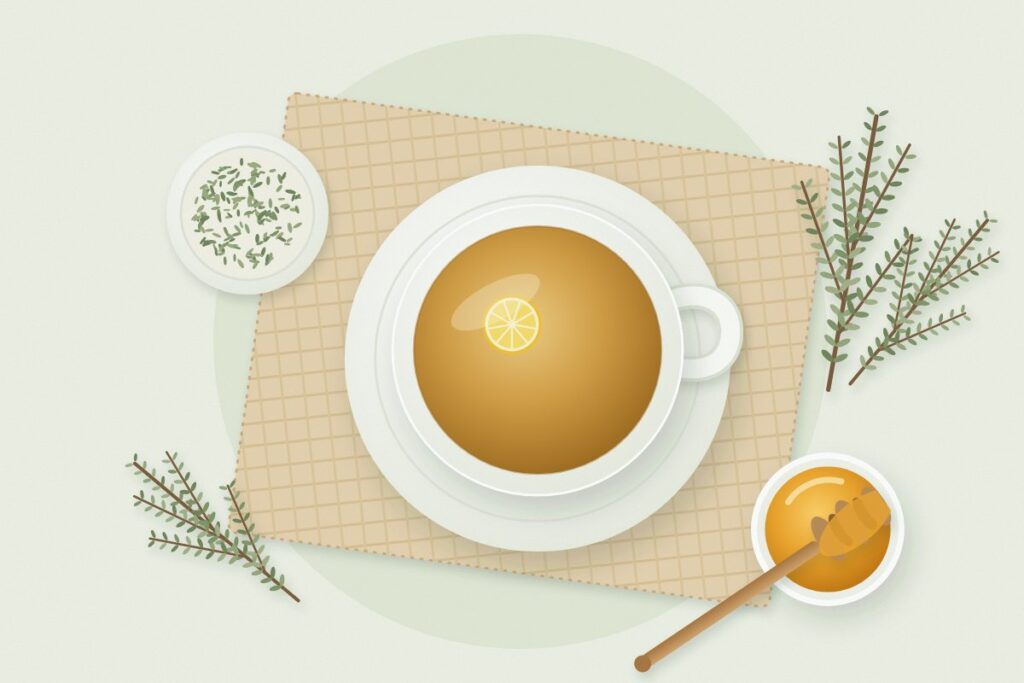
- Make a cup of thyme tea as described above.
- Add a slice of washed lemon or 1–2 teaspoons of lemon juice.
- Once the tea has cooled a little, stir in a teaspoon of honey.
Do not give honey to children under one year of age, not even in tea. The World Health Organization (WHO) warns about infant botulism.
A slice of fresh ginger makes the tea spicier; you will find how to make it in Ginger tea. If you prefer a gentle, floral flavor, try linden tea.
How much thyme tea per day
For a cough, the EMA monograph works with 3–4 cups a day. If the symptoms last longer than a week, it recommends seeing a doctor. The EMA does not give any data on drinking it every day over the long term. If you drink it for the flavor, alternate it with other herbs.
Thyme tea for cough: what the EMA says
In 2013, the EMA’s Committee on Herbal Medicinal Products (HMPC) adopted a monograph on thyme herb. In it, the committee recognized its traditional use for productive, or wet, cough associated with colds. Traditional means that thyme has been used safely in this way for at least 30 years, including 15 years in the EU. However, there is not enough evidence from clinical studies.
The EMA also assessed a study of 60 adults that compared thyme with bromhexine, a common medicine for wet cough. There was no significant difference between them, but the study had few patients and lacked an exact description of the preparation used. So no clear conclusions can be drawn from it.
No health claim has been approved in the EU for thyme tea as a food, and claims about botanical substances are still on hold. So drink it for its flavor and warmth, not as a medicine. We write about teas for sore throats in Tea for a sore throat.
Does thyme tea help with a dry cough?
The EMA monograph only covers wet cough, in which you cough up phlegm. It does not list a dry, irritating cough for thyme. For irritation of the mouth and throat with a dry cough, the EMA mentions traditional use of, for example, marshmallow root. If a dry cough lasts longer than a week, talk to your doctor. We compare herbs for dry and wet coughs in Tea for cough.
Can children drink thyme tea?
The EMA does not recommend thyme tea as a medicine for children under 12 because there is not enough data. From the age of 4, it only allows two liquid extracts with precise dosing, not tea. For children under 4, it does not recommend any thyme preparation; a child this young with a cough should see a doctor.
Babies under six months do not need tea; the WHO recommends exclusive breastfeeding. Only give thyme tea to an older child after talking to your pediatrician. A cough with a fever or difficulty breathing needs a doctor.
Thyme tea during pregnancy and breastfeeding
The safety of thyme as a medicine during pregnancy and breastfeeding has not been established. For lack of data, the EMA therefore does not recommend its use during this time. This is not evidence that it is harmful, but a precaution. The monograph covers medicines, not thyme as a seasoning in food. If you would like to drink thyme tea regularly, talk to your doctor.
Side effects: when to be careful
- Allergy to the mint family: the EMA lists hypersensitivity to thyme or other plants of the mint family (Lamiaceae), such as mint, sage, lemon balm or wild thyme, as a contraindication. If you are allergic to them, do not drink thyme tea.
- Stomach: stomach complaints may occur; how often is not known. If the tea does not agree with you, do not drink it.
- Cough: if it lasts longer than a week or gets worse, see a doctor. If you have shortness of breath, a fever or purulent phlegm, see a doctor right away.
- Medicines: the EMA does not list any reported interactions. If you take medicines regularly, ask your pharmacist.
Essential oil is not tea
Thyme essential oil is a concentrate, and the EMA assessed it separately in 2020. Medicines containing the oil that are taken by mouth or applied to the skin are for adults only; bath additives are for children aged 3 and over. The oil can cause allergies and skin irritation and should not be applied to the face. Do not add drops of it to your tea.
How to grow thyme on a balcony
According to the Royal Horticultural Society (RHS) in the UK, thyme also does well in a pot, but it needs the sunniest and warmest spot possible.
- Container: one plant per pot at least 15 cm wide and 10 cm deep, with drainage holes in the bottom.
- Growing medium: a peat-free, soil-based potting mix with up to a quarter of its volume of fine horticultural grit mixed in.
- Watering: only occasionally, mainly after planting and in hot, dry weather. In wet soil, the roots rot, especially in winter.
- Winter: most commonly sold varieties can take frost, but check this when you buy. Move the pot against a wall of the house where the rain does not reach it.
- Pruning: trim it in mid to late spring or after flowering so it stays compact. After a few years, it tends to get leggy and sparse; then replace it with a new plant.
Plant it from mid-spring to early summer. A plant grown from seed is ready to harvest in about a year; it is quicker to buy a young plant or to propagate it from cuttings in spring.
When and how to harvest thyme
Thyme is evergreen, so you can cut sprigs all year round. According to the RHS, young, soft shoots in late spring and summer have the best flavor. Regular cutting keeps the plant bushy.
To dry thyme, tie the sprigs into bunches and hang them for a few weeks in a warm, dark, well-ventilated place. Strip off the completely dry leaves and flowers and do not use the stems. Store them in an airtight jar.
Sources
- European Medicines Agency (EMA), Committee on Herbal Medicinal Products (HMPC) – monograph on thyme herb (Thymus vulgaris, Thymus zygis), EMA/HMPC/342332/2013, 2013.
- EMA – Thyme herb: summary for the public, EMA/307113/2016.
- EMA – Thyme oil (Thymi aetheroleum): summary for the public, EMA/380605/2020.
- EMA – Althaeae radix (marshmallow root): summary for the public, EMA/570566/2016.
- USDA FoodData Central – Thyme, fresh; Spices, thyme, dried (SR Legacy).
- Austria – Abgrenzungsverordnung 2004, as amended by BGBl. II Nr. 5/2026, annex (Thymian).
- Royal Horticultural Society (RHS) – How to grow thyme.
- WHO – Botulism fact sheet, 2023; Infant and young child feeding, 2026.
- Regulation (EC) No 1924/2006 on nutrition and health claims made on foods and the EU Register of nutrition and health claims.
We wrote this article on November 25, 2026. It is for general information only. For details, see our Disclaimer.