Agrimony tea: what common agrimony is used for, how to make it and when to harvest it
How to recognize common agrimony, when to harvest and dry it, how to make agrimony tea for drinking and gargling, and what the European Medicines Agency really says about it.
Contents
- What common agrimony looks like and where it grows
- When to harvest agrimony
- How to dry and store agrimony
- How to make agrimony tea
- Common agrimony: what it is used for according to the EMA
- Agrimony tea for the stomach: what we know
- Agrimony tea for children
- Agrimony tea during pregnancy and breastfeeding
- Side effects and when not to drink agrimony tea
- Sources
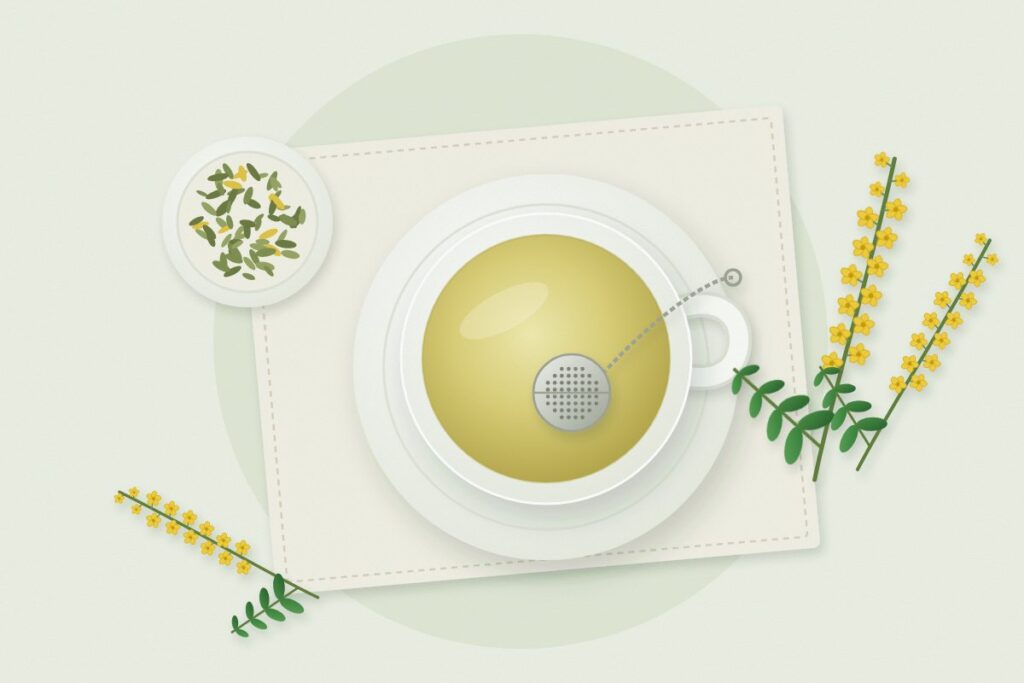
Agrimony tea is made from the dried flowering herb of common agrimony (Agrimonia eupatoria). For a mug (250 ml), use 1–2 teaspoons of the herb, which is about 1.5–3 g, pour boiling water over it and let it steep for 10–15 minutes. Agrimony is harvested in summer while it is in flower and dried in the shade.
The European Medicines Agency (EMA) recognizes agrimony as a traditional herbal medicine for mild diarrhea, as a gargle and for minor skin inflammation, but clinical studies have not proven that it works. You will find more herbs in our Herbs category.
Important: this article is for general information and does not replace medical advice. Agrimony is not recommended for children under 12 or during pregnancy or breastfeeding. For details, see the section When not to drink agrimony tea.
What common agrimony looks like and where it grows
Common agrimony is a perennial herb in the rose family. According to Květena České republiky (Flora of the Czech Republic), it grows 15–150 cm tall. It grows on dry grassy slopes, at the edges of forests and thickets, in orchards and along roadsides, often on lime-rich soils.
- Leaves are interruptedly pinnate: large, toothed leaflets alternate with tiny ones. Their undersides are usually covered in gray to whitish felt.
- Flowers are golden yellow, five-petaled and 7–10 mm across. They are densely arranged in a long, spike-like raceme.
- Fruits are small, cone-shaped burs with deep lengthwise grooves and a crown of hooks that catch on clothing and animal fur.
It flowers in summer, roughly from June to September. The Pladias database gives July to September.
Common agrimony or fragrant agrimony
The related fragrant agrimony (Agrimonia procera) also grows in Central Europe. You can tell them apart mainly by their leaves and ripe fruits:
| Feature | Common agrimony | Fragrant agrimony |
|---|---|---|
| Height | 15–150 cm | 50–200 cm |
| Underside of leaves | usually gray to whitish and felted | green, with many yellow glands |
| Petals | rounded at the tip | oblong, notched at the tip |
| Ripe fruits | cone-shaped, deeply grooved at least three-quarters of the way down | bell-shaped, shallowly grooved only halfway down |
| Outer hooks on the fruit | spread straight out to horizontal | bent backward |
According to Květena ČR, fragrant agrimony is also grown in gardens and fields, sometimes under the incorrect name of common agrimony, and it contains more tannins. The EMA monograph, however, covers only common agrimony.
When to harvest agrimony
For tea, the flowering herb is harvested, meaning the upper parts of the plant with flowers and leaves. The European Pharmacopoeia describes agrimony herb as the dried flowering tops of the plant. So harvest it in summer, when agrimony is in flower.
- Cut off the upper flowering parts of the stem. Do not pull the plant up; it is a perennial and will grow back from its rhizome.
- Harvest in dry weather. Wet herb dries slowly and goes moldy easily.
- Avoid plants next to busy roads and sprayed fields.
- Only pick plants you can identify with certainty.
How to dry and store agrimony
Spread the herb in a thin layer on paper or a screen and let it dry in a shady, airy place. It is dry when the leaves crumble and the stems snap.
Then crumble it and store it somewhere dry and dark in a closed container. You can read more in How to store loose leaf tea.
How to make agrimony tea
- For a mug (250 ml), use 1–2 teaspoons of crumbled agrimony herb. According to the information for a registered Czech tea, one teaspoon holds about 1.5 g.
- Pour boiling water over it.
- Cover and let it steep for 10–15 minutes.
- Strain the tea and let it cool a little before drinking.
The EMA monograph does not give a steeping time. The 10–15 minutes come from registered teas described in its assessment report.
Because of its tannins, the infusion is slightly astringent. According to the EMA, agrimony herb contains 3–11% tannins.
How much agrimony for which use
| Use | Amount of herb | Preparation | Times a day |
|---|---|---|---|
| Tea to drink for mild diarrhea | 1.5–4 g | infusion, 250 ml boiling water | 2–3 times |
| Gargle | 1.5 g | infusion, 150 ml boiling water | 2–4 times |
| Gargle (stronger) | 3–4.5 g | decoction, 250 ml water | 2–3 times |
| Skin compress | 3–10 g | decoction, 250 ml water | not specified |
These figures come from the EMA monograph and apply to adults and adolescents aged 12 and over.
Agrimony gargle
To make a gargle, pour 150 ml of boiling water over 1 teaspoon (1.5 g) of the herb and let it steep for 10–15 minutes. For a stronger decoction, boil 2–3 teaspoons (3–4.5 g) of the herb in 250 ml of water for about 10 minutes, let it stand and strain it.
Gargle with the lukewarm infusion 2 to 4 times a day. If mouth or throat problems last longer than a week or get worse, see a doctor. You can read more in Tea for a sore throat.
Common agrimony: what it is used for according to the EMA
In 2015, the EMA’s Committee on Herbal Medicinal Products (HMPC) published a monograph on agrimony herb. In it, agrimony is recognized as a traditional herbal medicine for three uses:
- by mouth, to relieve the symptoms of mild diarrhea,
- as a gargle, to relieve mild inflammation of the mouth and throat,
- on the skin, for minor inflammation and small superficial wounds, as a compress or in a bath.
Traditional use means that agrimony has been used this way for at least 30 years, including at least 15 years in the European Union, and is considered sufficiently safe. However, clinical studies have not proven that it works. The assessment report found only one small study without a control group, from which, according to the EMA, no conclusions can be drawn. In 2022, the committee reviewed the monograph, and none of the 118 new publications was a reason to change it.
Older herbals attributed dozens of other uses to agrimony, for example for liver and gallbladder problems or for coughs. Of these, the EMA recognized only the three listed above. There is also no approved health claim for agrimony on foods in the EU.
Agrimony tea for the stomach: what we know
Many people search for agrimony tea “for the stomach.” In the Czech Republic, agrimony herb has also been listed for minor digestive complaints, and it is an ingredient in registered tea blends, for example with chamomile, peppermint or fennel. Of the digestive complaints, however, the EMA recognized only one traditional use: relieving the symptoms of mild diarrhea.
According to the EMA assessment report, the tannins are probably involved in this use, but studies confirming this in humans are lacking. The monograph does not mention stomach pain, heartburn or bloating. We compare the herbs traditionally drunk for these complaints in Tea for digestion.
According to the World Health Organization (WHO), the biggest risk with diarrhea is dehydration, so it is important to replace fluids and salts. If you have stomach problems repeatedly or for a longer time, talk to a doctor.
Agrimony tea for children
The EMA monograph does not recommend agrimony for children under 12 because there is not enough data. For adolescents aged 12 and over, it considers short-term use acceptable.
If your child has diarrhea, talk to a pediatrician and do not give them agrimony tea on your own. You can read more in Herbal teas for children and babies.
Agrimony tea during pregnancy and breastfeeding
According to the EMA, the safety of agrimony during pregnancy and breastfeeding has not been established, so the EMA does not recommend it during this time. This is not evidence that it is harmful, but a precaution due to the lack of studies. You can read more in Herbal tea during pregnancy.
Side effects and when not to drink agrimony tea
The EMA monograph lists no known side effects, reported interactions with medicines or cases of overdose. However, tests for genotoxicity, carcinogenicity and effects on reproduction have not been carried out.
Important: according to the EMA monograph:
- If diarrhea lasts longer than 3 days, keeps coming back or gets worse, see a doctor.
- If there is blood in your stool, see a doctor.
- If problems in the mouth, throat or on the skin last longer than a week or get worse, see a doctor.
- Agrimony is not recommended for children under 12 or during pregnancy and breastfeeding.
- If you are hypersensitive to agrimony, do not use it. If you have an adverse reaction, talk to a doctor.
Experiments in mice have suggested a possible effect of agrimony on blood sugar levels, but no interactions have been reported. If you take medicines, for example for diabetes, talk to your doctor or pharmacist.
Sources
- European Medicines Agency (EMA), Committee on Herbal Medicinal Products (HMPC) – European Union herbal monograph on agrimony herb (Agrimonia eupatoria L., herba), EMA/HMPC/680597/2013, 2015.
- EMA, HMPC – assessment report on agrimony herb, EMA/HMPC/680595/2013, 2015, and the addendum following the periodic review, EMA/HMPC/626568/2022, 2022.
- EMA, HMPC – Agrimony herb, summary for the public, EMA/HMPC/332849/2015, 2015.
- European Pharmacopoeia – monograph Agrimony, 01/2011:1587 (as cited in the EMA assessment report).
- Skalický V.: Agrimonia L. – řepík. In: Květena České republiky 4, Academia, 1995.
- Pladias – Database of the Czech Flora and Vegetation, Agrimonia eupatoria.
- Universität Bayreuth – species profile of Agrimonia eupatoria (Qualifizierung Feldbotanik).
- World Health Organization (WHO) – Diarrhoeal disease fact sheet, 2024.
- Regulation (EC) No 1924/2006 on nutrition and health claims made on foods and the EU Register of nutrition and health claims.
We wrote this article on November 25, 2026. It is for general information only. For details, see our Disclaimer.