Tea brewing equipment: infusers, teapots, gaiwans and more
Which infuser and teapot to choose, what materials they are made of and which tools will help you brew tea equally well every time.
Contents
You do not need expensive equipment to make good loose leaf tea. All you need is something to heat water, something to steep the tea in and something to strain it with. The right tools, however, make brewing easier and help your tea taste the same every time. In this article you will find an overview of infusers, teapots and other helpers, what materials they are made of and which tea each one suits.
What you really need
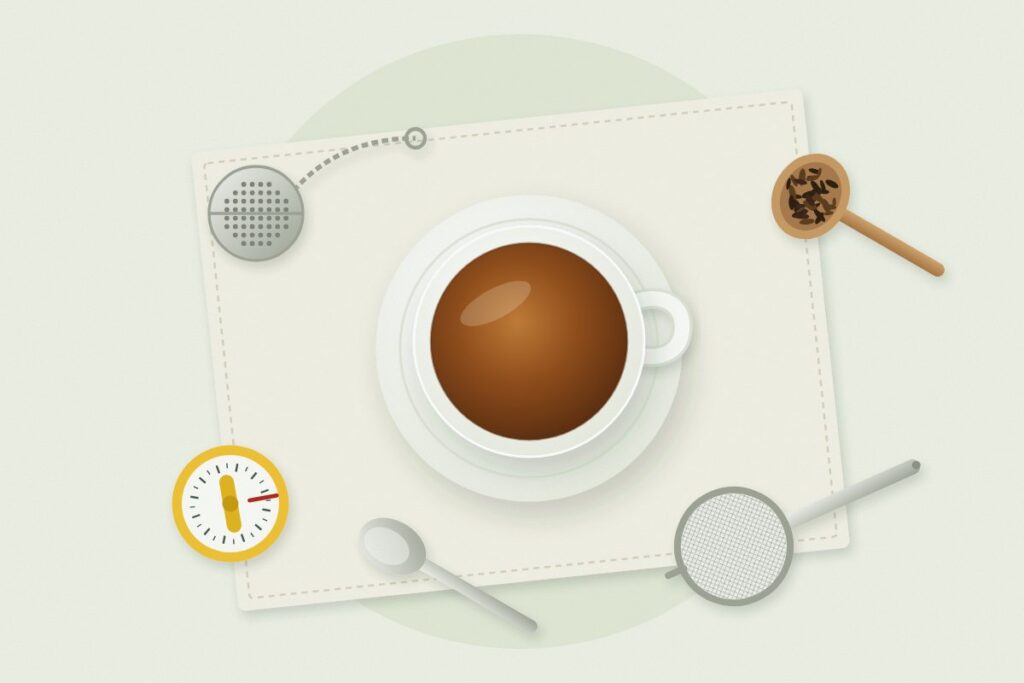
To start with, four things are enough:
- a kettle, ideally with temperature control,
- a brewing vessel, such as a teapot or a large mug,
- an infuser or strainer to separate the leaves from the infusion after steeping,
- a teaspoon or a kitchen scale to measure the leaves.
Everything else is a matter of convenience, personal passion or the particular type of tea.
Infusers and filters
The leaves unfurl and expand as they steep. The more room they have in the water, the better they release their flavor.
| Tool | Advantages | What to watch out for |
|---|---|---|
| Basket infuser for a mug or teapot | the leaves have plenty of room, it is easy to take out and clean | it should be deep enough for the leaves to be fully submerged |
| Tea ball or tea tongs | small, cheap, good for travel | the leaves are packed tightly and have no room to unfurl, so they are better suited to small-leaf teas |
| Paper tea filter | convenient, nothing to wash | it is single-use |
| Cloth (cotton) filter | fine, catches even tiny particles | it needs to be rinsed and dried after use, and it stains over time |
| Cup strainer | catches the leaves when pouring from a teapot or gaiwan | the leaves have to steep loose in the vessel |
For small-leaf teas, such as rooibos or broken black teas, reach for a finer infuser. Whole large leaves and oolongs will do fine with an infuser with larger holes.
Which material
- Stainless steel: durable, easy to clean and does not affect the taste of the tea. It is the most practical material for infusers.
- Glass and porcelain: neutral in taste and easy to wash. In a glass teapot you can also watch the leaves unfurl and the infusion darken.
- Glazed ceramics: mugs with a ceramic infuser look nice, but the holes in ceramic tend to be larger, so they are better suited to whole leaves.
- Plastic and silicone: light and cheap, but they can stain and take on smells. Only buy products intended for contact with food, marked with the glass and fork symbol. An EU regulation in force since January 20, 2025 bans bisphenol A in food contact materials. For most products, the transition period ran until July 20, 2026, and for some it runs until July 20, 2028.
- Unglazed clay: for example, Chinese teapots from the city of Yixing. More about them below.
Teapots and brewing vessels
- Porcelain or glass teapot with an infuser: a versatile choice for all types of tea. After steeping, take out the infuser with the leaves so the tea does not keep turning bitter.
- Gaiwan: a Chinese bowl with a lid and saucer. The leaves steep directly in the bowl, and when pouring you hold them back with the lid slightly open. It is good for short, repeated infusions, for example with oolong or pu-erh.
- Kyusu: a Japanese teapot with a side handle and a strainer at the spout. It is intended mainly for Japanese green teas, which are steeped briefly and at a lower temperature.
- Unglazed clay teapots: the clay is porous, and tea lovers have long held that it gradually absorbs the aroma of the tea. That is why only one type of tea is usually made in one teapot, and it is washed with water only.
- French press: it can also be used for tea. After steeping, press down the plunger and pour out all the tea right away, otherwise it will keep steeping.
- Bottle with an infuser for cold brewing: practical for summer. You will find the method in the article Iced tea.
We describe how teapots developed in China, Japan and Europe in the article History of the teapot.
Tools for precise brewing
The taste of tea depends mainly on the water temperature, the steeping time and the amount of leaves. These tools will help you get them right:
- Kettle with temperature control: the most convenient way to make green tea at 70–80 °C (158–176 °F) or white tea at 75–85 °C (167–185 °F).
- Thermometer: a cheaper alternative. You only need to find out once how long your water takes to cool and then remember it.
- Kitchen scale accurate to 0.1 g: a teaspoon is imprecise with bulky leaves. A teaspoon of fluffy white tea weighs much less than a teaspoon of tightly rolled oolong pellets.
- Timer: the one on your phone will do. With green tea, every extra minute counts.
You will find recommended temperatures, times and amounts for the individual types in the article How long to steep tea.
Tools for matcha
Matcha is not steeped; instead, the powder is whisked into water. Traditionally, this is done with a bamboo whisk (chasen), a wide bowl (chawan) and a bamboo scoop for measuring the powder (chashaku). It is a good idea to sift the powder through a fine strainer before whisking so that no lumps form. More about matcha in the article Sencha vs. matcha.
Caring for your tea tools
- After each use, throw away the leaves and rinse the infuser and teapot with warm water.
- You can remove brown tea stains from porcelain, glass and stainless steel with baking soda and a little water.
- A citric acid solution dissolves limescale in a kettle. Then rinse it several times with clean water.
- Do not wash cloth filters and unglazed clay teapots with dish soap, because they can take on its smell.
Tea tools are also a popular gift. You will find tips in the article Tea as a gift.
Sources
- Commission Regulation (EU) 2024/3190 on the use of bisphenol A (BPA) and other bisphenols and bisphenol derivatives with harmonised classification for specific hazardous properties in certain materials and articles intended to come into contact with food.
- Regulation (EC) No 1935/2004 of the European Parliament and of the Council on materials and articles intended to come into contact with food (glass and fork symbol).
We revised this article on November 24, 2026. It is for general information only. For details, see our Disclaimer.