Oolong tea: the tea between green and black
From floral pellets to roasted rock teas. We explain oxidation, the Fujian and Taiwan regions and how to brew oolong with multiple infusions.
Contents
Oolong is a group of teas that sit between green and black tea. Some smell like a flowering meadow, others like roasted nuts or honey. This variety comes mostly from how far the leaves are allowed to oxidize during production. We explain what that means, where oolongs come from and how to brew them.
The name comes from the Chinese wulong, meaning “black dragon”. There are several legends about why the tea is called this, but none of them is reliably documented.
Oxidation, not fermentation
All true teas come from the tea plant (Camellia sinensis), and the differences between them arise mainly in processing. Oxidation plays the key role. When a leaf is damaged, the compounds in it begin to react with air with the help of the leaf’s own enzymes. It is a process similar to what happens with a cut apple that turns brown in the air.
With green tea, oxidation is stopped right at the start by heating, and with black tea it runs almost to completion. With oolong, it is stopped somewhere in between. The degree of oxidation in oolongs covers a wide range, often given as roughly 10 to 80 percent.
Oolong is often called semi-fermented tea. The term is common but inaccurate. Fermentation in the true sense means the action of microorganisms, and that does not happen in making oolong. It is more accurate to call it a partially oxidized tea. True fermentation is used, for example, in making some kinds of pu-erh.
How oolong is made
Making oolong is more demanding than for most other teas. In simple terms, it has these steps:
- Withering – the picked leaves are left to wither in the sun or indoors.
- Shaking – the leaves are repeatedly tossed gently in baskets or drums, which bruises their edges and starts oxidation.
- Halting oxidation – when the leaves reach the desired degree of oxidation, they are briefly heated.
- Rolling – the leaves are rolled into tight pellets or long, twisted shapes.
- Drying and roasting – some oolongs are roasted after drying, often over charcoal, which gives them a darker color and nutty notes.
Where oolongs come from
Fujian
China’s Fujian province is considered the cradle of oolong. The Wuyi mountains are the source of the so-called rock teas (yancha), darker and roasted oolongs with a pronounced, mineral flavor. The best known of them is Da Hong Pao, or “big red robe”.
Tie Guan Yin, the “iron goddess of mercy”, comes from Anxi county in the south of the province. Today it is made mostly as greenish pellets with a strong floral aroma, but darker, traditionally roasted versions also exist. The neighboring province of Guangdong is also worth mentioning, with its Dan Cong teas, which are known for their pronounced fruity and floral aromas.
Taiwan
Tea growing came to Taiwan from Fujian, and the island became another powerhouse of oolong. Well known are the high mountain oolongs (gao shan) from high-elevation plantations, for example in the Alishan area, and Dong Ding with its lightly roasted flavor.
A special case is Dong Fang Mei Ren, or “oriental beauty”. The leaves it is made from are nibbled before harvest by a tiny insect, the leafhopper, and the plant responds by producing compounds that give the tea its honeyed aroma. This oolong tends to be oxidized more heavily, and its flavor comes close to black tea.
Re-steeping
The rolled leaves of oolong unfurl gradually, so you can pour water over them several times. Each infusion tastes a little different: the first tends to be floral and fresh, the later ones fuller and sweeter. For many people, watching these changes is the most interesting part.
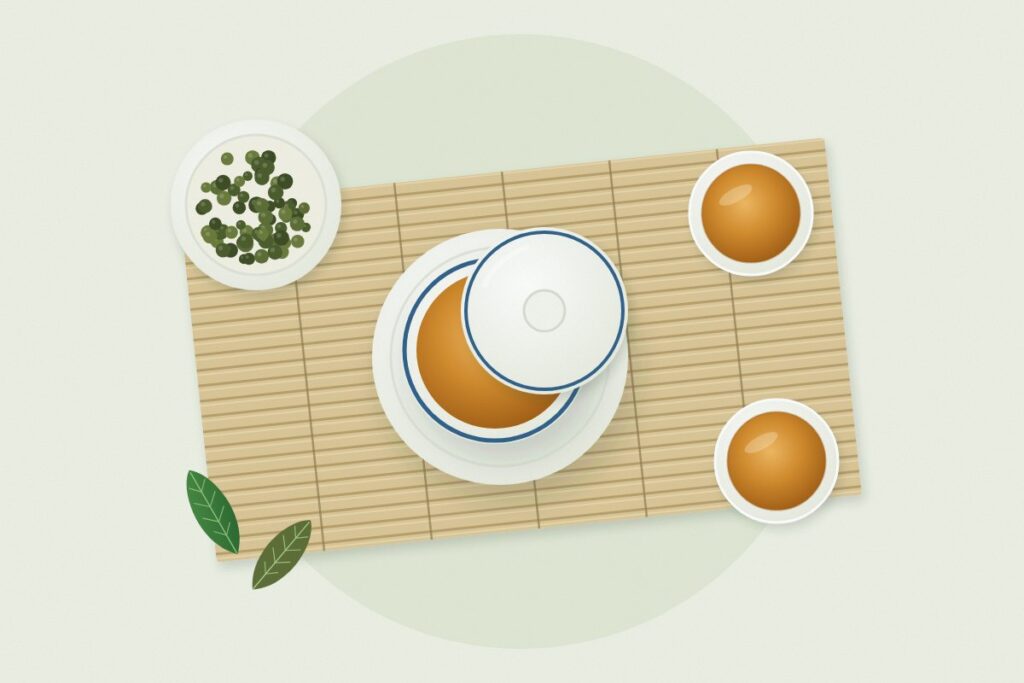
In China and Taiwan, oolong is often prepared in the gongfu cha style. A much larger amount of leaf goes into a small teapot or a lidded bowl (gaiwan), and it is steeped only briefly, from a few seconds up to a minute. The same leaves can then last five or more infusions. You can read more about the vessels in which tea is traditionally prepared in the article History of the teapot.
How to brew oolong at home
In an ordinary teapot or in a mug with an infuser, these values will serve you well:
- Amount: 2–3 g per 200–250 ml of water. For pellets, a full teaspoon is enough, and for long twisted leaves use more.
- Water temperature: 85–95 °C (185–203 °F). Brew light, floral oolongs closer to 85 °C (185 °F), and dark, roasted ones closer to 95 °C (203 °F).
- Time: 2–4 minutes for the first infusion, a little longer for later ones.
- Number of infusions: three or more, until the flavor fades.
Pellets need enough room in the teapot, because after the water is poured on they unfurl into whole leaves and grow several times in volume. Some tea lovers briefly rinse them with hot water before the first infusion to help them begin opening. It is not necessary, but you can try it.
If you like green tea, start with a light, floral oolong. If you prefer black tea, reach for a dark, roasted one. You can find a comparison with the other types in the overview How long to steep tea and with what water.
Oolong is a good choice for anyone who likes to explore. One serving of leaves will last you the whole afternoon, and with every infusion it shows a slightly different face.