Yerba mate: what it is, how to drink it with or without a gourd and how much caffeine it has
What yerba mate is, how to drink it from a gourd through a bombilla or make it in a French press, what water temperature to use, how much caffeine it has and when to be careful.
Contents
Yerba mate, or simply mate, is a South American drink made from the dried, crushed leaves of the yerba mate holly (Ilex paraguariensis). It is an everyday drink in Argentina, Uruguay and Paraguay, and it is also popular in southern Brazil. Although it is commonly called a tea, it has nothing to do with the tea plant (Camellia sinensis), but it does contain caffeine. It is traditionally drunk from a small vessel through a metal straw, but you can just as easily make it in an ordinary teapot or a French press.
To make it like tea, use 3–5 g of dry leaf per 200–250 ml of water at 70–80 °C (158–176 °F) and let it steep for 3–5 minutes. A cup of mate made like tea usually contains 13–55 mg of caffeine, which is less than a cup of coffee. If you drink it the traditional way from a gourd and keep refilling it, however, you can take in a total of 130–270 mg.
Important: this article is for general information and does not replace a doctor’s advice. If you are pregnant or breastfeeding, have high blood pressure, heart disease or a stomach ulcer, or take medicines, read the section When to be careful.
What is yerba mate
Mate is made from the dried, crushed leaves and thin twigs of the yerba mate holly (Ilex paraguariensis). It is an evergreen tree or shrub that grows in South America. It belongs to the same genus as the common holly, whose glossy leaves and red berries you know from Christmas decorations.
Strictly speaking, then, mate is not tea but an infusion of a different plant, like rooibos or herbal teas. For simplicity, though, it is usually grouped with teas, and it is prepared in a similar way.
Yerba means herb in Spanish, and the word mate comes from the Quechua word mati, meaning a small gourd. In Brazil, mate prepared the traditional way is called chimarrão.
The drink was known to the indigenous peoples of the region, especially the Guarani, long before the Europeans arrived. In the 17th century, Jesuit missionaries began growing the holly on a larger scale, which is why mate was sometimes also called Jesuit tea.
How mate is made and what it tastes like
After harvest, the leaves are briefly exposed to fire, then dried, often with the help of smoke, and crushed. Some types rest for several months before packaging to soften their flavor.
The flavor of mate is herbal, grassy and pleasantly bitter. Depending on how it is dried, it can also be smoky or earthy. A distinction is made between mate with twigs (con palo), which tends to be milder, and mate without them (sin palo), which is stronger.
Brazilian mate is finely ground, vividly green and tastes fresher. There is also roasted mate, which is darker in color, has a nutty, lightly toasted flavor and is usually less bitter.
Caffeine in mate
Mate contains caffeine. It used to be called mateine, just as people speak of theine in tea, but it is in fact the same substance. Besides caffeine, mate also contains a smaller amount of theobromine, which you know from cocoa.
How much caffeine you take in depends mostly on the amount of leaf and how you prepare it. For traditional drinking, a lot of dry leaf goes into the vessel, usually 25–50 g, and water is added many times, so the total amount can be higher than with a cup of tea.
| How you drink mate | Volume | Caffeine |
|---|---|---|
| Like tea (tea bag or 3 g) | a cup of 180–250 ml | 13–55 mg |
| From a gourd, first four refills | about 120 ml in total | 80–85 mg |
| From a gourd, a whole session with repeated refills | about 500 ml in total | 130–270 mg |
| Tereré with cold water in a gourd | about 500 ml in total | about 85 mg |
| For comparison: drip coffee | 200 ml | about 90 mg |
The European Food Safety Authority (EFSA) considers up to 400 mg of caffeine a day from all sources safe for healthy adults. A whole session with a gourd is therefore one third to two thirds of that amount. If you are sensitive to caffeine, drink mate in moderation and preferably not in the evening. We describe what affects the caffeine content in the article Caffeine in tea, and how to drink less of it in How to cut down on caffeine.
How mate is traditionally drunk: gourd and bombilla
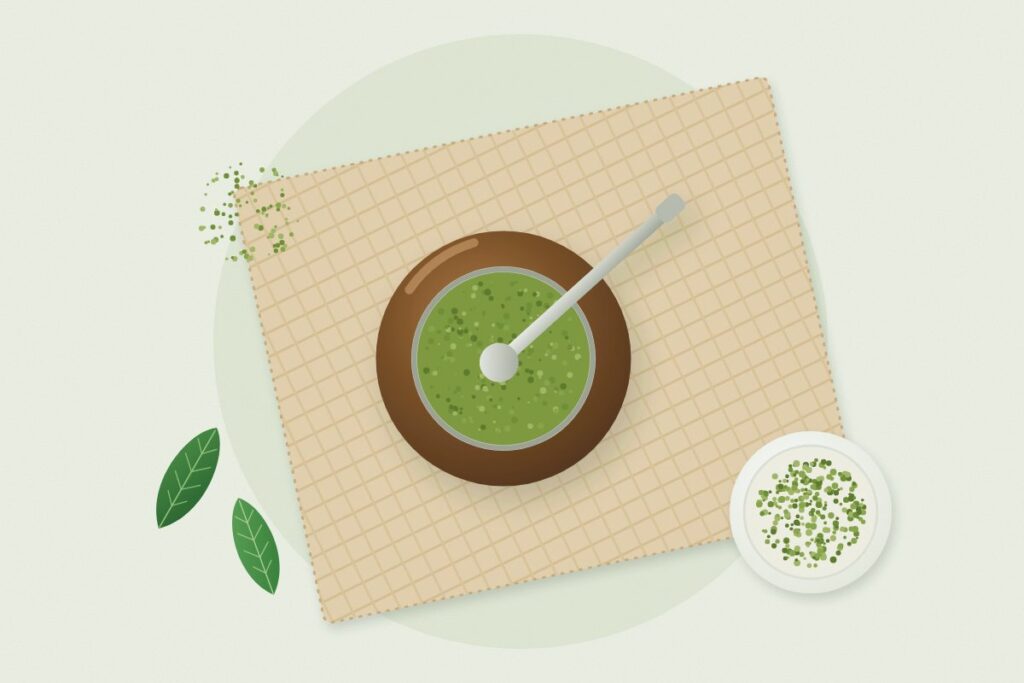
The traditional vessel is the gourd, a hollowed-out and dried calabash. Today they are also made of wood, ceramic, glass or metal. In Spanish, the vessel itself is called mate, just like the drink.
The bombilla is a metal straw with a strainer at its lower end. Thanks to it, you can drink straight from a vessel full of crushed leaves without getting them in your mouth.
Step by step
- Fill the gourd about halfway to two thirds with mate.
- Cover the opening with your palm, shake the vessel a few times, then tilt it so the leaves pile up on one side.
- Pour a little lukewarm water into the emptier part and let the mate soak for a moment.
- Insert the bombilla into the moistened part, covering the top end with your thumb as you do.
- Pour in water at 70–80 °C (158–176 °F) and drink. When you finish, refill.
Do not stir with the bombilla while drinking, or the strainer will clog. Mate lasts through many refills before its flavor fades. When it has lost both its flavor and its color, people in Argentina say it is “lavado”, meaning washed out. That is the time to empty it and prepare a fresh one.
Mate as a shared ritual
In South America, mate is often drunk in company from a single vessel. One person pours the water and passes the gourd to each person in turn, who drinks it all and hands it back. If you say “thank you” when you return it, it usually means you do not want another round.
In Paraguay, tereré is also popular: mate made with cold water, often with ice or fruit juice. We write about how leaf drinks are enjoyed in other countries in the articles How the world drinks tea and Tea ceremonies and traditions around the world.
What comes in a mate set
A mate set usually includes a gourd and a bombilla, and sometimes also a brush for cleaning the straw or a thermos for hot water. A gourd made of calabash or wood needs to be prepared before its first use according to the instructions that come with it. After drinking, rinse it and let it dry so it does not get moldy. A ceramic, glass or stainless steel one is washed like an ordinary mug.
How to make mate at home without a gourd
You do not need any special equipment. You make mate much like loose leaf tea, just with a different amount and water temperature:
- Amount: 3–5 g per 200–250 ml of water. Mate is light, so this can be more spoonfuls than you are used to with tea.
- Water temperature: 70–80 °C (158–176 °F). Boiling water brings out the bitterness.
- Time: 3–5 minutes.
- Vessel: a teapot with a strainer, a mug with an infuser or a French press. You will find an overview of tools in the article A guide to tea brewing equipment.
Finely ground mate also contains dust, so a finer strainer is a good idea. You can pour water over the leaves a second or third time; for each further infusion, let them steep a little longer. Mate in tea bags is made like ordinary tea; in Argentina it is called mate cocido.
Mate in a French press
A French press comes in handy when you are making mate for several people. Use 6–10 g of mate for 500 ml of water, pour water at 70–80 °C (158–176 °F) over it and let it steep for 3–5 minutes. Then press the plunger and pour out all the mate right away, otherwise it will keep steeping and turn bitter.
What water temperature to use for mate
Water at 70–80 °C (158–176 °F) is right for mate; with cooler water, the flavor does not develop. But the temperature of the water you brew with is not the temperature of the drink you sip: do not drink mate while it is still scalding. The International Agency for Research on Cancer (IARC) has classified drinks hotter than 65 °C (149 °F) as probably carcinogenic. More in the section When to be careful.
When mate is too bitter
If mate is too bitter for you, try a lower temperature, a shorter time or a type with twigs. It goes well with a slice of lemon, a piece of orange peel, honey or a few mint leaves. If you like mint, you will find more inspiration in the article Mint tea.
Mate tastes different from tea, so it is worth tasting it without comparing. Start with a milder type and a lower water temperature. If you take to it, the gourd and bombilla will come in their own time.
Yerba mate effects: what we know
The European Medicines Agency (EMA) published a monograph on mate leaf in 2010. It lists two traditional uses: for symptoms of fatigue and a feeling of weakness, and to increase the amount of urine to flush the urinary tract in minor urinary complaints. Traditional use means that it has been used this way for at least 30 years, including 15 years in the EU. Its effectiveness has not been proven in clinical studies; it is based on long experience. When the EMA reviewed the monograph in 2021, it found nothing in new studies that would change it.
Mate is often marketed as an aid to weight loss. However, the EMA rejected a proposal to add weight loss to the uses in the monograph, because the results of studies were inconclusive. More in the article Tea and weight loss.
No health claim has been approved in the EU for mate as a food, and claims about botanical substances are still on hold.
When to be careful
Very hot mate
In 2016, the IARC classified drinking very hot beverages above 65 °C (149 °F) as probably carcinogenic to humans (Group 2A), mainly because of the link with esophageal cancer. What matters is the temperature, not the drink itself: the IARC could not classify mate that is not very hot in this respect (Group 3).
In South America, mate is traditionally drunk at about 70 °C (158 °F). In studies from the region, the risk of esophageal cancer rose with the amount of mate drunk over a lifetime and was higher with hotter mate. So let it cool a little and do not refill it with boiling water.
Substances from smoke drying
When the leaves are dried over smoke, polycyclic aromatic hydrocarbons (PAHs) form in them, and some of these are carcinogenic. Only part of them passes into the infusion. To limit PAHs, the EMA included only quickly dried green leaves in its monograph and excluded roasted mate. It is not yet clear whether temperature or PAHs contribute more to the risk.
Pregnancy and breastfeeding
The EMA states that mate should not be used as a medicine during pregnancy and breastfeeding. There is little data, and caffeine passes through the placenta and into breast milk. EFSA considers no more than 200 mg of caffeine a day from all sources safe during pregnancy and breastfeeding. A whole session with a gourd can exceed this amount. More in the article Tea during pregnancy and breastfeeding.
Children and teenagers
The EMA does not recommend mate as a medicine for children and adolescents under 18 because of a lack of data. For caffeine, EFSA considers about 3 mg per kilogram of body weight a day safe for children and adolescents. For a child weighing 30 kg, that is 90 mg, or roughly two cups of mate made like tea. Do not give children a gourd with repeated refills. More in the article Tea for babies and children.
Health conditions, medicines and sleep
- Health conditions: the EMA does not recommend mate if you have a stomach or duodenal ulcer, heart or blood vessel disease such as high blood pressure or heart rhythm disorders, or an overactive thyroid, or if your doctor has advised you to limit fluids.
- Medicines: the EMA advises caution with medicines from the group of MAO inhibitors, for example some antidepressants. Caffeine can weaken the effect of sedatives and increase the side effects of sympathomimetics.
- Sleep: the EMA does not recommend mate before bedtime, as it can disturb your sleep. If fatigue lasts longer than a week, see a doctor.
Important: if you are pregnant, breastfeeding, ill or take medicines regularly, talk to your doctor or pharmacist before drinking mate, and to a pediatrician in the case of children.
You will find more drinks from the tea plant and from other plants in our Types of tea category.
Sources
- European Medicines Agency (EMA), Committee on Herbal Medicinal Products (HMPC) – Community herbal monograph on mate leaf (Ilex paraguariensis St. Hilaire, folium), EMA/HMPC/580539/2008, 2010.
- European Medicines Agency (EMA), HMPC – overview of comments received on the monograph on mate leaf, EMA/HMPC/139995/2010, 2010.
- European Medicines Agency (EMA), HMPC – addendum to the assessment report on mate leaf (periodic review), EMA/HMPC/599113/2020, adopted 2021.
- International Agency for Research on Cancer (IARC): IARC Monographs, Volume 116, Drinking Coffee, Mate, and Very Hot Beverages, 2018.
- Loomis D. et al.: Carcinogenicity of drinking coffee, mate, and very hot beverages. The Lancet Oncology, 2016.
- European Food Safety Authority (EFSA): Scientific Opinion on the safety of caffeine. EFSA Journal, 2015.
- Bastos D. H. M. et al.: The Chlorogenic Acid and Caffeine Content of Yerba Maté (Ilex paraguariensis) Beverages. Acta Farmacéutica Bonaerense, 2005.
- Fragale D. J. et al.: Comparison of Caffeine Content in Coffee and Yerba Mate Prepared According to Traditional Consumption Methods in Argentina. Beverages, 2026.
- Lubin J. H. et al.: Maté drinking and esophageal squamous cell carcinoma in South America: pooled results from two large multicenter case-control studies. Cancer Epidemiology, Biomarkers & Prevention, 2014.
- Oranuba E. et al.: Polycyclic aromatic hydrocarbons as a potential source of carcinogenicity of mate. Journal of Environmental Science and Health, Part C, 2019.
- Real Academia Española: Diccionario de la lengua española, entry mate.
- Regulation (EC) No 1924/2006 on nutrition and health claims made on foods; EU Register of nutrition and health claims.
We updated this article on November 25, 2026. It is for general information only. For details, see our Disclaimer.