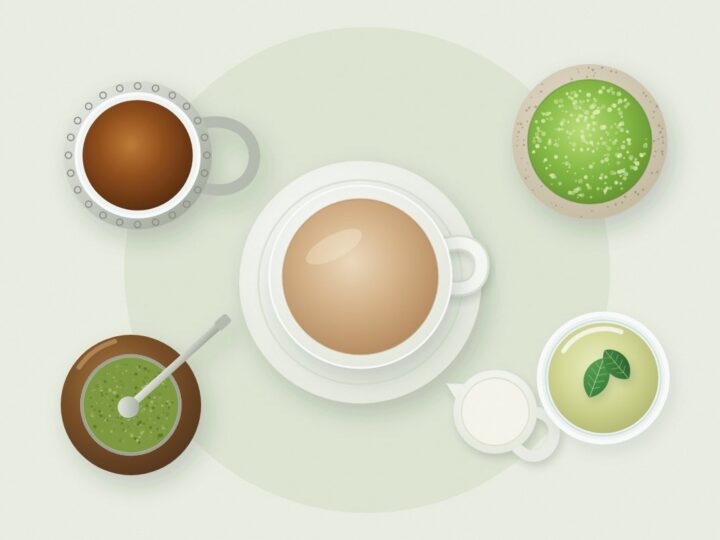
Tea ceremonies and traditions around the world: from Japan to East Frisia
How the Japanese tea ceremony and Chinese gongfu cha work, and where English afternoon tea, the Russian samovar and East Frisian tea with a cloud of cream come from.
Contents
In many countries, tea is more than a drink. It is a way to welcome a guest, pause in the middle of the day or spend time with family. Some tea traditions have precise rules and hundreds of years of history, while others appeared only a few generations ago. In this article you will find the best-known tea ceremonies and customs in the world and where they came from. How tea is made in different countries and what it is drunk with is described in the article How the world drinks tea.
China: from legend to gongfu cha
According to legend, tea was discovered by the mythical emperor Shennong in 2737 BC, when a few leaves fell into his boiling water. It is a legend, not a historical fact. What is certain is that tea has been drunk in China for a very long time and that the first book devoted entirely to tea, the Cha Jing (The Classic of Tea), was written by Lu Yu around 760, during the Tang dynasty.
The way tea was prepared in China changed over the centuries. It was boiled, later whisked as a powder and finally steeped as loose leaves. We write more about this in the article History of the teapot.
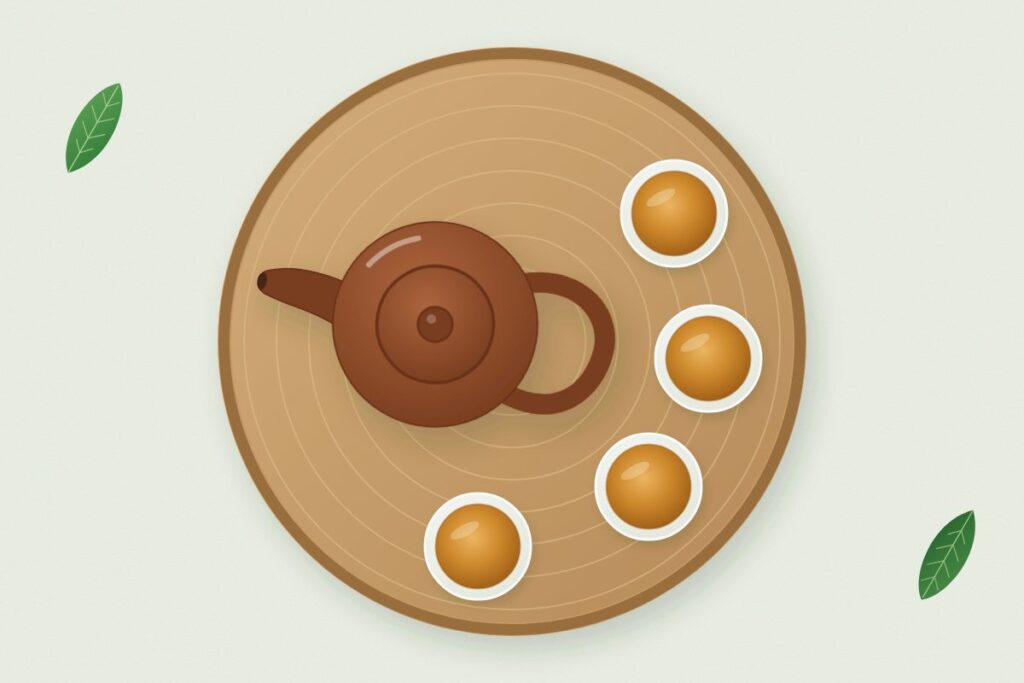
The best-known ceremonial way of preparing tea today is gongfu cha, which roughly means “tea made with skill”. It comes from southeastern China, from the Chaozhou area and Fujian province. It is used mainly for oolongs and pu-erh.
- The host first warms a small teapot or a lidded bowl (gaiwan) and the cups with hot water.
- A generous amount of leaves goes into the teapot, about 5–7 g per 100 ml of water.
- The leaves are briefly rinsed and the first water is poured away.
- Then the tea is steeped for just a few seconds and poured into a pitcher, and from there into small cups, so that every guest gets equally strong tea.
- The same leaves are infused again and again. Each infusion tastes a little different, and the guests talk about it.
In 2022, UNESCO inscribed traditional tea processing techniques in China and the social practices associated with them on the Representative List of the Intangible Cultural Heritage of Humanity.
Japan: the tea ceremony
The Japanese tea ceremony, called chanoyu or sadō in Japanese, centers on matcha, green tea ground into a powder. Whisked powdered tea spread in Japan at the end of the 12th century, largely thanks to the Zen monk Eisai, who returned from China in 1191. In 1211 he also wrote the first Japanese book about tea.
The form of the ceremony as we know it today was shaped above all by the tea master Sen no Rikyū (1522–1591). He championed simplicity and modesty, known as wabi. His name is associated with the four principles of the way of tea: harmony (wa), respect (kei), purity (sei) and tranquility (jaku).
The ceremony takes place in a simple tea room. In front of the guests, the host slowly and precisely cleans the utensils, whisks the matcha with a bamboo whisk and hands over the bowl. Before drinking, the guest bows and turns the bowl so as not to drink from its front, decorated side, and after drinking hands it back. A short gathering with tea and a sweet is called a chakai. A full chaji ceremony with a meal and two kinds of matcha can last up to four hours. We describe how to make matcha at home in the article Sencha vs. matcha: what is the difference.
Great Britain: afternoon tea
Tea reached England in the mid-17th century. In 1657, the London coffee house owner Thomas Garway began selling it. It became a fashionable drink at court mainly thanks to the Portuguese princess Catherine of Braganza, who married King Charles II in 1662 and brought the habit of drinking tea with her from home.
Tradition credits afternoon tea to Anna, Duchess of Bedford. Around 1840, she is said to have started having tea with a little something to eat at about four in the afternoon to tide her over until a late dinner. Her habit became a social occasion. Today it includes small sandwiches, scones with cream and jam and little cakes, often served on a three-tiered stand, along with black tea such as Earl Grey.
A common mix-up: high tea is not a more formal afternoon tea. It was the evening meal of working families after work, with meat, bread and strong tea. The name is often explained by the fact that it was eaten at a high dining table, while afternoon tea was served at low tables in the drawing room.
Russia: tea from the samovar
According to tradition, tea reached Russia in 1638 as a gift from a Mongol khan to Tsar Michael. Later it was brought from China by caravans across Siberia.
The symbol of Russian tea is the samovar. It is a large metal vessel that heats water, with a small teapot of strong tea standing on top. The first known samovar workshop was registered by the Lisitsyn brothers in Tula in 1778. The samovar stood in the middle of the table, and thanks to it a family or a group of friends could drink tea for hours. Tea is served with jam, honey, cookies or pastries and drunk from glasses in metal holders.
Morocco: tea as a sign of hospitality
In Morocco and other countries of northwest Africa, mint tea is a natural part of hospitality. It is almost always offered to guests. The host prepares it in front of them, pours it from a great height so that foam forms in the glasses, and usually serves several rounds in a row.
This is linked to the well-known saying about three glasses. In one of its versions, the first glass is as gentle as life, the second as strong as love and the third as bitter as death. The saying is passed on in various versions, and its exact origin is unknown.
Green tea was already reaching Morocco in the 18th century, but it only became an everyday drink for the whole of society in the 19th century, when British merchants imported it in large quantities.
East Frisia: tea with a cloud of cream
The highest tea consumption in Germany is in East Frisia, in the northwest of the country. According to estimates, each inhabitant drinks around 300 liters of tea a year on average. Since 2016, East Frisian tea culture has been on Germany’s nationwide inventory of intangible cultural heritage.
A strong blend of black teas is poured over a piece of rock sugar, which crackles in the cup. Then cream is carefully added with a spoon so that it forms a little cloud in the tea. The tea is not stirred but drunk in layers: first the mild cream, then the bitter tea and finally the sweet sugar. A spoon placed in the cup means that the guest does not want any more tea.
South America: mate from a shared gourd
In Argentina, Uruguay, Paraguay and southern Brazil, people drink yerba mate, an infusion made from the leaves of a South American holly. It is not tea from the tea plant, but the tradition around it is just as strong. It is drunk from a single vessel, traditionally a hollowed-out gourd, through a metal straw with a filter (bombilla). The person preparing the mate refills it and passes it around to everyone in the group. Sharing one vessel is a sign of friendship and trust.
Sources
- UNESCO: Traditional tea processing techniques and associated social practices in China, Representative List of the Intangible Cultural Heritage of Humanity, 2022.
- German Commission for UNESCO (Deutsche UNESCO-Kommission): Ostfriesische Teekultur, Nationwide Inventory of Intangible Cultural Heritage, 2016.
- Historic England: Where Does the English Habit of Afternoon Tea Come From?
- Okakura K.: The Book of Tea, 1906.
We revised this article on November 24, 2026. It is for general information only. For details, see our Disclaimer.