Sage tea: effects, how to make it, gargling and when to avoid it
How to make sage tea from dried and fresh sage, how to gargle with it, what the European Medicines Agency says about sweating, thujone and safety, and how other types of sage differ.
Contents
- What is common sage
- How to make sage tea
- Sage gargle and mouth rinse
- Sage tea effects: what the EMA says
- Sage tea for sweating
- Thujone: how much sage tea is still okay
- Sage tea for children
- Sage tea during pregnancy and breastfeeding
- Side effects and when to be careful
- Common sage, clary sage and other types of sage
- Growing and harvesting sage
- Sources
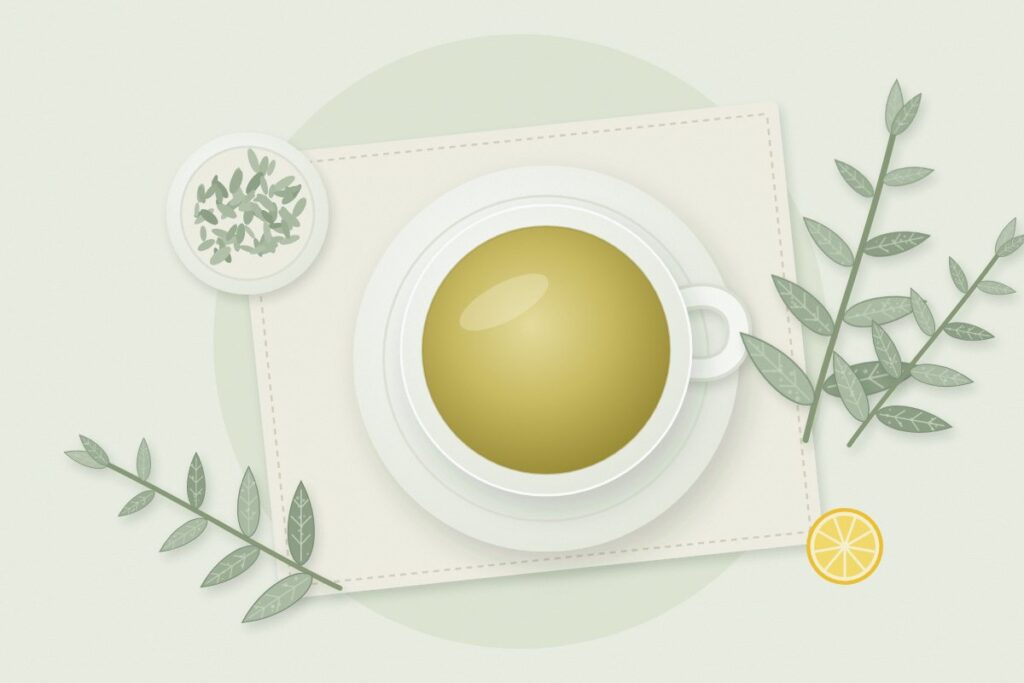
Sage tea is made from the dried leaves of common sage (Salvia officinalis). For one cup (150 ml), use 1–2 g of leaves, which is about 1 teaspoon, pour boiling water over them and let them steep, covered, for 5–10 minutes. The European Medicines Agency (EMA) recognizes sage as a traditional herbal medicine for mild digestive complaints, excessive sweating and inflammation of the mouth and throat, but it does not recommend it for children or during pregnancy and breastfeeding.
You will find more herbs in our Herbs category.
Important: this article is for general information and does not replace medical advice. The EMA does not recommend sage tea for children and teenagers under 18 or during pregnancy or breastfeeding. Do not drink sage essential oil. You can read more in the section When to be careful.
What is common sage
It is an evergreen, aromatic subshrub from the Mediterranean region, according to the EMA mainly from the area around the Adriatic. According to the Flora of the Czech Republic (Květena České republiky), it grows 20–70 cm tall, has gray-green, felty leaves and pale purple flowers from May to July. Like peppermint and wild thyme, it belongs to the mint family (Lamiaceae). The main components of the essential oil in the leaves are thujone, camphor and 1,8-cineole.
How to make sage tea
- For one cup (150 ml), use 1–2 g of dried, cut leaves. According to the Wichtl handbook, which the EMA cites, a teaspoon holds about 1.5 g.
- Pour boiling water over them.
- Cover and let them steep for 5–10 minutes.
- Strain the tea. Drink it warm, or let it cool first if you have night sweats.
The EMA monograph does not give a steeping time; Wichtl recommends 5 minutes for drinking and 10 for gargling.
How much sage for which use
| Use | Leaves | Water | Times a day |
|---|---|---|---|
| Digestive complaints (heartburn, bloating) | 1–2 g | 150 ml, boiling | 3 times |
| Excessive sweating | 2 g | 150 ml, boiling | not stated |
| Gargling | 2.5 g | 100 ml, boiling | 3 times |
| Compress on the skin | 2.5 g | 100 ml | 2–4 times |
The figures come from the 2016 EMA monograph and apply to adults.
Fresh sage tea
The EMA does not give a dose for fresh leaves. They contain a lot of water, so you need more of them: a U.S. university guide to herbal teas works with twice the volume of dried leaves. You cannot know how much thujone the sage from your garden contains, so do not drink large amounts of fresh sage tea either.
Sage gargle and mouth rinse
To make a gargle, pour 100 ml of boiling water over 2.5 g of leaves (just under 2 teaspoons), cover, let it steep for about 10 minutes and strain. Gargle with the warm infusion 3 times a day and then spit it out.
The infusion also works as a mouth rinse, for example for irritated gums. A toothache or swelling, however, is a job for the dentist. If the complaints last longer than a week, see a doctor. You can read more in Tea for a sore throat.
Sage tea effects: what the EMA says
The EMA’s Committee on Herbal Medicinal Products (HMPC) issued a monograph on sage leaf in 2009 and revised it in 2016. It recognizes sage as a traditional herbal medicine for relieving mild digestive complaints such as heartburn and bloating, excessive sweating, inflammation of the mouth and throat, and minor inflammation of the skin.
Traditional use means that sage has been used this way for at least 30 years, including 15 years in the EU. Its efficacy has not been proven in clinical studies. Studies on memory, menopausal hot flashes or blood sugar tested capsules, tablets and extracts, not tea, and the EMA did not recognize any use based on them.
Since 2025, the EMA has been reviewing the monograph. No health claim has been authorized in the EU for sage tea sold as a food. Claims about botanical substances are “on hold”, and until the EU decides on them, they may be used on packaging under transitional rules, but they are no confirmation that the tea works.
Sage tea for sweating
For excessive sweating, the EMA works with 2 g of leaves per 150 ml of boiling water, but it does not say how many cups to drink a day. According to the EMA assessment report, a registered German tea was taken 2–3 times a day. For night sweats, Wichtl advises letting the tea cool before you drink it.
In this case, the monograph allows long-term use, but if nothing improves within 6 weeks, talk to your doctor. The evidence is weak: these are older studies without a control group.
The UK’s National Health Service (NHS) recommends seeing a doctor if you have night sweats regularly, or together with a fever, a cough or unexplained weight loss.
Thujone: how much sage tea is still okay
According to the EMA, thujone is neurotoxic and in high doses can cause seizures. The EMA therefore prefers sage with a low thujone content and, for medicines, has set a daily thujone limit of less than 6 mg.
A German study from 2011 measured 0.03 to 4.56 mg of thujone in a cup of tea (1.5 g per 150 ml), and after about 5 minutes of steeping, the amount no longer increased. The authors estimated that with an average thujone content, the limit is not exceeded at 3–6 cups a day.
With the essential oil, the limit could be exceeded according to the EMA, so it did not issue a monograph for it. An amount of essential oil corresponding to more than 15 g of leaves can cause a feeling of heat, a rapid heartbeat, dizziness and seizures.
How long to drink sage tea
The monograph does not set a fixed length of use, but it advises seeing a doctor if digestive or skin complaints last longer than 2 weeks, if inflammation of the mouth and throat lasts longer than a week, and if sweating does not improve within 6 weeks.
Sage tea for children
The EMA does not recommend sage for children and teenagers under 18 because there is not enough data. According to its public statement on thujone, children and pregnant women should receive preparations containing thujone as little as possible.
The EMA assessment report describes an 18-month-old child whose seizures may have been triggered by tea made from garden sage. After sage essential oil, both a newborn and a five-year-old child had seizures.
Only give sage to a child after talking to your pediatrician. You can read more in Herbal teas for children and babies.
Sage tea during pregnancy and breastfeeding
The safety of sage during pregnancy and breastfeeding has not been established, so the EMA does not recommend it during this time. You can read more in Herbal tea during pregnancy.
In folk medicine, sage is used when stopping breastfeeding, and the EMA assessment report mentions this too. According to the U.S. database LactMed, however, there are no studies that confirm its effect on milk production, and no data on its safety for the breastfed baby. If you want to stop breastfeeding, talk to your doctor or a lactation consultant.
Side effects and when to be careful
The EMA monograph lists no known side effects or interactions with medicines, and no overdose with the leaves has been reported. According to LactMed, sage is usually well tolerated; occasionally, nausea, abdominal pain or dizziness occur.
- If you are hypersensitive to sage, do not use it.
- Do not drink sage essential oil or add it to tea.
- If you have epilepsy or have had seizures, talk to your doctor before drinking sage.
- If your complaints get worse or you have an adverse reaction, see a doctor.
- If you take medicines regularly, ask your pharmacist.
Common sage, clary sage and other types of sage
The EMA monograph covers only common sage, so when buying it, look for the name Salvia officinalis on the package.
| Species | What it looks like | Use |
|---|---|---|
| Common sage (Salvia officinalis) | evergreen subshrub, gray-green felty leaves | tea, gargling, seasoning |
| Clary sage (Salvia sclarea) | biennial to perennial herb up to 140 cm, large leaves, pinkish-purple bracts | essential oil for perfumes and foods, no EMA monograph |
| Meadow clary (Salvia pratensis) | perennial of meadows and grassy slopes, purple flowers | grows wild, no EMA monograph |
Growing and harvesting sage
According to the Royal Horticultural Society (RHS) in the UK, sage needs full sun, a sheltered spot and well-drained soil. It tolerates frosts down to −10 to −15 °C (14 to 5 °F); waterlogged soil is more of a problem for it. It is planted in spring.
Trim it lightly every spring, but not into the old wood. After 6–7 years, it becomes woody, so replace it with new plants from cuttings.
You can pick the leaves all year round; the spring and summer growth has the best flavor. For medicinal use, according to the Flora of the Czech Republic, they are harvested while the plant is in flower. Dry the sprigs by hanging them in a warm, dark, well-ventilated place and store the leaves in a tightly closed container.
Sources
- European Medicines Agency (EMA), Committee on Herbal Medicinal Products (HMPC) – European Union herbal monograph on sage leaf (Salvia officinalis L., folium), EMA/HMPC/277152/2015, 2016.
- EMA, HMPC – assessment report on sage leaf and sage oil (Salvia officinalis L., folium and aetheroleum), EMA/HMPC/150801/2015, 2016.
- EMA, HMPC – public statement on the use of herbal medicinal products containing thujone, EMA/HMPC/732886/2010 Rev. 1, 2012.
- EMA – Salviae officinalis folium, call for data for the review of the monograph, EMA/HMPC/42211/2025.
- Walch S. G. et al.: Determination of the biologically active flavour substances thujone and camphor in foods and medicines containing sage. Chemistry Central Journal, 2011.
- LactMed, U.S. National Library of Medicine – Sage, 2024.
- Štěpánková J.: Salvia L. – šalvěj. In: Květena České republiky 6, Academia, 2000.
- Royal Horticultural Society (RHS) – Salvia officinalis; How to grow sage; Salvia sclarea.
- Oregon State University Extension, Food Hero – Garden Herbal Tea, 2021.
- NHS – Night sweats.
- Regulation (EC) No 1924/2006 on nutrition and health claims made on foods and the EU Register of nutrition and health claims.
We wrote this article on November 25, 2026. It is for general information only. For details, see our Disclaimer.