Loose leaf tea or tea bags? Flavor, cost per cup, waste and microplastics
What is inside a tea bag, why it tastes different from loose leaf tea, what a cup costs and what we really know about microplastics and chemicals in tea bags.
Contents
A tea bag is convenient: you put it in a cup, pour water over it and throw it away a few minutes later. Loose leaf tea needs a strainer and a little more time. Is it worth it? In this article you will find what is inside a tea bag, how the two forms differ in flavor and cost per cup, what to do with the waste and what we really know about microplastics and chemicals in tea bags.
What is inside a tea bag
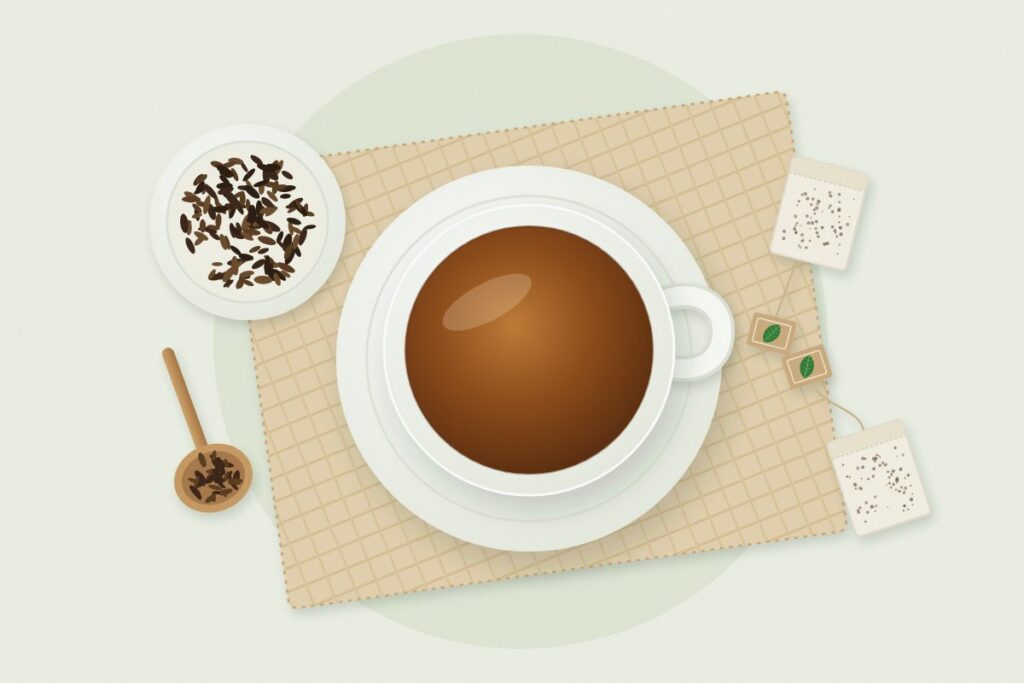
Most tea bags are filled with tea broken into small pieces. For black tea, these are most often the so-called fannings and dust, the smallest grades of tea. They are often made using the CTC method (crush, tear, curl), in which the leaves are crushed, torn and curled into small granules. Tea like this steeps very quickly and gives a strong, dark infusion.
Loose leaf tea usually consists of whole or only coarsely broken leaves. However, there are also larger pyramid-shaped bags that can hold whole leaves. So the difference is not only in the form, but above all in what kind of tea is inside.
The tea bag is not such an old invention. One of the first American patents for a fabric “tea-leaf holder” was filed by Roberta Lawson and Mary McLaren of Milwaukee in 1901. A popular story says that the tea bag was invented by accident by the New York merchant Thomas Sullivan in 1908, when he sent out tea samples in silk bags. However, there is no evidence for this story. William Hermanson patented the heat-sealed paper tea bag in 1930. Tetley brought tea bags to Britain in 1953, and today they make up most of the tea sold there.
Flavor and aroma
Small pieces of tea have a large surface area. Thanks to this, water quickly draws out both the color and the tannins. The infusion is strong, but often one-dimensional, and it turns astringent if steeped longer. Whole leaves slowly unfurl in the water and gradually release their flavor and aroma. Many teas, such as oolong or pu-erh, can be infused several times, and each infusion tastes different. A tea bag is usually used only once.
The large surface area is also a drawback in storage. Aromatic compounds escape from small pieces faster, so tea in bags loses its aroma sooner than whole leaves. This is especially true of herbs such as mint. We describe how long tea keeps in the article Does tea expire?.
Loose leaf tea is not automatically better. Cheap, old or poorly stored loose leaf tea tastes worse than a fresh, good-quality tea bag. If you really want to taste the difference, prepare both teas side by side under the same conditions: the same amount of tea, the same water, temperature and time. This is also how professional tea tasters compare tea.
Cost per cup
Comparing the price of a package makes no sense; you need to work out the cost of a single cup. A tea bag usually holds about 2 g of tea. For loose leaf tea, 2–3 g per cup is used.
Example calculation (prices are for illustration only):
| Tea | Price | Per cup | Cost per cup |
|---|---|---|---|
| Tea bags, 20 pcs | €2 | 1 tea bag | €0.10 |
| Premium pyramids, 20 pcs | €5 | 1 tea bag | €0.25 |
| Loose leaf tea, 100 g | €10 | 2.5 g, one infusion | €0.25 |
| Loose leaf oolong, 100 g | €15 | 5 g for three infusions | €0.25 |
So loose leaf tea does not have to be more expensive, especially if you infuse the leaves several times. Plug in the prices of the tea you drink.
Waste
Leaves from loose leaf tea can go into the organic waste bin or onto the compost. With tea bags, it is more complicated.
- Paper tea bags are made from cellulose fibers. If they have heat-sealed edges, they also contain plastic fibers that fuse together when heated. Most often this is polypropylene. Some manufacturers have replaced it with polylactic acid (PLA) made from plant starch. However, this is also a plastic, and it breaks down mainly in industrial composting facilities.
- “Silk” pyramids are made of plastic, most often nylon, PET or PLA.
- Other waste includes staples, strings, paper tags and the envelopes in which tea bags are individually wrapped.
If you do not know what a tea bag is made of, empty its contents into the organic waste and throw the bag in the trash. Only loose leaf tea in a strainer or a teapot with a filter is completely waste-free.
Microplastics from plastic tea bags
In 2019, a study from McGill University in Canada was published (Hernandez et al.). In the lab, the authors emptied four plastic tea bags made of nylon and PET and steeped them for 5 minutes at 95 °C (203 °F). They calculated that a single bag releases about 11.6 billion microparticles and 3.1 billion nanoparticles of plastic into the cup. The news quickly spread around the world.
However, the results should be treated with caution:
- Other scientists (Busse et al., 2020) pointed out that most of the particles were probably not released during steeping, but were already on the surface of the bag. Many of them were probably not even solid plastic particles, but dissolved substances that precipitated when the sample was dried.
- In 2025, the German Federal Institute for Risk Assessment (BfR) stated that the numbers of particles larger than 1 µm are probably overestimated by a factor of 100 to 1,000. Based on current knowledge, the BfR does not expect any harm to health, but data on the effects of microplastics on the human body are still incomplete.
- The European Food Safety Authority (EFSA) has not yet published a full risk assessment of microplastics in food. Above all, data on how they affect humans are lacking.
So no study proves that plastic tea bags are harmful to health. Still, it is quite reasonable to avoid unnecessary plastic in hot water. If you want to be on the safe side, reach for loose leaf tea or plastic-free tea bags.
Paper tea bags and epichlorohydrin
You can read online that paper tea bags contain epichlorohydrin, a substance used in making epoxy resins. The truth is more nuanced. Tea bag paper must hold together in boiling water, so resins are added to it that keep it strong even when wet. Some of them are made from epichlorohydrin. Traces of chloropropanols can pass from them into the infusion.
That is why their amount is limited. In its Recommendation XXXVI/1 for hot filter papers, which include tea bags, the German BfR sets how much of these resins the paper may contain. The substance 1,3-dichloropropanol must not be detectable in the water extract at all, and 3-MCPD must not exceed 12 µg per liter. This is no reason to panic; these are regulated trace amounts.
When to choose which
- A tea bag is handy at work, when traveling and anywhere you have no strainer or no time. Choose tea bags without sealed edges, or ones the manufacturer states are plastic-free.
- Loose leaf tea is the better choice when you want more flavor and aroma, several infusions from one serving and less waste.
Making loose leaf tea is simpler than it seems. All you need is a teapot with a large strainer or a mug with an infuser that gives the leaves enough room. We describe brewing equipment in the article A guide to tea brewing equipment, the right temperatures and times in How long to steep tea and storage in How to store loose leaf tea.
Sources
- Hernandez L. M. et al.: Plastic Teabags Release Billions of Microparticles and Nanoparticles into Tea. Environmental Science & Technology, 2019.
- Busse K. et al.: Comment on “Plastic Teabags Release Billions of Microparticles and Nanoparticles into Tea”. Environmental Science & Technology, 2020.
- German Federal Institute for Risk Assessment (BfR): BfR assesses study on tea bags and microplastic particles, Communication No. 029/2025.
- German Federal Institute for Risk Assessment (BfR): Recommendation XXXVI/1 – Cooking papers, hot filter papers and filter layers.
- ISO 3103:2019 – Tea – Preparation of liquor for use in sensory tests.
- European Food Safety Authority (EFSA): Presence of microplastics and nanoplastics in food, with particular focus on seafood. EFSA Journal, 2016.
We revised this article on November 24, 2026. It is for general information only. For details, see our Disclaimer.